Listen Now
0:00
OTTAWA — President Donald Trump threatened Monday morning to double tariffs on Canadian vehicles to 50 per cent starting next year, a move that Prime Minister Mark Carney said reflects a U.S. desire to “destroy” major Canadian industries.
“Canada has been ripping off the United States of America for years,” Trump wrote in a social media post, pointing toward a trade deficit between the countries. “Not sustainable, and NOT ANYMORE!” He said the higher duties on autos and trucks, which are currently affected by 25 per cent tariffs under Section 232, would kick in Jan. 1, 2027. He also said he would extend those duties to auto parts, which would end Canada’s exemption from 25 per cent tariffs for parts that comply with the Canada-United States-Mexico Agreement (CUSMA).
Talking Points
- President Donald Trump threatened to double tariffs on Canadian autos to 50 per cent beginning Jan. 1 and expand them to include auto parts
- Lucas Malinowski of Global Automakers of Canada is waiting for the documentation before “panicking,” but says such high duties would be “devastating”
Trump included steel among the goods for which duties would be “increased” to 50 per cent, but the Section 232 tariffs on steel have been at that level since June 2025.
That confusion aside, it further escalates the trade war that ramped up significantly after talks collapsed Friday and Trump slapped 50 per cent tariffs on about US$20 billion worth of Canadian goods, from cement and essential oils to plywood and hockey sticks. Businesses are bracing for impact, with those in Ontario, Quebec and British Columbia the hardest hit.
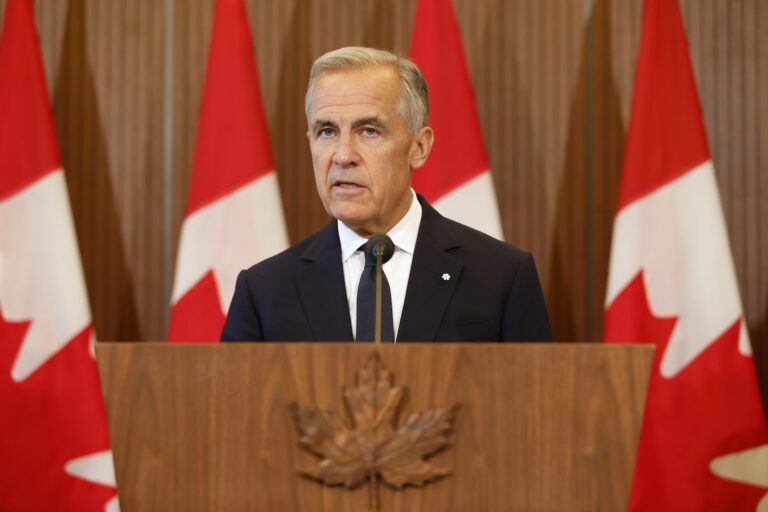
Prime Minister Mark Carney said Monday in Levis, Que., that Trump’s latest threat was “not a surprise,” because Ottawa learned during negotiations the U.S. wanted to “destroy” Canada’s major industries, including autos. “But what message does that send to the workers in Michigan, in Ohio, in Kentucky and Alabama, who rely on Canadian demand? We’re their largest customer for automobiles.”
Related Articles

The White House has backed off tariff threats before, said Lucas Malinowski, president and CEO of the Global Automakers of Canada, which represents Honda, Toyota and other foreign automakers in Canada. “We don’t start panicking until things are in writing,” he said. “But obviously doubling the tariffs on autos would be devastating. The 25 per cent is already untenable.”
Ryan Robinson, head of automotive research at Deloitte Canada, said an auto tariff anywhere near the level Trump has threatened would make it hard for carmakers to keep up production here, even with the federal government offering remission from its 25 per cent counter-tariffs on U.S. autos for companies that maintain their operations and investments in Canada.
“I think some of the economics at that point start to fall apart,” said Robinson. “It will make it very difficult for the investments that have been made, let alone any kind of incremental investments that the manufacturers are thinking about going forward for the Canadian market.”
In March 2025, Trump signed an executive order to impose 25 per cent tariffs on major auto parts not made in the U.S., but then exempted CUSMA-compliant parts until the U.S. secretary of commerce could figure out how to apply them only to non-U.S. content. The carve-out was a relief to Canadian manufacturers in the highly integrated sector. It also spared companies such as Guelph, Ont.-based auto parts manufacturer Linamar, from most of the damage from tariffs.
“As of today more than 90 per cent of our sales this year are tariff-free,” Linamar’s executive chair Linda Hasenfratz and Jim Jarrell, its president and CEO, said in a joint statement sent to The Logic. “It is a dynamic environment, and we are ready to navigate through it. We remain confident that [CUSMA], or a version of such, will ultimately prevail, as the economic benefits to all three countries are undeniable.”
Malinowski said he is skeptical that Trump will expand the tariffs to auto parts given his choice to hold off on implementing them last year. “The administration quickly realized that would, on top of the existing steel and aluminum tariffs, significantly increase the costs of inputs for American-built cars,” Malinowski said. “Adding those tariffs to include parts would make American auto manufacturing significantly more expensive and less competitive.”
Unifor national president Lana Payne said in a written statement that Trump’s “latest intimidation tactic” would hurt the U.S. too. “The U.S. administration fails to recognize that our highly integrated auto industry means ongoing instability hurts workers on both sides of the border and makes it increasingly difficult to build cars in North America,” said Payne. Unifor represents employees at Canadian plants owned by Ford, General Motors and Chrysler parent company Stellantis, known as the Detroit Three. “That’s the opposite of what autoworkers need right now.”
Shares in Ford, GM and Stellantis closed down 3.33 per cent, 1.08 per cent and 3.51 per cent, respectively on Monday.
Robinson agreed the economic impact of expanding tariffs to parts would not stop with Canada, given how deeply integrated the North American auto industry is. “I think you would likely see very material impacts on the U.S. side of the border as well,” he said, especially in Michigan and other states where production is based. The question, he said, is whether the threat is a negotiating tactic or something the U.S. administration intends to follow through on.