Skip to content

Commentary
Carmichael: Carney’s pipeline deal with Smith is all about the long run—and that’s a nice change
The two leaders found a way to talk about the root problems with Canada’s sluggish economy. Long may it last.
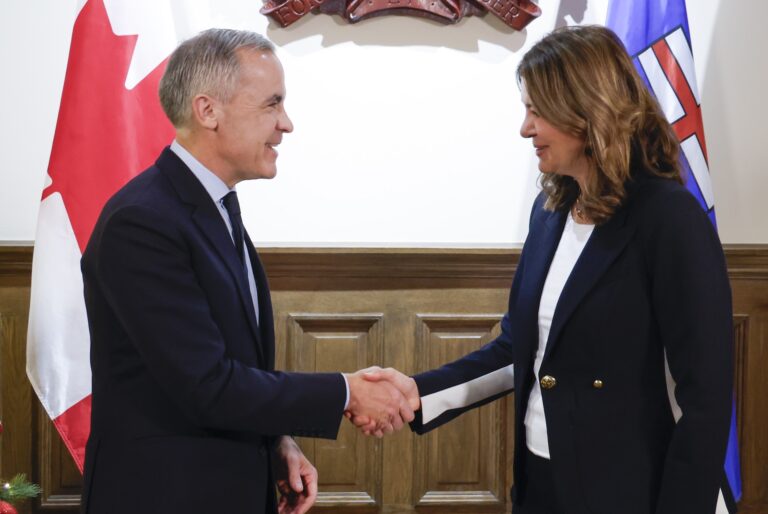
Prime Minister Mark Carney and Alberta Premier Danielle Smith signed a sweeping deal Thursday intended to kickstart development of a new oil pipeline to the West Coast. Photo: The Canadian Press/Jeff McIntosh
I don’t know yet what I think about the specifics of the Carney-Smith pact on energy production and carbon capture. But I know where to start that thinking. The same place as Candace Laing, president of the Canadian Chamber of Commerce.
“Achieving Canada’s potential as an energy superpower and dealing with increasing geopolitical shifts requires unprecedented levels of federal-provincial collaboration,” Laing said in a statement. “The federal government and the province of Alberta must be pulling in the same direction, alongside all provinces in the federation.”
Related Articles
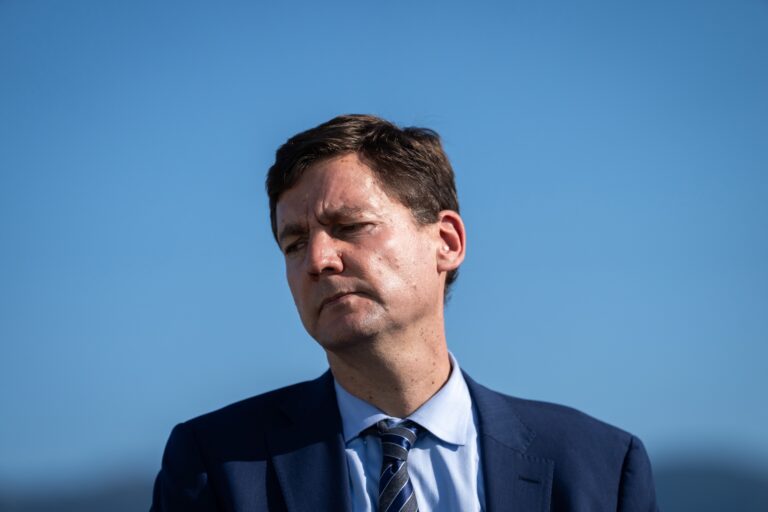
Laing, a former Nutrien executive, is still a relatively new voice on the national scene. Maybe that’s why she stands out. Nutrien’s history goes back to the 1940s. It’s a place that by necessity places value on long-term thinking and a focus on what matters. Laing appears to have brought some of that with her when she took over as the Chamber’s leader a little over a year ago. She didn’t focus on partisan totems such as the emissions cap on oil and gas production. She tried to drive the conversation toward the root causes of why the economy has become so vulnerable.
That’s reassuring, because, with the work of recovering from the rupture with the U.S. only getting started, I worry about complacency setting in. We’ve had only two royal commissions in the last quarter-century. The political class is badly out of practice when it comes to planning long-term.
Same for those of us in the public sphere. The anniversary of Chrystia Freeland’s decision to resign as Justin Trudeau’s finance minister to become a king-slayer is suddenly only a couple of weeks away. I wrote that day about how difficult it was to perceive non-violent history in real time. Deciding what to make of a memorandum of understanding at a time when we’ve been conditioned to think the worst of politicians is especially challenging.
Radio-Canada focused on environmentalist Steven Guilbeault’s resignation from Prime Minister Mark Carney’s cabinet. If my deadlines on Thursday were measured in hours or minutes, I probably would have too. Politico’s Canada Playbook newsletter highlighted Alberta Premier Danielle Smith’s many wins. The intransigence of British Columbia Premier David Eby and some Indigenous communities over the possibility of a new pipeline over their territory was another important headline. Winners. Losers. Tension. A scribe will never get it wrong if they go with any of those.
A historian might look at the day differently. Laing put the Carney-Smith agreement in the context of “geopolitical shifts.” It was a timely reminder of what’s happening offstage.
Four decades ago, Canada made a decision to base its prosperity on its proximity to the world’s most important country. It was a good bet. The collapse of the Soviet Union and the apparent desire of China to join the world economy implied that history was all but over.
But like most one-way bets, it proved to be costly. Statistics Canada’s third-quarter tally of gross domestic product shows that the economy survived President Donald Trump’s tariff shock, but we’re hardly thriving. Household consumption declined and business investment stalled. This is what the future looks like without dramatic change.
In 2019, Jared Diamond, the author of Guns, Germs, and Steel, published a less famous book called Upheaval: Turning Points for Nations in Crisis. Diamond put some nations on the couch, using the methods of applied psychology to diagnose how countries recovered from traumatic events.
One of the countries Diamond considered was Finland. Its crisis was invasion by the Soviet Union in November 1939, coupled with the eventual realization that democratic allies such as Britain and France weren’t coming to its rescue.
The Soviets absorbed the tiny Baltic states of Estonia, Latvia and Lithuania at about the same time. Finland avoided that fate. It created a liberal democracy and a rich capitalist economy in the shadow of a totalitarian empire that opposed both personal liberty and free markets. Finland might be the unsung hero of the second half of the 20th century.
As Diamond describes it, Finland’s path to resilience began with an acknowledgement that it was a small and weak country living next to a big and menacing one. It decided that its survival as an independent nation depended on keeping the Soviet Union happy and creating a highly productive economy that would generate high wages for a relatively small population. The industrial policy that Finland put in place after the Second World War is the reason that Canada and the U.S. need its help to build icebreakers.
Nothing about what Finland did was easy. In a previous column, I referenced how it curbed free speech when it came to criticism of the Soviet Union, a tradeoff it decided was necessary to protect its freedom to do everything else. It could build diplomatic trust and execute long-term economic policy because it had political stability: Juho Paasikivi led the country from 1946 to 1956, and then Urho Kekkonen served as president until 1981.
I don’t think Laing is advocating for Carney and Smith to dominate Canadian politics for the next four decades. Rather, I see her comments as an attempt to focus the conversation on what matters and to get people thinking about root causes. The reason business investment was flat in the third quarter and has been weak for years is that Canada’s regulatory barriers have become higher than businesses are willing to climb.
Politicians created those regulations and politicians are the only ones who can tear them down. That will never happen unless we find ways to offset the short-termism of modern politics. In The Adaptable Country: How Canada Can Survive the Twenty-First Century, Alasdair Roberts, a public policy professor at the University of Massachusetts Amherst, isolated the loss of institutionalized meetings of first ministers as one of the reasons Canada has struggled to get ahead of crises in recent decades. “Left unattended, small differences between governments can fester into deep grievances that undermine the capacity to talk about shared challenges,” he wrote.
That’s what Carney and Smith have done—create a way to talk about shared challenges. I look forward to the conversation.
Kevin Carmichael is The Logic’s economics columnist and editor-at-large. He has spent more than two decades covering economics, business and finance for outlets including Bloomberg News, The Globe and Mail and the Financial Post, where he also served as editor-in-chief.



Loading...
Thanks for sharing!
You have shared 5 articles this month and reached the maximum amount of shares available.
CloseThis account has reached its share limit.
If you would like to purchase a sharing license please contact The Logic support at [email protected].
CloseGift the full article!
You have gifted 0 article(s) this month and have 5 remaining.
Recipients will be able to read the full text of the article after submitting their email address. They will not have access to other articles or subscriber benefits.
Photo: The Canadian Press/Jeff McIntosh
Most Popular This Week

In-depth, agenda-setting reporting
Great journalism delivered straight to your inbox.
Commentary
Carmichael: How free trade with the U.S. made Canadian businesses lazy
Briefing
BDC joins NATO investment group to back defence-tech companies
Brookfield says it’s not becoming the ‘WeWork of AI,’ despite data-centre slowdown
Ottawa earmarks $880M for skilled trades training
Best business newsletter in Canada
Get up to speed in minutes with insights and analysis on the most important stories of the day, every weekday.
Exclusive events
See the bigger picture with reporters and industry experts in subscriber-exclusive events.
Membership in The Logic Council
Membership provides access to our popular Slack channel, participation in subscriber surveys and invitations to exclusive events with our journalists and special guests.