OTTAWA — The federal Liberals want to deploy a new “made-in-Canada AI tool” across the federal government, according to their new budget—a tool to be created under the supervision of defence and security agencies and with the help of Canadian AI companies.
Skip to content

Analysis
Budget shows what Carney’s big promises will cost but few of the sacrifices he says Canada must make
The Liberal government’s budget promises deep public service cuts and billions worth of spending on defence and infrastructure—details to come at a still later date
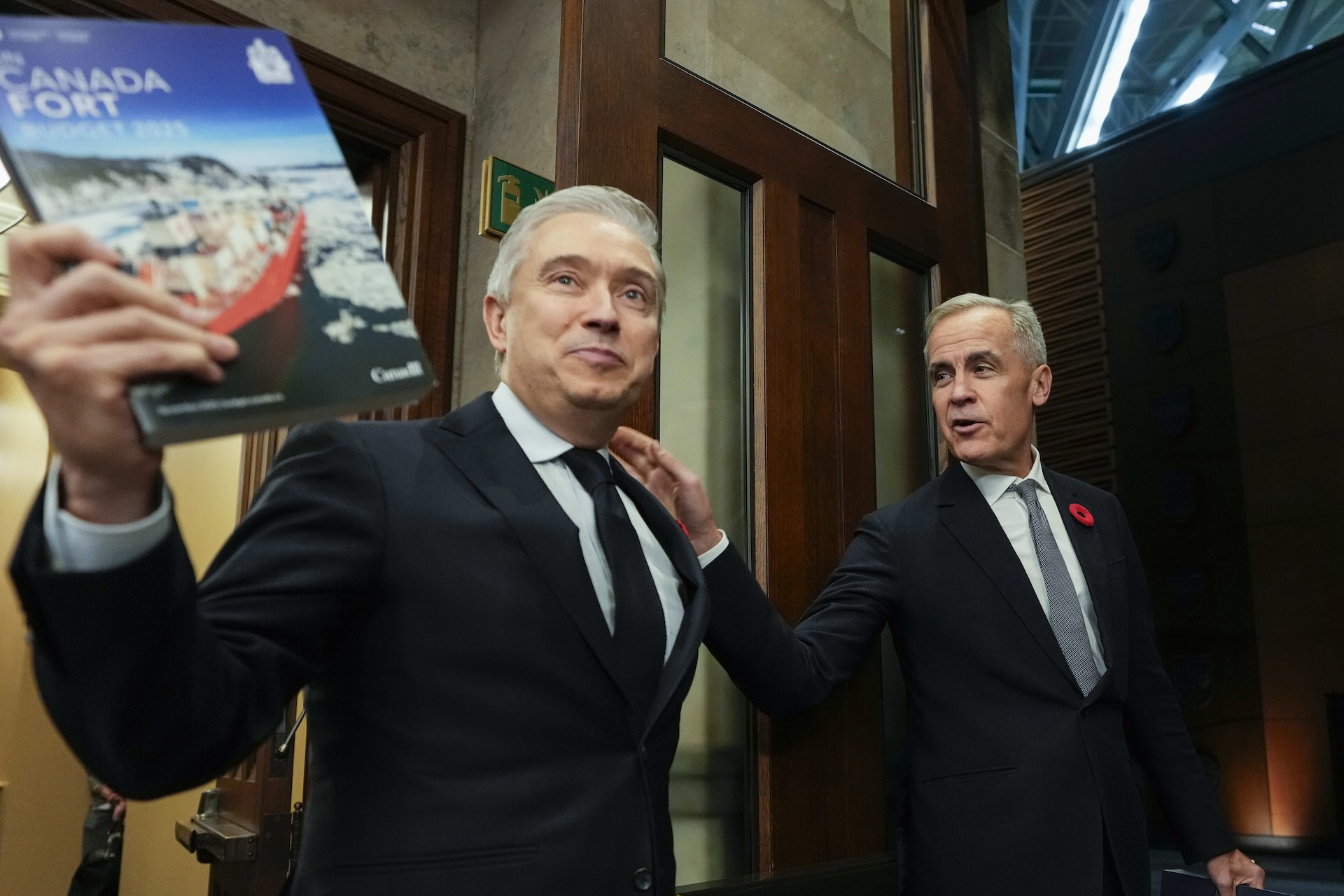
Prime Minister Mark Carney and Minister of Finance and National Revenue Francois-Philippe Champagne make their way into the House of Commons for the tabling of the federal budget on Parliament Hill in Ottawa, on Tuesday, Nov. 4, 2025 Photo: The Canadian Press/Justin Tang
OTTAWA — The federal Liberals want to deploy a new “made-in-Canada AI tool” across the federal government, according to their new budget—a tool to be created under the supervision of defence and security agencies and with the help of Canadian AI companies.
“By supporting innovative research to strengthen public services, this work will protect our digital sovereignty, keep government data and information safe in Canada and create opportunities for the Canadian technology sector,” the budget document says.
Talking Points
- The latest federal budget promises a “generational investment strategy” and does away some of the flashier promises left over from the Justin Trudeau years, such as a tree-planting target and a luxury tax on boats and planes
- To help pay for Mark Carney’s pledges, the budget proposes federal cuts deeper than any in 30 years, but with the details to be dribbled out over months or years
It does not say what the tool will be for—whether it’ll be a large language model or a weather predictor, an evaluator of subsidy programs or a patriotic-image generator.
If the budget were revealing for the first time things that Prime Minister Mark Carney has announced over the past several months, such as a massive increase in defence spending, or the new Major Projects Office and its priority list, it would be a monumental document.
But instead, as a detailed explanation of just how the Liberals plan to pay for and execute some of the really big whats they have promised, much of the budget reads like the AI-tool promise. The sacrifices Carney has called on Canadians to make remain veiled.
Related Articles


The budget deficit this year is deep, at $78.3 billion, and at the end of the government’s planning horizon in 2029–30 it shrinks only to $56.6 billion. That improvement comes as a result of significant cuts, both internally and on external spending, that will dribble out over months and years.
The budget includes consequential new plans, if not on the scale of the defence investments: $1 billion for Arctic infrastructure; another $1 billion to lure over 1,000 world-class researchers to Canadian universities; tax changes (long sought by multiple industries) to encourage business capital investments, reforms to a key research and development tax credit (also long sought); and a promise to unstick long-stuck progress on open banking by putting the Bank of Canada in charge of it.
After an announcement last week that the federal government would support a series of mining projects, including with “equity-like” investments, the budget takes the next step by promising a new Critical Minerals Sovereign Fund that will make actual equity investments (and loan guarantees and offtake agreements), with $2 billion over five years.
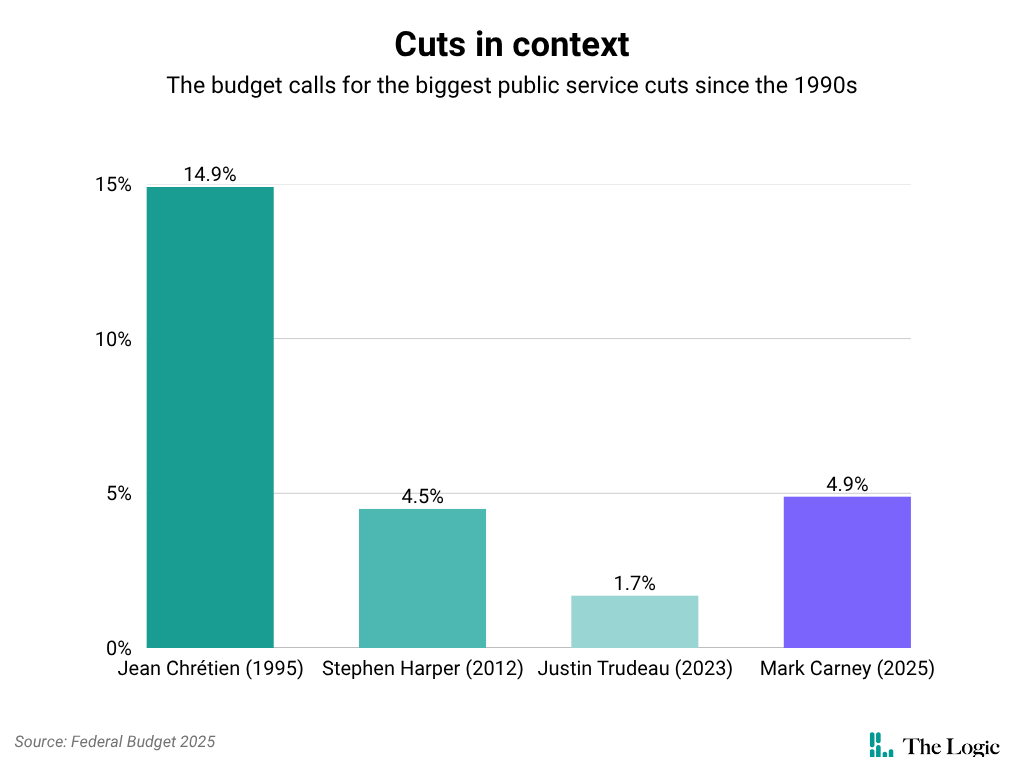
There’s no mistaking the scale of what Carney and Finance Minister François-Philippe Champagne are explicitly promising to keep all this at all affordable: the deepest cuts to the federal government since Jean Chrétien and Paul Martin attacked the federal deficit in 1995, when Canada was genuinely on the brink of a crisis.
Deeper than Justin Trudeau and Chrystia Freeland’s effort to demonstrate fiscal responsibility after the worst of the COVID-19 pandemic, deeper even than those Stephen Harper’s Conservatives executed after the Great Recession of the late 2000s.
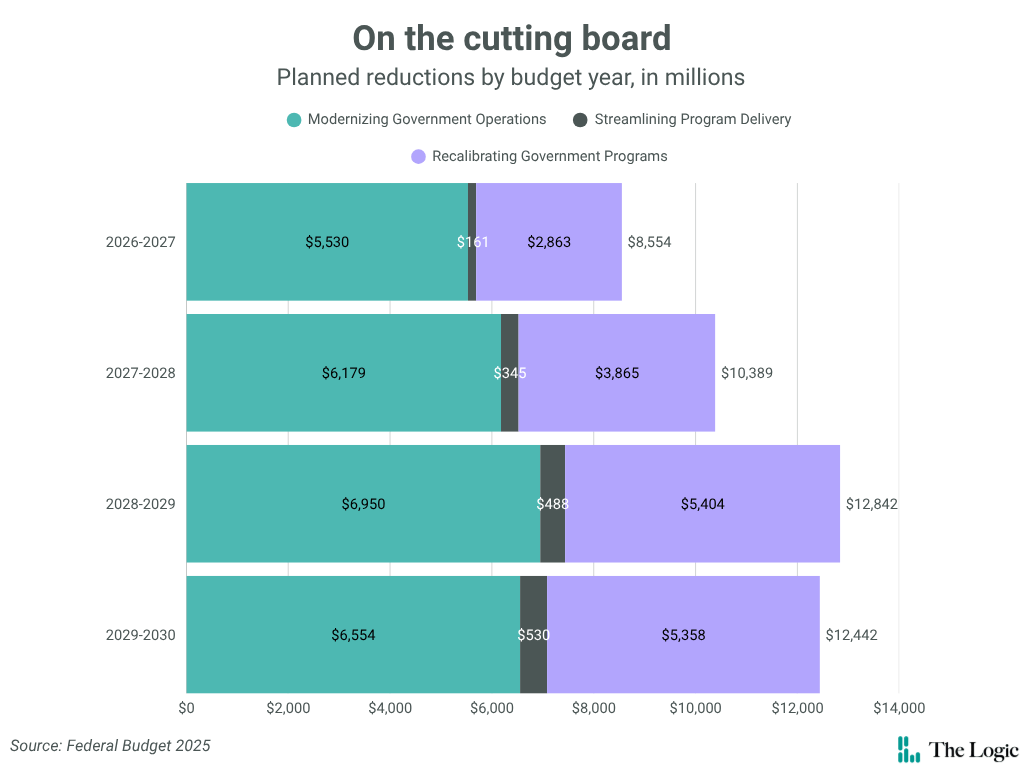
By the end of a five-year plan, about half the $12.5 billion in ongoing annual spending reductions are to come from “modernizing government operations” and “streamlining program delivery” (that is, cuts to government operations), and half from “recalibrating government programs” (cutting them).
“This will create a more effective government, one that can deliver smarter, faster and more effectively for Canadians,” Champagne said in his budget speech. The better delivery will come from “a modern, agile and efficient public service,” he went on.
The modernizing and streamlining will be done in part through “workforce renewal,” which means shrinkage. Through early retirements and other job cuts, the Liberals intend to eliminate 16,000 federal jobs from current ranks, and 1,000 executive-level managers in the next two years.
Meanwhile, a new Office of Digital Transformation—yet another new creation, like the Major Projects Office, Build Canada Homes and the Defence Investment Agency, that sidesteps existing systems Carney evidently views as unworkable—will “lead the adoption of AI and other new technologies across government.”
The budget doesn’t say whether or how the new office will work with the Canadian Digital Service, the 250-strong organization meant to modernize citizens’ interactions with the federal government, which necessarily means modernizing the back-office systems that define those interactions.
Meanwhile, most of the planned program cuts intended to help balance the federal operating budget are also spelled out only vaguely.
“Returning international development assistance to a pre-pandemic level” means cuts of $2.7 billion over four years, thanks to recalibrating and “leveraging innovative tools.” What exactly will be recalibrated and what innovative tools will be leveraged, we’ll have to see.
While the Liberals are spending to build housing through the new Build Canada Homes agency, they’re also “recalibrating programming that does not directly contribute to increasing the housing supply,” cutting those by $2.4 billion over four years. Which programs? Don’t know.
Some relatively small changes do get specific attention in the budget, however. Carney is making a point of wiping away some programs and plans that Trudeau announced just as pointedly.
A luxury tax on boats and private planes, which literally targeted the have-yachts class, is ending immediately, to “provide relief to the aviation and boating industries” while saving the cost of collecting it. Manufacturers of boats and planes have lobbied hard for this.
The plan to plant two billion trees: “wrapping up.” That’s to save $200 million over four years. It’s part of Carney’s broader “climate competitiveness strategy,” which moves away from regulatory limits and goals in favour of encouraging investment in cleaner technology.
Relatedly, the Net Zero Accelerator stream of funding for big industrial emissions-reductions projects: scrapped “due to declining demand,” contrary to the government’s own claim that it has “been in high demand since its launch in 2020.” (The federal environment commissioner has not been impressed by it.) The money is to be redirected to other industrial subsidies.
The Industrial Research Assistance Program (IRAP), which supports early-stage innovation, is getting a similar recalibration: the National Research Council, which runs IRAP for now, is “adjusting contributions to some program streams, while not impacting strategic sectors,” the budget says.
Which program streams are strategic and which are frivolous? As with so many of the budget’s hard choices, Canadians will have to keep waiting.
Subscribers can join The Logic’s newsroom for an exclusive event unpacking the 2025 federal budget on Thursday, Nov. 6, at 12 p.m. ET/9 a.m. PT. Keep an eye on your inbox for the registration link. And you can read more of our 2025 federal budget coverage here.



Loading...
Thanks for sharing!
You have shared 5 articles this month and reached the maximum amount of shares available.
CloseThis account has reached its share limit.
If you would like to purchase a sharing license please contact The Logic support at [email protected].
CloseGift the full article!
You have gifted 0 article(s) this month and have 5 remaining.
Recipients will be able to read the full text of the article after submitting their email address. They will not have access to other articles or subscriber benefits.
Photo: The Canadian Press/Justin Tang
Most Popular This Week




In-depth, agenda-setting reporting
Great journalism delivered straight to your inbox.
Commentary
Carmichael: Canadian ignorance about India is a strategic weakness
Briefing
Aritzia shares pop after earnings rise 204%
First Nation in Alberta goes to court over fast-tracked oil pipeline
Chinese EV maker Geely Auto Group to launch in Canadian market in 2027
Best business newsletter in Canada
Get up to speed in minutes with insights and analysis on the most important stories of the day, every weekday.
Exclusive events
See the bigger picture with reporters and industry experts in subscriber-exclusive events.
Membership in The Logic Council
Membership provides access to our popular Slack channel, participation in subscriber surveys and invitations to exclusive events with our journalists and special guests.





