Listen Now
0:00
TORONTO — Cohere has released a new version of its North AI system that lets clients employ models from rival developers. The update comes as businesses seek to do more with AI while also trying to keep costs down and maintain control of their technology.
Staff at organizations that deploy North 2 can use the platform to set up AI agents capable of completing longer-term and more complex tasks. The updated system will hold on to more details of those assignments in an attempt to improve automations over time. Companies can also set AI spending limits for specific staff and teams, and measure the return of their AI-powered work within the platform.
Talking Points
- Cohere has launched North 2, a new version of its system for automating work and running AI agents. The platform now lets businesses set usage limits, plug in AI models from competitors and give staff pre-built tools to speed up their adoption of the technology.
- Developers have embraced so-called AI agent harnesses like Anthropic’s Claude Code and OpenAI’s Codex for programming. Cohere hopes to create a similar wave of AI adoption among non-technical workers.
“This is really the tool that helps large enterprises move their AI transformation from a large number of small experimentations to production-grade,” said Paul Teyssier, Cohere’s vice-president of product for AI.
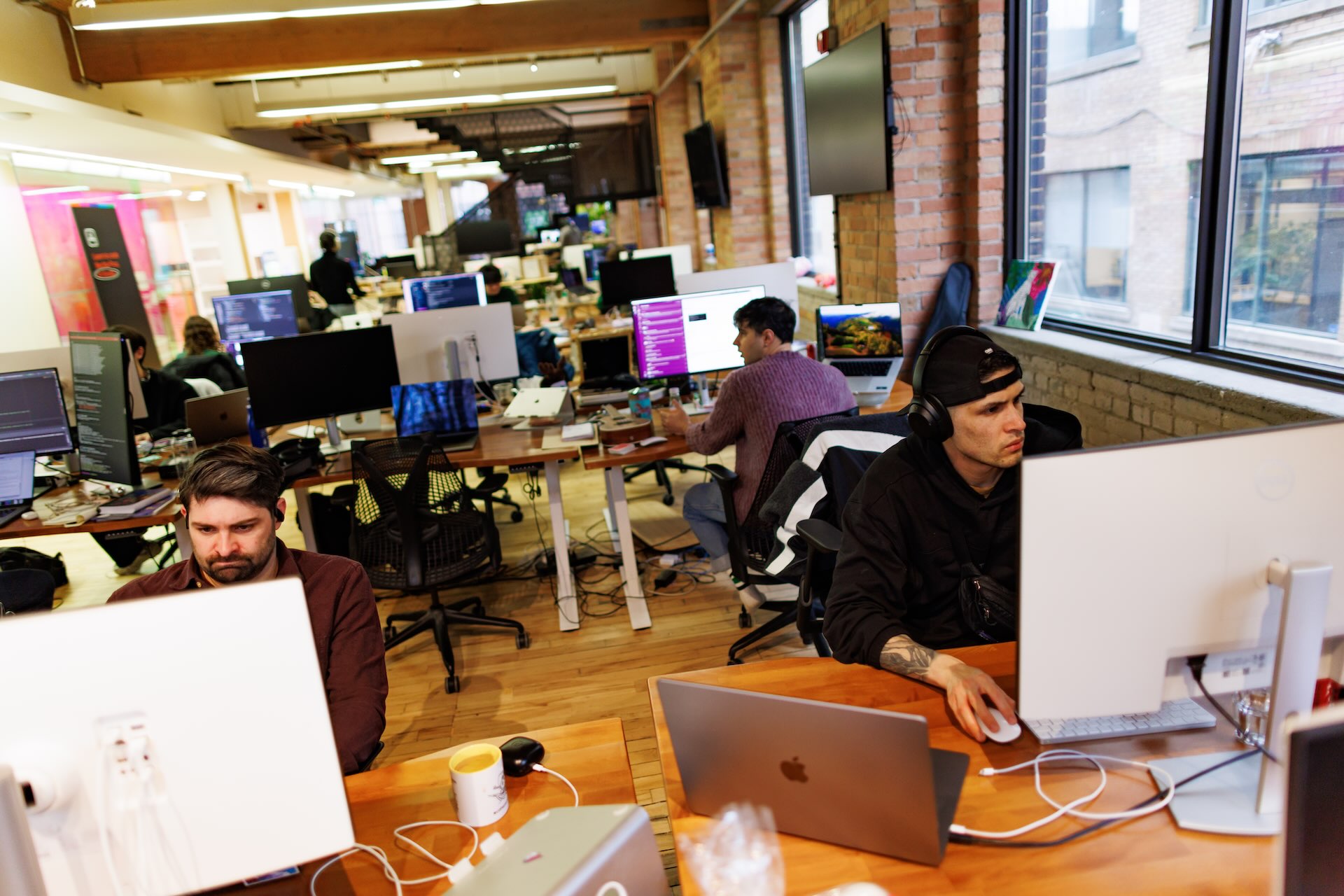
North is a so-called AI agent harness, essentially the software that connects AI models to the tools, memory and data to accomplish tasks, while following the rules that users set for them. Cohere unveiled the platform in January 2025 with flagship customer RBC, then made it widely available that August. Other clients include Bell, Saudi telecom STC Group, the federal Innovation Department and the Aston Martin F1 team.
AI agent harnesses have significantly accelerated AI adoption, after open source system OpenClaw went viral at the start of the year. Anthropic’s Claude Code and OpenAI’s Codex have become the new default operating system for many developers, who use them to automate most programming work.
Related Articles
Lots of non-technical users “are getting incredibly familiar with agentic work,” Teyssier said. While North 2 can be used for coding, it’s built to be useful to non-developers. That includes pre-programming the system with common capabilities that specific teams like finance and marketing might need, as well as libraries of pre-built agents that employees can easily start running for themselves. “The product itself needs to do a really good job at helping people go up the AI adoption curve,” Teyssier said.
Unlike Claude Code or Codex, Cohere is opening North 2 up to AI models from other developers. Customers can plug in the most advanced systems from Anthropic, OpenAI and Google, or cheaper open source ones from Chinese firms like Alibaba, DeepSeek and Z.ai.
Cohere designed North 2 and its forthcoming products to be modular, so clients can swap technology from different developers in and out to suit their needs, according to Teyssier. “A whole bunch of players [are] trying to take the customers deeper and deeper into their ecosystem, with no way out,” he said. “We are intentionally taking the other approach.”
That could mean less usage of Cohere’s own AI models, the company’s original foundation. The firm has open sourced several of its recent releases, meaning businesses can run its models for free on their own AI infrastructure. Cohere still makes money by hosting some models for clients, and sells access to others.
The firm’s technology isn’t as good at certain coding and cybersecurity capabilities as Anthropic or OpenAI, Cohere CEO Aidan Gomez acknowledged in an interview with The Logic last month. The Toronto-headquartered company is working to close those gaps by securing more compute capacity and scaling up its models.
Still, Teyssier said opening North 2 up to third-party technology shouldn’t be seen as an admission that Cohere’s models are lagging or unpopular. The firm’s focus is on building tools for highly regulated industries like financial services, telecom, defence and the public sector. It has also developed specialized models for business-specific tasks like retrieving information from databases and extracting it from scanned documents.
Cohere expects that clients will keep using its technology for most of their regular AI applications, but might choose alternatives for niche tasks or to experiment, Teyssier said. “They’re going to prefer our models based on hard facts, not based on the fact that it’s locked together.”
Large firms are increasingly experiencing sticker shock as their workforces start to use AI in earnest, and are concerned that their data is being used to improve the technology of AI giants. Many companies are setting usage caps, or switching to customized open source models hosted by startups like Baseten and Fireworks, which have recently raised huge sums. Others are using routing tools that match less complicated tasks with cheaper models; in August, fintech firm Stripe bought leading player OpenRouter for a reported US$7.5 billion.
Cost control is “probably the number one rising concern for AI leaders,” Teyssier said. North 2 lets businesses set budgets, monitor and limit how much each employee and team is spending overall, and automatically downgrade to cheaper tools for simpler tasks. Cohere hasn’t yet built its own router into the platform, but is seeing demand for it, Teyssier said.