OTTAWA — Canada is granting the United States a major carve-out from its retaliatory tariffs, which Prime Minister Mark Carney says will help maintain the advantage President Donald Trump has given his northern neighbour through the North American trade pact.
Skip to content


News
Carney dials back retaliatory tariffs to jump-start trade talks with Trump
Canada’s North American trade pact carve-out from U.S. tariffs is a ‘vital’ advantage, PM says
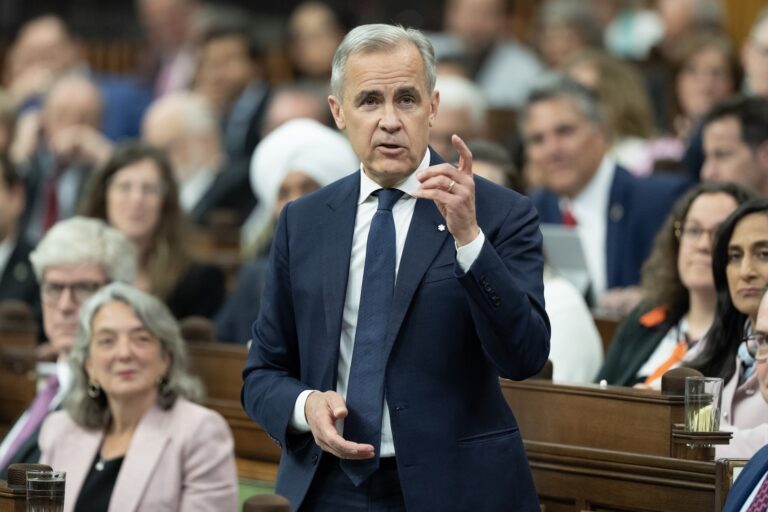
Prime Minister Mark Carney, right, said Trump agreed on Thursday to "intensify" trade talks. Photo: AP Photo/Mark Schiefelbein
OTTAWA — Canada is granting the United States a major carve-out from its retaliatory tariffs, which Prime Minister Mark Carney says will help maintain the advantage President Donald Trump has given his northern neighbour through the North American trade pact.
What’s changing?
Beginning Sept. 1, the federal government will not apply its 25 per cent counter-tariffs to any U.S. goods that enter through the United States-Mexico-Canada Agreement (USMCA) that Trump negotiated during his first term to replace the North American Free Trade Agreement.
Canada launched its initial wave of retaliatory tariffs in early March on a wide range of U.S. products worth $30 billion, from orange juice to motorcycles, in response to Trump’s 25 per cent universal tariffs on Canadian goods. Days later, Trump granted a carve-out for anything that moved through USMCA. Canada did not reciprocate at the time with a corresponding exemption.
Related Articles

How does it work?
The USMCA, which in Canada is also known as CUSMA, gives preferential tariff treatment to goods that meet certain rules regarding the country of origin. The shipper needs to complete paperwork to prove a product is eligible. That can be onerous. RBC Economics estimated that just 38 per cent of Canadian exports to the U.S. moved through USMCA last year, but when there is a will there is a way. In June, RBC reported, 92 per cent of Canadian goods moved duty-free. The new carve-out from Canada means businesses shipping U.S. goods into Canada will need to take those steps, too.
Why is it changing?
After Trump announced his tariffs on the auto sector this spring, Carney declared the old Canada-U.S. relationship “over” and vowed to negotiate a new one. The carve-out for USMCA-compliant goods was already in place at the time. Much has happened since, including Trump’s decision to hike the fentanyl-linked tariffs on non-USMCA goods to 35 per cent on Aug. 1.
Carney highlighted Trump’s decision that day to preserve Canada’s carve-out for USMCA-compliant goods. That has kept Canada’s effective U.S. tariff rate low—at 5.6 per cent, Carney said Friday, compared to a global average of 16 per cent.
“Canada currently has the best trade deal with the United States. While it’s different from what we had before, it is still better than that of any other country,” the prime minister said in Ottawa. Yet Carney also noted that Trump has made clear he is serious about overhauling U.S. trade policy in a way that means there is scant hope of escaping tariffs entirely. “As we work to address outstanding trade issues with the United States, it’s important—it’s vital—we do everything we can to preserve this unique advantage for Canadian workers and Canadian businesses.”
What’s next?
Carney said Trump agreed Thursday in a phone call to “intensify” Canada-U.S. trade talks as a result of the move. He said the federal government will also launch new consultations for the review of the USCMA, which is due by July 2026, and a new industrial strategy that will help shore up parts of the economy hit by Trump’s sector-specific tariffs, such as steel and autos.
Which retaliatory tariffs are staying?
The federal government is keeping its 25 per cent counter-tariffs on $12.6 billion worth of steel and $3 billion of aluminum products from the U.S. Canada also has 25 per cent retaliatory tariffs on vehicles made in the U.S., but there are USMCA-related exemptions for those, too. A six-month reprieve from tariffs on goods used in Canadian manufacturing or processing, packaging food or beverages, as well as for health care, public health, public safety and national security began in April.
What about the money?
The Liberal election platform booked $20 billion worth of revenue from retaliatory tariffs in the current fiscal year. It is difficult to say how much has flowed in to date, but the Fiscal Monitor showed that customs import duties contributed $3.4 billion to federal coffers from March to May this year—a 168 per cent increase over that period in 2024.
What’s the reaction?
Conservative Leader Pierre Poilievre accused Carney of breaking his election promises to strike back at American tariffs and secure a new trade and security deal with Trump. “His elbows have mysteriously gone missing,” he told reporters Friday on Parliament Hill.
Goldy Hyder, president and CEO of the Business Council of Canada, called the decision “a necessary step to preserve and strengthen our preferential trade relationship with our most important trading partner.”
Catherine Fortin LeFaivre, senior vice-president of international policy and global partnerships at the Canadian Chamber of Commerce, said businesses hit by sector-specific tariffs have “borne the brunt” of the trade war, without any USMCA exemption. “Canada must work closely with these businesses to calibrate our response while pressing for a lasting resolution with the U.S. and other trade partners,” she wrote in a statement.



Loading...
Thanks for sharing!
You have shared 5 articles this month and reached the maximum amount of shares available.
CloseThis account has reached its share limit.
If you would like to purchase a sharing license please contact The Logic support at [email protected].
CloseGift the full article!
You have gifted 0 article(s) this month and have 5 remaining.
Recipients will be able to read the full text of the article after submitting their email address. They will not have access to other articles or subscriber benefits.
Photo: AP Photo/Mark Schiefelbein
Most Popular This Week




In-depth, agenda-setting reporting
Great journalism delivered straight to your inbox.
Commentary
Carmichael: Canadian ignorance about India is a strategic weakness
Briefing
Aritzia shares pop after earnings rise 204%
First Nation in Alberta goes to court over fast-tracked oil pipeline
Chinese EV maker Geely Auto Group to launch in Canadian market in 2027
Best business newsletter in Canada
Get up to speed in minutes with insights and analysis on the most important stories of the day, every weekday.
Exclusive events
See the bigger picture with reporters and industry experts in subscriber-exclusive events.
Membership in The Logic Council
Membership provides access to our popular Slack channel, participation in subscriber surveys and invitations to exclusive events with our journalists and special guests.





