OTTAWA — The federal government plans to keep leading the charge to bust down internal trade barriers across Canada, even if most of the remaining work now falls to the provinces and territories, the senior public servant managing the file said in an interview with The Logic.
Skip to content


News
He’s Ottawa’s secret weapon in the push to break down Canada’s internal trade barriers
Behind the scenes, self-described ‘data nerd’ Jay Barber is one of the key players in the fight for freer trade among the provinces
Jay Barber, the Privy Council Office’s director of internal trade, says the federal government will keep pushing to break down interprovincial barriers. Photo: Handout/Canadian Chamber of Commerce
OTTAWA — The federal government plans to keep leading the charge to bust down internal trade barriers across Canada, even if most of the remaining work now falls to the provinces and territories, the senior public servant managing the file said in an interview with The Logic.
Jay Barber is having a big and busy year. He is the director for internal trade at the Privy Council Office (PCO)—the advisory body that supports the prime minister and cabinet. That puts him at the heart of efforts to deliver on the Liberal government’s core promise to shore up the Canadian economy against threats from U.S. President Donald Trump and his trade war.
“What we’re seeing now … is the direct result of strong and consistent federal leadership on this file,” said Barber, whose previous work with the PCO had him leading intergovernmental discussions, including meetings between Ottawa and the premiers.
Talking Points
- The head of internal trade at the Privy Council Office tells The Logic that Ottawa plans to keep playing an active leadership role as provinces move to break down barriers
- A pan-Canadian survey of businesses on the obstacles they face to buying or selling goods and services across provincial boundaries helped inform ambitious moves this year
As Internal Trade Minister Chrystia Freeland put it earlier this year, liberalizing trade across provincial and territorial borders is something “Canadian geeks” have been studying for decades. A 2022 report by the Macdonald-Laurier Institute, a market-oriented think tank, estimated that removing barriers to internal trade could increase Canada’s real GDP by 4.4 to 7.9 per cent. A report published this week by the progressive Canadian Centre for Policy Alternatives challenged those assumptions, arguing the costs of internal trade barriers are overstated and their removal could create a “race to the bottom.”
Either way, internal trade left the realms of inertia and obscurity when Ottawa and the premiers agreed to dismantle longstanding obstacles to moving people and goods—including booze—across provincial and territorial boundaries. “Internal trade has become sexy,” Freeland said May 14 as she headed into the first post-election cabinet meeting. “It’s funny, but yet true.”
Barber did not use those words when he spoke to The Logic, although he called himself one of the “data nerds” and said right off the bat that it was an “exciting time” to talk about internal trade. Bill C-5, which paves the way for Ottawa to remove regulatory requirements for goods and services that duplicate those at the provincial or territorial level, had received royal assent the day before. The following week, Freeland announced the removal of all remaining federal exceptions to the 2017 Canadian Free Trade Agreement (CFTA). That move came right before Canada Day, Prime Minister Mark Carney’s self-imposed deadline to get rid of the federal barriers. Barber is one of the people steering the rest of the work.
Related Articles

The long-term goal is to set up a Canada-wide system of mutual recognition, which means that if a good, service or worker meets the regulatory requirements in one jurisdiction, it is deemed to have met them in every other. Many provinces are hammering out their own mutual recognition agreements for goods, services and labour mobility within their own areas of responsibility. The federal legislation means Ottawa will take a closer look at its own regulations and figure out which ones it can let slide, and under what circumstances.
Barber said that would apply only to situations where there are regulations in place at both levels of government. The federal government is not trying to add rules where none exist, or promote a “deregulation agenda,” Barber said. Rules must also touch on the same aspect of the good or service, Barber added. A situation where one level of government regulates the price of a good and another its safety would mean both layers of regulation would apply, said Barber.
The regulations must also have the same goal, such as energy efficiency in appliances. “A washing machine that is produced or sold using the federal energy efficiency standard could be produced or sold using an equivalent or similar energy efficiency standard,” he said.
In February, Nova Scotia became the first province to legislate mutual recognition of goods, services and labour qualifications. The original version of the bill was straightforward and simple. Too much so, argued professional regulatory bodies, who feared losing oversight of people moving to Nova Scotia to work in their industries. They successfully pushed for amendments requiring someone seeking professional certification in Nova Scotia to prove they are insured and in good standing.
Still, once those checks are done, the legislation would also force the organizations to issue credentials within 10 days.
Barber would not comment on Nova Scotia’s amendments, but said it is important for Ottawa to keep working with the provinces “to ensure that we have an ongoing dialogue about where and how this will operate in practice.” That includes keeping up regular meetings of the Committee on Internal Trade, which oversees the implementation of the CFTA, so they can help each other avoid “gaps or unintended consequences” as they roll out the regulatory reforms.
The federal government began making big moves on internal trade last year, before Trump returned to office. That work made few headlines, but Barber said it laid the groundwork for the recent progress. Last year’s federal budget announced the June 2024 launch of Canada’s first countrywide survey of businesses about challenges they face when trying to buy, sell, hire or invest in other provinces or territories. Statistics Canada created an online hub for data and information on internal trade.
“Those aren’t activities conducted in a vacuum,” Barber said. “We did that in order to provide better, faster data to inform policy direction on this file.”
The survey asked, among other things, what obstacles businesses face in hiring someone from another province or territory. Respondents cited the time, complexity and cost of getting that worker the credentials they need. In light of that finding, Barber said, the federal government has pushed hard at the Committee of Internal Trade to have credentials recognized anywhere within 30 days. “We continue to advocate for that to the full extent possible,” he added.
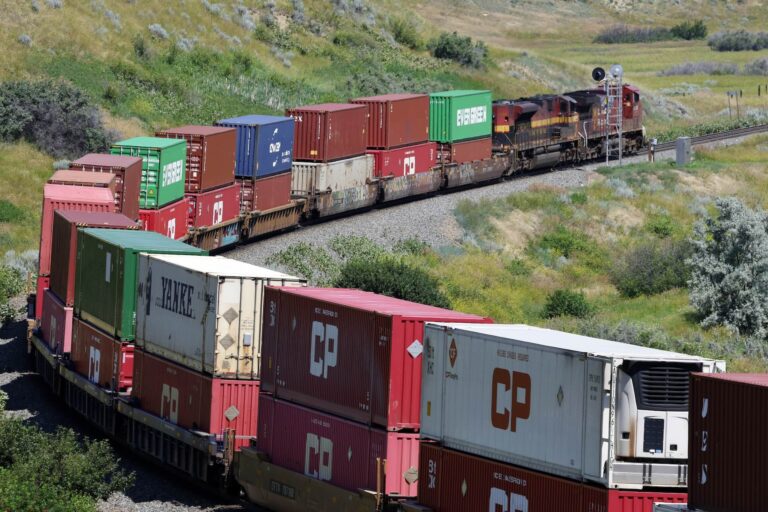
The survey’s most commonly cited obstacle to interprovincial trade was the cost of transportation. Barber said that was not a surprise. The Liberal government announced a pilot project on mutual recognition in the trucking sector in the 2024 fall economic statement. The project has since identified a range of rules and regulations the provinces could harmonize, from weight limits and steering axles specifications to “common approaches to carrier safety and electric vehicles.” The survey “reaffirmed why selecting that sector as a first mover for mutual recognition is so important,” Barber said. Transportation officials and experts are joining Freeland in Toronto next week for a “hackathon” to find other ways to make it easier to move goods across the country.
Much of the rest now lies with the provinces and territories. Ryan Manucha, a research fellow at the C.D. Howe Institute, who wrote a book on internal trade, has in the past called for Ottawa to use its trade and commerce powers under Section 91 of the Constitution to force the issue.
Barber suggested that approach is neither on the table nor needed—at least not yet. “What’s on the table for the government of Canada is the strong co-operation that we are having with the provinces and territories across the country,” he said. “The level of co-operation across all 14 governments, the level of enthusiasm and the willingness to roll up our sleeves and get the hard work done is meeting the moment. So that’s what we’re focusing our efforts on.”



Loading...
Thanks for sharing!
You have shared 5 articles this month and reached the maximum amount of shares available.
CloseThis account has reached its share limit.
If you would like to purchase a sharing license please contact The Logic support at [email protected].
CloseGift the full article!
You have gifted 0 article(s) this month and have 5 remaining.
Recipients will be able to read the full text of the article after submitting their email address. They will not have access to other articles or subscriber benefits.
Photo: Handout/Canadian Chamber of Commerce
Most Popular This Week



In-depth, agenda-setting reporting
Great journalism delivered straight to your inbox.
News
Canada faces a satellite-launch crunch as SpaceX retires its workhorse rocket
Briefing
Cohere says it caught an Alibaba model trying to send data to a server in China
Feds and First Nations to work on sharing resource revenue, with a sovereign wealth fund one option
Zafin buys U.S. fintech Naehas in nine-figure deal
Best business newsletter in Canada
Get up to speed in minutes with insights and analysis on the most important stories of the day, every weekday.
Exclusive events
See the bigger picture with reporters and industry experts in subscriber-exclusive events.
Membership in The Logic Council
Membership provides access to our popular Slack channel, participation in subscriber surveys and invitations to exclusive events with our journalists and special guests.