A reader was unimpressed with my last column. For those who didn’t read it, it was an amplification of the argument from former Bank of Canada senior deputy governor Carolyn Wilkins that Canada is doing almost everything you could think of to ignite stagnant productivity—except actually sitting down to figure out how to do so.
Skip to content

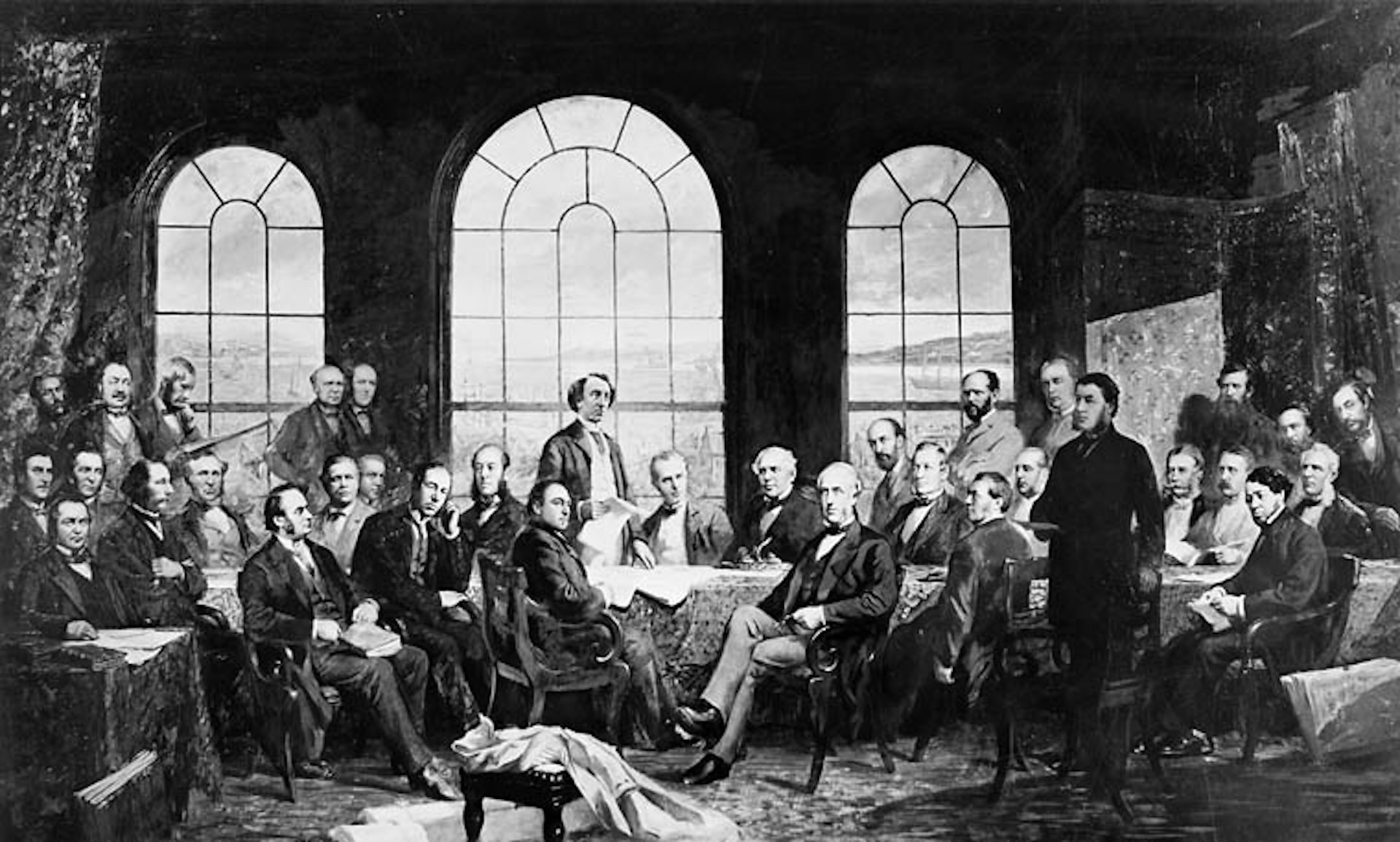 A copy of a Robert Harris painting of the Fathers of Confederation at a conference in Québec, in 1864. Photo: Library and Archives Canada

Commentary
Carmichael: An easy win in the fight to fix Canada’s productivity problem
A reader asks for ‘concrete recommendations.’ Here’s one
Bank of Canada senior deputy governor Carolyn Wilkins n Ottawa in November 2020. Photo: The Canadian Press/Adrian Wyld
A reader was unimpressed with my last column. For those who didn’t read it, it was an amplification of the argument from former Bank of Canada senior deputy governor Carolyn Wilkins that Canada is doing almost everything you could think of to ignite stagnant productivity—except actually sitting down to figure out how to do so.
The reader in question would rather avoid wasting time on a strategy and get to work. “I would appreciate that your next email to me provides concrete recommendations on how Canada can increase its efficiency,” they said. “A strategic plan is not something that the current political environment can produce and start to follow.”
I’m unsure about that. A group of individuals with broad support across the political spectrum could take a few months and put together a strategy. Our peers do this kind of thing all the time. Australia’s new government tapped Wilkins and two Australian economists to review the country’s approach to monetary policy in July 2022; the trio reported back nine months later. A government that worries political polarization is undermining confidence in democratic capitalism might even see this kind of strategy development as a way to restore confidence in government.
Related Articles


But the reader’s challenge was to provide concrete recommendations on how Canada can increase its efficiency. Challenge accepted. I’ll go back to something Wilkins said at the panel discussion on the productivity problem that The Logic co-hosted with the Canadian Club of Toronto last week. Besides a strategy, Wilkins said she would “focus on the things that didn’t cost that much money,” including all the regulations that impede trade within Canada. “It is crazy,” she said. “We are leaving billions of dollars on the table from that. We’ve been talking about that for years. We should just do it.”
In 2019, the International Monetary Fund published a study that estimated complete trade liberalization within Canada would increase gross domestic product per capita by four per cent. There’s a Statistics Canada report that’s been making the rounds as evidence of Canada’s economic atrophy: it estimates that we need per capita growth of about seven per cent to get back to its long-term trend. If we’re serious about attacking the productivity problem, there’s an obvious way to get started: secure a trade agreement with ourselves that’s as rigorous as some of those we have with other countries.
“If we could realize that kind of bump, why wouldn’t we?” asked Matthew Holmes, senior vice-president of policy at the Canadian Chamber of Commerce. “There’s very little trade going east to west.”
That’s probably not what the Fathers of Confederation had in mind when they were writing the Constitution Act. Section 121 states that, “all articles of the growth, produce, or manufacture of any one of the provinces shall, from and after the union, be admitted free into each of the other provinces.”
Yet the Supreme Court has applied a narrow interpretation of that provision over time, equating the free movement of goods with the absence of tariffs, leaving provinces lots of room to create non-tariff barriers via regulation. The best known are the rules that limit the “importation” of alcohol between provinces, but the irritants are much broader than that; inconsistent regulations plague virtually every industry, reducing the size of Canada’s internal market and impeding the ability of companies to scale.
It’s been a while since internal trade received much press. If anything, inertia seemed to be reasserting itself, with one example being the federal government’s decision in 2021 to give up trying to coerce the provinces into creating a national securities regulator.
So it was a pleasant surprise to some committed internal free-traders to stumble on some positive developments in the federal budget. The government said that it had removed 14 “exceptions” to the terms of the Canada Free Trade Agreement related to procurement, meaning it would no longer insist on its own standards in those areas; and it amplified that Statistics Canada had launched the Canadian Internal Trade and Information Hub, creating a repository for data and analysis on trade and labour mobility between provinces and territories.
The government also said that it will survey “thousands” of businesses next month to identify the biggest challenges they face when trying to buy, sell and invest within Canada. The goal is to put a spotlight on the most restrictive barriers, “so that they can be eliminated.”
It might not sound like much, but progress in trade negotiations is incremental wins, not big bangs. “All the things in the budget, pretty huge in the world of internal trade,” said Ryan Manucha, a research fellow at the C.D. Howe Institute and the author of Booze, Cigarettes, and Constitutional Dust-Ups, an award-winning history of Canada’s star-crossed attempts to create a country that trades with itself the way it trades with the rest of the world. “This was the loudest enunciation of federal action on interprovincial trade barriers in decades.”
Manucha said he’s at work on a report that will likely show that Canada’s mish-mash of transportation rules cost the trucking industry about $1.6 billion a year. He said better data, and easier access to it, will help build the case for change. If one of the points of Confederation was to force the colonies to trade freely amongst themselves, Manuch is betting the court of public opinion can be more easily persuaded than the Supreme Court.
The unsung story of the budget might be that there is now evidence of momentum to boost internal trade. The government said it would “announce further progress to align the regulatory environment across the country in due course.”
My concrete recommendation on how to fix the productivity problem is to put pressure on Ottawa and the provinces and territories to make good on that work. “In due course” isn’t fast enough.
Kevin Carmichael is The Logic’s economics columnist and editor-at-large. He has spent more than two decades covering economics, business and finance for outlets including Bloomberg News, The Globe and Mail and the Financial Post, where he also served as editor-in-chief.



Loading...
Thanks for sharing!
You have shared 5 articles this month and reached the maximum amount of shares available.
CloseThis account has reached its share limit.
If you would like to purchase a sharing license please contact The Logic support at [email protected].
CloseGift the full article!
You have gifted 0 article(s) this month and have 5 remaining.
Recipients will be able to read the full text of the article after submitting their email address. They will not have access to other articles or subscriber benefits.
Photo: The Canadian Press/Adrian Wyld
A copy of a Robert Harris painting of the Fathers of Confederation at a conference in Québec, in 1864.
Most Popular This Week




In-depth, agenda-setting reporting
Great journalism delivered straight to your inbox.
News
Canada faces a satellite-launch crunch as SpaceX retires its workhorse rocket
Briefing
Cohere says it caught an Alibaba model trying to send data to a server in China
Feds and First Nations to work on sharing resource revenue, with a sovereign wealth fund one option
Zafin buys U.S. fintech Naehas in nine-figure deal
Best business newsletter in Canada
Get up to speed in minutes with insights and analysis on the most important stories of the day, every weekday.
Exclusive events
See the bigger picture with reporters and industry experts in subscriber-exclusive events.
Membership in The Logic Council
Membership provides access to our popular Slack channel, participation in subscriber surveys and invitations to exclusive events with our journalists and special guests.