Two-thirds of The Logic’s subscribers think Canada should mirror the regulatory approach that led Facebook to temporarily ban news on its platform in Australia last week, according to our most recent survey.
“News needs to be worth something,” one subscriber wrote.
Methodology
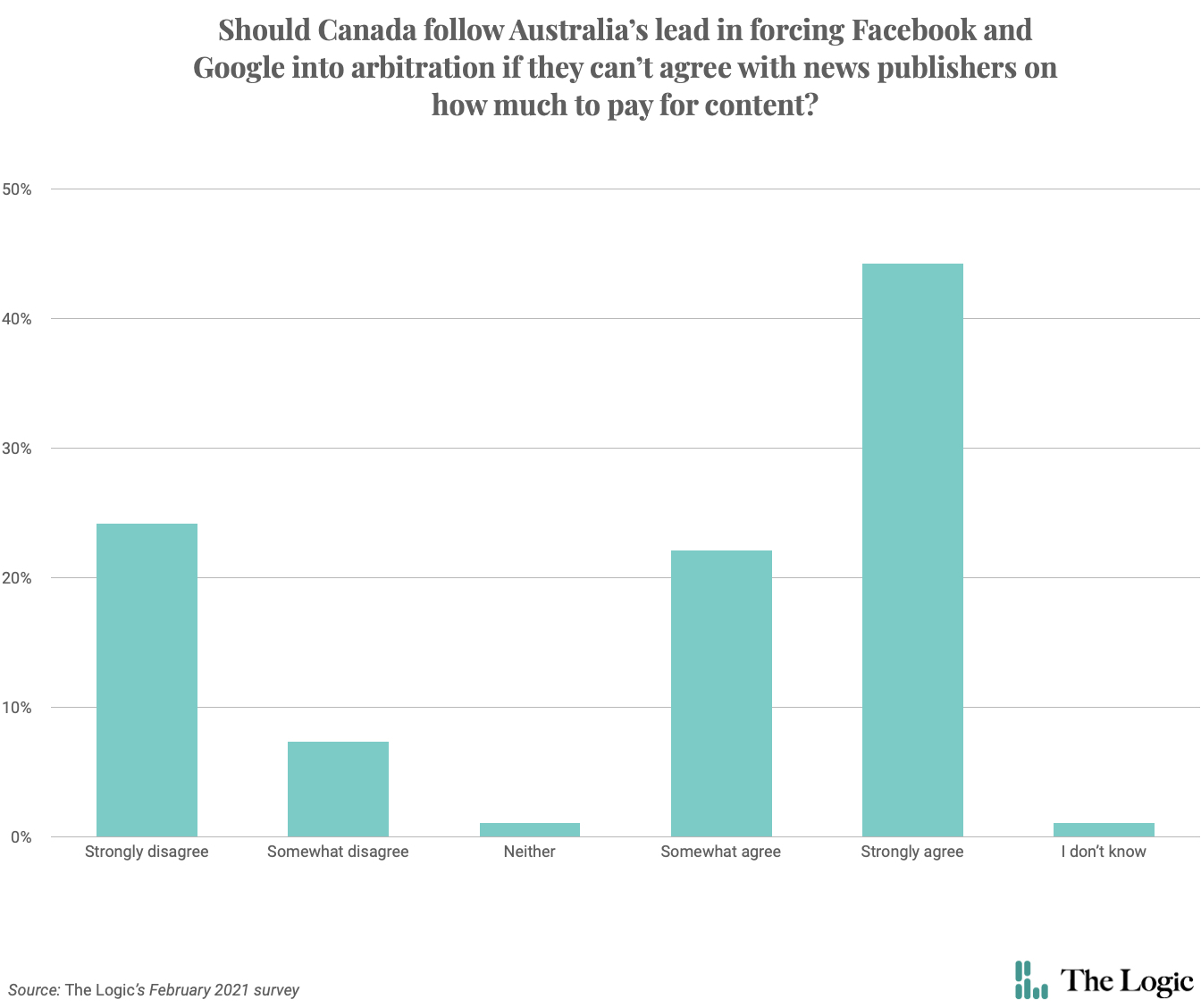
The Logic emailed subscribers a private link to an online survey on Feb. 22, and the survey closed Feb. 23. Respondents’ identities were kept anonymous and duplicates were removed as needed. Subscribers were asked whether they agree or disagree with the following statement: “Canada should follow Australia’s lead in forcing Facebook and Google into arbitration if they can’t agree with news publishers on how much to pay for content.” Their choices were: “Strongly disagree,” “Somewhat disagree,” “Neither disagree nor agree,” “Somewhat agree,” “Strongly agree,” “I don’t know.”
Sixty-six per cent of respondents agreed that Canada should follow Australia’s example in forcing Facebook and Google into arbitration if they fail to negotiate with news publishers on how much to pay for content. Of those, 44 per cent said they “strongly agreed,” and 22 per cent agreed somewhat. Thirty-two per cent disagreed.
Facebook suspended news-sharing in the country for five days last week in what Australian treasurer Josh Frydenberg called “a proxy battle for the world.” The ban, in response to legislation compelling Google and Facebook to strike payment deals with publishers, was lifted Tuesday after the Australian government negotiated new terms with the company.
Although news is now back on Australian feeds, several other countries, including Canada, are considering similar regulations. Earlier this month, Canadian Heritage Minister Steven Guilbeault told The Logic he plans to put forward legislation following the Australian model as part of a broader regulatory push.
Many subscribers who responded to the survey said Facebook and Google should be required to pay for news that generates revenue on their platforms.
“Why should they be able to build hugely profitable businesses with other people’s content and intellectual property?” one subscriber asked.
Several wrote that because journalism costs money, requiring tech platforms to pay for content could be a way of “ensuring a vibrant news publishing industry moving forward.”
Subscribers wrote that Facebook and Google have created anti-competitive monopolies that “need reining in.” Some highlighted the societal importance of journalism. “Bad things happen in a democracy when the control of media is tightly held by a small group,” one wrote.
Some subscribers who supported the Australian government’s new legislation saw paying publishers as just one aspect of a larger regulatory reckoning.
“The only way to get these big companies to the table is to threaten their revenue,” one wrote.
Several subscribers voiced support for a coalition of countries that would work together to push back against Big Tech. “Canada should coordinate with other G7 countries so Facebook faces a common approach to regulation and cannot afford to just deny local content in retaliation,” one wrote. This week, Justin Trudeau and Australian Prime Minister Scott Morrison agreed to coordinate their regulatory efforts. Guilbeault has said he is seeking a “formal coalition” with Australia, Germany, France and Finland.
However, roughly one-third of respondents didn’t want to see Canada follow Australia’s lead. Some were unsure whether requiring platforms to pay for news was the right lever to pull in support of the media industry.
One subscriber called for enhanced support for the news industry and a digital-services tax—which Ottawa has said it will impose in 2022, if an OECD deal isn’t reached by then—instead of “forcing payments from profitable private companies to those who have been unable to adapt to business model shifts.”
Some were more critical of Australia’s approach to regulation. Several said that tech platforms actually benefit news publishers by driving traffic to their stories. Others said it’s up to publishers to monetize their content through paywalls or other revenue models.
“This seems like leveraging Big Tech to solve the publishing industry’s issue,” one subscriber wrote.
As to whether following Australia’s template made sense for Canada, one subscriber pointed to the unique dynamics at play in the country: Australia has one of the most concentrated media industries in the world—dominated by Rupert Murdoch’s News Corp—and a history of market intervention.
Guilbeault is expected to introduce wide-ranging legislation on online platforms in the coming weeks.
***
On Tuesday, March 2 at 12 p.m. ET, Facebook’s Kevin Chan, director of public policy for Canada, joins The Logic’s Murad Hemmadi for a subscriber-exclusive conversation about the deal the company made in Australia, and what it could mean for the Canadian media industry.
Subscribers can register to join this exclusive virtual event.