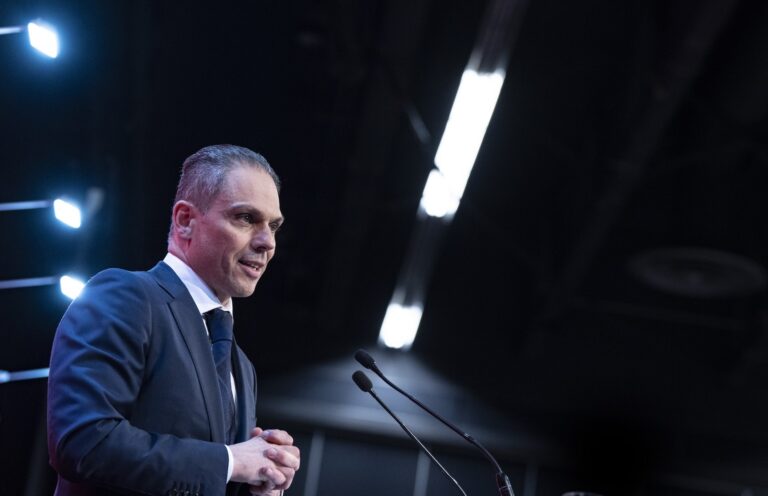
MONTREAL — Steven Guilbeault, the minister of Canadian Heritage, doesn’t like Facebook much. The blue-hued social media platform is mentioned 34 times, almost always negatively, in The Good, The Bad and The Ugly, Guilbeault’s 2019 treatise on artificial intelligence. To wit: when it isn’t Hoovering data, helping elect the likes of Donald Trump or otherwise destroying humanity’s social fabric, Guilbeault says Facebook is busy hooking users on its product much as heroin ropes in addicts.
A longtime environmentalist, in 1993 Guilbeault co-founded Équiterre, one of the more prominent environmental-activism groups in Quebec. He wrote The Good, The Bad and The Ugly when he was a consultant for Quebec cleantech VC Cycle Capital Management. Nearly two years and one attempted U.S. insurrection later, Guilbeault now has the power to regulate the main target of his ire. And his sleeves are already rolled up.
In the next three weeks, Guilbeault will introduce wide-ranging legislation that he says will tame the hateful and at times violent excesses social media tends to engender. I spoke with him last week, and was able to extract a few details about what we (and Big Tech) can expect. It’s a doozy.
Talking Point
The federal government will create a new regulator position to oversee the actions of online platforms in the country. The regulator will have the ability to audit what platforms are doing, as well as enforce what Guilbeault called a “Canadian code of conduct” and levy fines against companies that don’t comply with it. Canada will also follow Australia’s lead in seeking to make Google and Facebook pay publishers for content, and is meeting with other countries in hopes of creating a “formal coalition” to push back against Big Tech’s dominance.
The federal government will create a new regulator position to oversee the actions of online platforms in the country. The regulator will have the ability to audit what platforms are doing, as well as enforce what Guilbeault called a “Canadian code of conduct” and levy “very, very important fines” against companies that don’t comply with it.
The government, Guilbeault told me, will also introduce a 24-hour takedown notice, which would give the regulator power to compel platforms to remove material the regulator deems illegal or hateful, or that otherwise fosters radicalization, incites violence or promotes terrorist propaganda.
Further, the legislation will cover not only these sins but all online harms—including sexual exploitation and consent, meaning the regulator will oversee not just Big Tech, but Big Porn.
Guilbeault told me the government will put forward separate legislation similar to that being considered in Australia, forcing Google and Facebook into arbitration should they be unable to come to an agreement with news publishers on how much they should pay for content. Finally, he said he is meeting with the governments of France, Australia, Germany and Finland in two weeks, with the intent of creating a “formal coalition” of countries to push back against Google and Facebook’s dominance.
“These companies—as mighty as they might be—can they simultaneously boycott France, Australia, Canada and Germany, and I suspect soon enough many others who will join our efforts? I don’t know, but it will be challenging for them,” Guilbeault told me.
Social media platforms have shown themselves to be horrible at moderating the content on their sites. The process is often arbitrary and piecemeal, with the 45th American president disappeared while other race-baiting leaders remain in their good graces.
These platforms also misconstrue legitimate content as terrorist propaganda, fail to sniff out humour and satire and mistake breast-cancer awareness programs as pornography. They often allow misinformation to fester, yanking it only once the damage is done. The end result is a set of rules unequally enforced by artificial intelligence and teams of forever overwhelmed human content moderators.
At the same time, Google and Facebook have behaved exactly as you’d expect: unsubtly.
Australia’s government is among the first to entertain a law on paying for media content. In response, Facebook threatened to pull its services from the country. Google did the same, with an extra flash of teeth: it temporarily hid Australian news sites from its search results for some users in the country—an “experiment,” the company said, performed just as it is negotiating with the country’s government.
“Google and Facebook have reacted the same way monopolies do in Australia all the time, and I suspect the way monopolies do around the world. They want to be in control,” Australian competition head Rod Sims told me.
Enter Guilbeault, whose plans to both legislate tech platforms and adopt an Australian-style media-payment law put him squarely in the sights of two of the world’s biggest tech companies. His transition from cleantech whisperer railing against the pratfalls of technology to federal minister regulating Big Tech has been positively charmed.
Written over five years, Guilbeault published The Good, The Bad and The Ugly in June 2019—the very month he announced his intention to run for the Liberal Party in the Montreal riding of Laurier–Sainte-Marie. Not only did he win the riding, becoming the first Liberal to do so, he landed in cabinet a month later.
The mandate letters of past heritage ministers are chock-full of bromides about vibrant diversity and the importance of telling Canadian stories. Guilbeault’s letter has those, too—along with specific instructions to regulate social media platforms in the country, which Guilbeault says became his pet project when he decided to run for office. “The issue of Google, Facebook and media wasn’t something we’ve done a lot of work on. But I was told by the team, ‘Go for it, Steven,’” he told me.
To be fair, Guilbeault isn’t a Luddite. The “good” portion of The Good, The Bad and The Ugly finds the 50-year-old environmentalist positively smitten with smart glasses, autonomous cars, experimental nursing-care robots and other aspects of the tech-driven “fourth industrial revolution.” Facebook’s algorithm, meanwhile, is hardly the book’s only villain. Guilbeault doesn’t have much time for the Chinese government or for autonomous weapons, both of which have become all the more lethally efficient thanks to technology.
And while Guilbeault harps on social media platforms, there isn’t much in the book about the scourge of violence and misinformation. His dystopian view of the future isn’t populated with racists and QAnon types spreading lies on social media. Rather, it is part Skynet, part 1984, part Star Trek, in which dopamine-addled, Borg-like humans wander around, infinitely surveilled, physically and emotionally attached to their screens.
Guilbeault nonetheless argues that governments constitute the only effective bulwark against Big Tech, because Big Tech sure as hell can’t be trusted to police itself. He uses the example of Sidewalk Labs, Alphabet’s grand (and ultimately failed) experiment to build a smart neighbourhood in Toronto, as an example of private industry running roughshod over the public good. “I’m worried that my children will grow up in a world where these platforms are unregulated,” he recently declared, cheekily enough, on Facebook.
As it turns out, Big Tech agrees. “We agree that regulations could set baseline standards for what kind of content is prohibited online and require social media companies to build systems to enforce these standards. The status quo of having private companies decide what is and isn’t acceptable speech online is not sustainable longer term, and lacks transparency and accountability,” Facebook Canada public policy head Kevin Chan told a parliamentary committee on Friday.
Social media companies say this is because they value civil discourse and the safety of their users. A cynic would say having governments set laws would give these companies political cover to, say, arbitrarily flush over 70,000 QAnon-associated accounts into the ether, as Twitter did earlier this month, to give but one example.
We would indeed do well to worry what they wish for. Canada’s new social media regulator, at least as outlined in Guilbeault’s mandate letter, will have powers to police hate speech. This might sound like a good idea in theory; in practice, hate speech is often tough to define and notoriously difficult to prosecute in court, let alone over the internet within the span of 24 hours.
“If the government is going to impose big financial penalties on platforms and give them raw definitions of what they have to take down, the platforms are going to err on the side of removal, and that is bad for freedom of expression,” Cara Zwibel of the Canadian Civil Liberties Association told me recently. (A recent Public Policy Forum paper recommended that quick takedowns within 24 hours be limited to instances of imminent danger to a person or group.)
On the other front, Guilbeault plans to introduce the legislation compelling Facebook and Google to pay for news at some point this spring. He expects both Google and Facebook will take great umbrage to it—and knows it is likely that both will threaten to pull their wares from Canada, as they did in Australia. A Facebook Canada spokesperson wouldn’t comment on the possibility, but said the Australian model was “the wrong way to do this.” A Google representative offered much the same thing, saying the company hoped to work with government so as to “avoid problematic elements of Australian code that will undermine the Internet.”
But by selling the likes of France, Germany and Finland on a coalition, Guilbeault is betting Big Tech can’t keep boycotting countries that legislate against its bottom line. It seems Facebook really is bringing the world together, after all.
Martin Patriquin is The Logic’s Quebec correspondent. He joined in 2019 after 10 years as Quebec bureau chief for Maclean’s. A National Magazine Award winner, he has written for The New York Times, The Guardian, The Walrus, Vice, BuzzFeed and The Globe and Mail, among others. He is also a panelist on CBC’s “Power & Politics.” @MartinPatriquin