Sponsored Content
Genomics: A strategic advantage for Canada in the AI era
Experts say digitizing biology through genomics and AI can revolutionize how industries operate. Here’s how Canada can lead this high-impact use of AI globally.
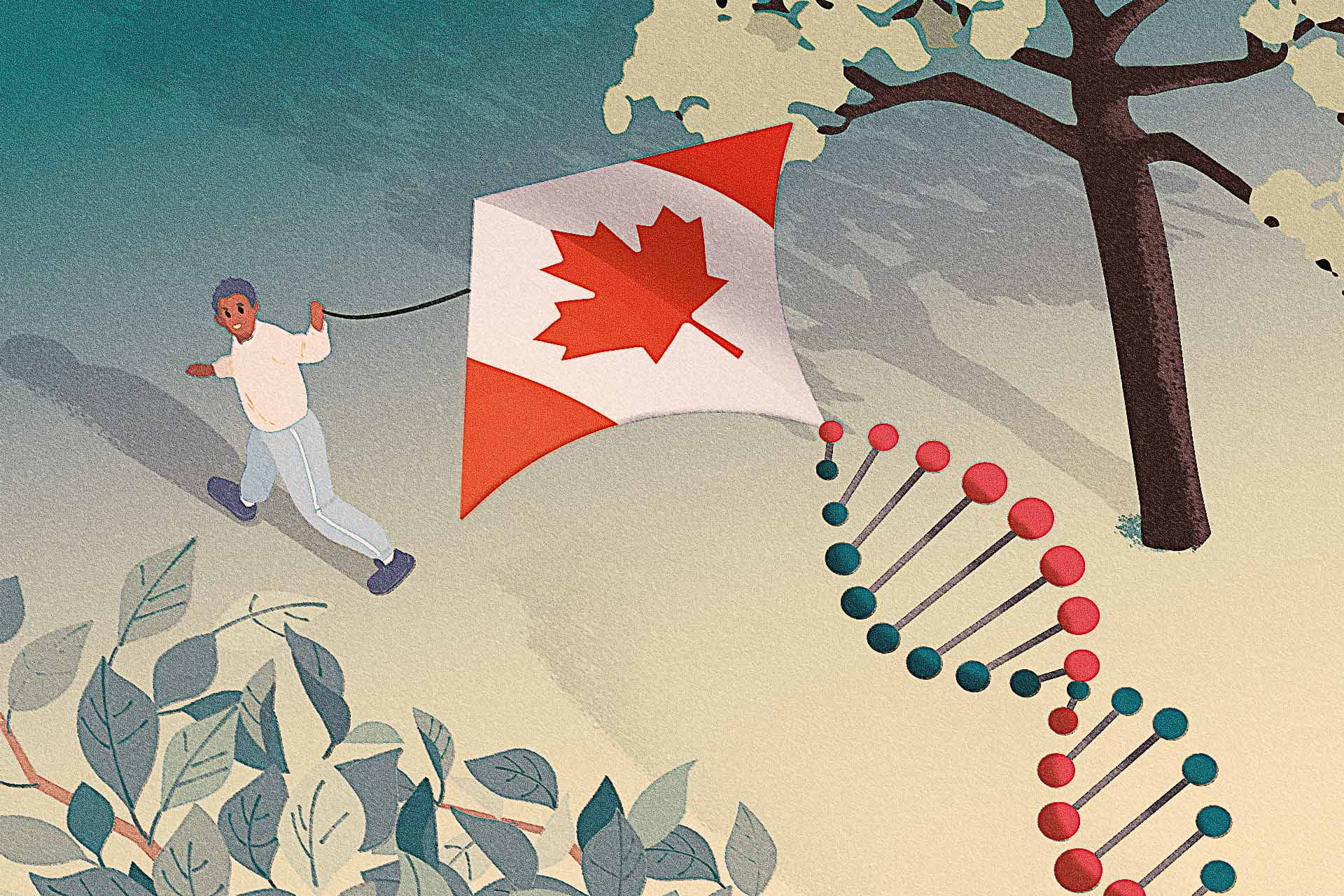
Illustration by Paul Kim

Sponsored by:
Sponsored by:
In 2003, when the coalition of international researchers behind the Human Genome Project (HGP) announced their landmark mapping and sequencing of a nearly-complete human genome, it was the culmination of nearly 15 years of research and more than $3 billion in investments.
Nearly a quarter-century later, researchers can do the same job in about 15 hours, for a few hundred bucks. Globally, hundreds of thousands of genomes have now been sequenced, quantifying the foundational genetic building blocks of all manner of human, animal, plant, viral, and bacterial organisms, and generating petabytes of data about how, exactly, living things work.
Welcome to the so-called “bio revolution,” a burgeoning era of genomics-based innovation that experts expect to transform medicine, agriculture, forestry, natural resources, construction, technology, and more. It’s the result of a post-HGP proliferation in scientific activity converging with blistering technological advancements (especially in AI), and the proof points of its traction are everywhere: In new algorithms that can predict the likelihood of hundreds of diseases. In tools that can model how protein structures will evolve over time. In the rapid development of synthetic mRNA vaccines and CRISPR gene-editing tools. In the flurry of new and established businesses working to develop and commercialize genomic solutions to major societal problems. “We’re in the early stages of a golden age in biotech,” confirms Rob Annan, the President and CEO of Genome Canada, which invests in and coordinates initiatives meant to advance the national genomics sector. “The discovery power of AI, and its ability to manage and manipulate these large data sets that we’re now producing, is really changing our field.”
Experts believe Canada has many of the ingredients to be a global leader on the new genomics frontier, including a deep bench of blue-chip technical researchers, clear government support (see: the federal government’s recent Canadian Genomics Strategy, which pegs genomics as a “powerful tool for addressing today’s major global challenges” and allocates more than $175 million over seven years to advancing the space), and decades of experience advancing genome-based work in such areas as agriculture, forestry, fisheries, and natural resources, in addition to biomedicine. “When I look at the economic sectors in Canada that could be affected by genomics, it absolutely blows my mind,” says Alison Sunstrum, a tech entrepreneur and investor who, as Founder and CEO of CNSRV-X (among other roles), is actively working to commercialize emerging technologies in agriculture. “There’s no opportunity that comes even close to what exists now in biotechnology,” says Carl Hansen, CEO of Vancouver-based biotech firm AbCellera, which uses genomics and AI as part of its antibody discovery platforms, and which has in recent years brought its first two therapeutic antibody programs (one for vasomotor symptoms, and one for autoimmune conditions) into clinical development. “It is the great frontier,”
But converting all this promise into impact is not without challenges: Canada’s genomics research ecosystem is more siloed, its data more fragmented, its capital more cautious, and its policy more restrictive than many in the field would like. “We have such an opportunity to transform our economy by really doubling down on these technologies,” says Annan. “But I don’t think we’re treating this space as the new, sophisticated, AI-enabled sector that it has become.”
There is no silver bullet that can transform Canada’s genomics potential into a competitive asset that drives innovation, accelerates economic growth, and supports sovereignty. But according to experts, thoughtful and ambitious changes in three key areas can help the country meet the moment.
Related Articles


Rally around real-world impact
A survey of the genomics research landscape in Canada presents a promising, but patchy, picture. “We have a flourishing community of researchers and funders that are really passionate about genomics, and who are experts in their fields,” says Felipe Pérez-Jvostov, Director of Strategic Development and Initiatives at the Digital Research Alliance of Canada. The problem is that their work, and the valuable data that comes from it, tends to be contained within individual institutions and discrete projects. The result is a collection of fragmented and sometimes overlapping efforts that too often adds up to less than the potential sum of its parts. “We have a really convoluted ecosystem that is not conducive to sharing,” Pérez-Jvostov explains. “There’s growing consensus that the country needs to come together and coalesce around some strategic priorities.”
That will require focus. Canada has neither the size nor the influence to dominate all areas of genomics, but experts believe the country can and should rally behind solutions to select big, real-world problems in areas where Canadian researchers have both expertise and experience. These include healthcare (e.g. creating equitable access to genomic medicine), agriculture (e.g. building food systems that are resilient to climate change), and natural resources (e.g. developing bioeconomic opportunities that protect forests, waterways, and prairies). “We need to be thinking about sectors where we can be globally competitive,” Annan reasons. “Instead of having 1,000 projects working in disparate ways, we need to have 1,000 projects pulling in a few really important directions to create more opportunity and more benefit.”
This alignment would make it easier to build the massive data pools needed for AI to work its magic. “When you get a well-established base of curated, multimodal data, AI can start to make inferences that are really, really powerful,” explains Avak Kahvejian, a genomics veteran who helped pioneer the world’s first single-molecule DNA sequencer, and a Partner at Massachusetts-based Flagship Pioneering, whose venture portfolio includes such biotech giants as Moderna and Etiome. (Kahvejian sits on the board of Genome Canada.) “The more data we collect, and the better we do it, and the more we share it—that will all have an impact within our lifetime.”
There’s precedent for creating large sovereign data assets: Specifically, the UK Biobank, which has gathered 500,000 individual genomes and associated health records data, to widespread acclaim. It’s a blueprint of sorts for efforts like the Canadian Precision Health Initiative, a multi-year effort led by Genome Canada to establish a national data bank of more than 100,000 human genomes, for user-controlled open-access use by researchers, clinicians, and other stakeholders. “We’re not a big enough country, population or economy-wise, to allow these valuable assets to be disconnected,” Annan explains. “We need the scale to apply these cutting-edge tools.”
The jurisdictional, competitive, and privacy considerations of bringing together thousands of genomics researchers and hundreds of trillions of data points are both complicated and considerable. But technology can help to streamline the process, and experts believe the potential impact of focused collaboration is worth the effort. “It is extremely important for us to find a way to work across sectors,” says Pérez-Jvostov. “In a space that is evolving so rapidly, a coordinated approach that is multi-sectoral, and that is aligned with Canadian values and the values of the people who are giving their genomes for research and innovation, is the way to go.”
Accelerate industry adoption
As critical as research alignment may be, experts say it’s equally important to get genomics out of the lab by encouraging the engine of commerce, for reasons of velocity and scale. “Companies have the speed, the technology, and the capital to do a lot of really good things really quickly,” says Pérez-Jvostov. Annan elaborates on the role of business: “Industry is where the rubber hits the road. It’s crucial for Canadian economic performance, but also to ensure life-changing impact will actually be delivered where it is needed.”
Across the country, nascent and established businesses are already applying genomics into commercial applications of all stripes. They’re active in health and pharma, but also in such critical sectors as agriculture (see: Saskatoon-headquartered NRGene, which leverages genomics for crop and livestock breeding, including the development of insect-based sustainable proteins), forestry (see: B.C.’s Canfor, which is using technology to better identify and sort different tree species in woodchip piles for downstream use), and fisheries (see: St. John’s based eDNAtec, which uses advanced DNA sequencing to monitor marine ecosystems). These are all applications with strong global demand, and experts say they’re all areas in which Canada’s relatively deep experience creates an edge.
It’s not a situation that should be underestimated, according to AbCellera’s Hansen. “We should be looking for opportunities where Canada can compete, and win, and grow, and deliver products that we’re proud of, that can make a difference in the world,” he says. Canada has several genomics-leveraging biotech companies with a real shot at becoming $100- to $200-billion global champions, he says, if (and only if) they can avoid the all-too-common Canadian phenomena of failing to scale or selling to foreign buyers. “If we can make good choices, if we can get the data that we want, and if the macro world cooperates, then we have a chance, for the first time in Canada, to be the opposite of that story where you sell too early and you don’t see the full value of things realized,” Hansen says. “We’d better find a way for the government and ambitious private companies to work together, and we’d better be willing to take risks and put real dollars behind things, or we are not going to win in this.”
On that, he has an ally in Sunstrum. “We need a bias for action,” she says. “With AI, you can go from genomics being a discovery platform to a deployment engine, and that’s how we have to think about these things. It’s deployment time.” She’d like to see public and private investment in genomics upstarts at least double, and, ideally, increase tenfold. “We run the risk of failing to translate our strengths into large-scale bioeconomic wins,” Sunstrum says. “I think we can avoid that, but we have to invest.”
Create policy for innovation
Neither researchers nor industry will be able to seize the opportunity in genomics if policy impedes their ability to do so. Experts say there’s a pressing need for revamped regulatory and legal guidelines that better support innovation in the space.
Genomics occupies a complicated policy terrain, especially when it deals with human biology. People are the ultimate owners of their own genomic data, and while experts say many are happy to share it for safe use in pursuit of the greater good, others are wary of turning over private health information for purposes they don’t trust or understand. Some say current policies do little to incentivize the safe trans-jurisdictional sharing of things like electronic health records, genomic data, and imaging information. “There’s some policy work to be done to update and modernize privacy,” comments Annan. “It’s time for a difficult, but necessary, conversation about the balance between regulation and innovation.”
Experts contend that a more productive and secure policy environment might emerge if everyone at the table has a few foundational variables in place. First: Education, to give all involved a clearer picture of what genomics involves, what it can do, and what it needs to get there. “When people hear about genomics or the bio economy, their eyes tend to glaze over. There’s a tendency to say ‘Let’s leave that to the scientists,’” says Sunstrum. “We need to be a little more sophisticated in our understanding.”
Second: Urgency. In a world of geopolitical upheaval, global pandemics, and increasingly commodified information, experts say a sovereign genomics ecosystem is not just a nice-to-have, it’s a strategic imperative. “We need policymakers to recognize that genomics data generation and management is a core strategic need for Canada, and that requires investment and protection,” says Annan.
Finally: Ambition. Experts agree that this is no time for timidity. “We need to get our act together and be part of the next big wave of things that are happening,” says Hansen. “I really think the opportunity here is for Canada to be more proactive and ambitious in our industrial policy. We need to be more muscular to make sure all the potential we have finally sees the light of day.”
As is the case with all frontier technologies, there will be winners and losers as genomics enters its AI era. But according to experts, if Canadians play this moment right, we’ll get a lot more of the former than the latter. “Political interest in genomics waxes and wanes, but history has taught us that there will be positive impacts. They will be hard to foresee and hard to predict, whether in time or in nature, but they will come,” says Kahvejian. “The opportunity in genomics is not science fiction. It’s becoming science reality. And I do believe Canada has the scientific horsepower and the infrastructure to make its mark in this field.”
This content was paid for and directed by Genome Canada and was produced independently of The Logic’s newsroom in consultation with the advertiser. You can read our policies on advertising, sponsorships and partnerships here.



Loading...
Thanks for sharing!
You have shared 5 articles this month and reached the maximum amount of shares available.
CloseThis account has reached its share limit.
If you would like to purchase a sharing license please contact The Logic support at [email protected].
CloseGift the full article!
You have gifted 0 article(s) this month and have 5 remaining.
Recipients will be able to read the full text of the article after submitting their email address. They will not have access to other articles or subscriber benefits.