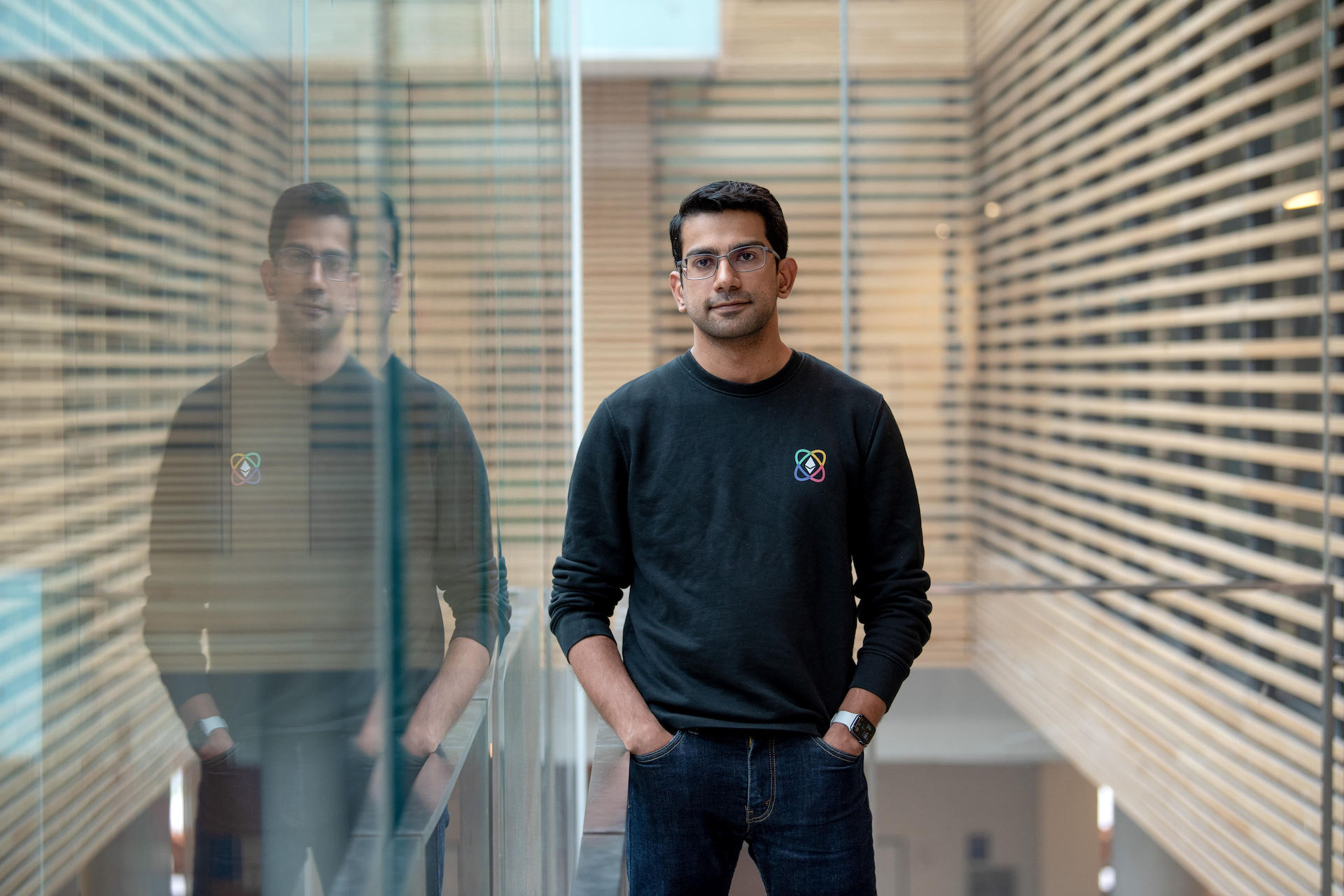
WATERLOO, ONT. — Kartik Talwar’s team at ETHGlobal is worried about breaking the internet.
It is a rainy Friday in June. In about an hour, 900 people are going to start coming through the doors of the Lazaridis School of Business on the Wilfrid Laurier University campus in Waterloo. Many of them will stay there for the next 48 hours straight, hacking away at blockchain projects in pursuit of more than $325,000 in prizes.
Talking Points
- Toronto-based organization ETHGlobal hosts hackathons around the world, playing a key role in the Ethereum blockchain by bringing developers and other community members together
- ETHGlobal hosted a June hackathon in Waterloo, returning to the site of its inaugural 2017 event that saw the creation of Dapper Labs’ first blockchain collectible hit, CryptoKitties
To handle the demand, the ETHGlobal team “had to bring in our own internet,” Talwar says, putting about 40 routers throughout the building in areas where competitors will sit. “You never know what new problem will come up.”
It takes a lot of juice to power ETHGlobal, an organization that plays a key role in fostering community and advancing the technology of the US$223-billion Ethereum blockchain, the world’s second most valuable after Bitcoin. There are half a dozen such in-person hackathons around the world every year. ETHGlobal uses them to cultivate new developer talent and bring people together to find solutions to Ethereum’s most pressing problems—things that will be crucial if the blockchain is to succeed in its mission of building the backbone of a fairer financial system and a more open internet.
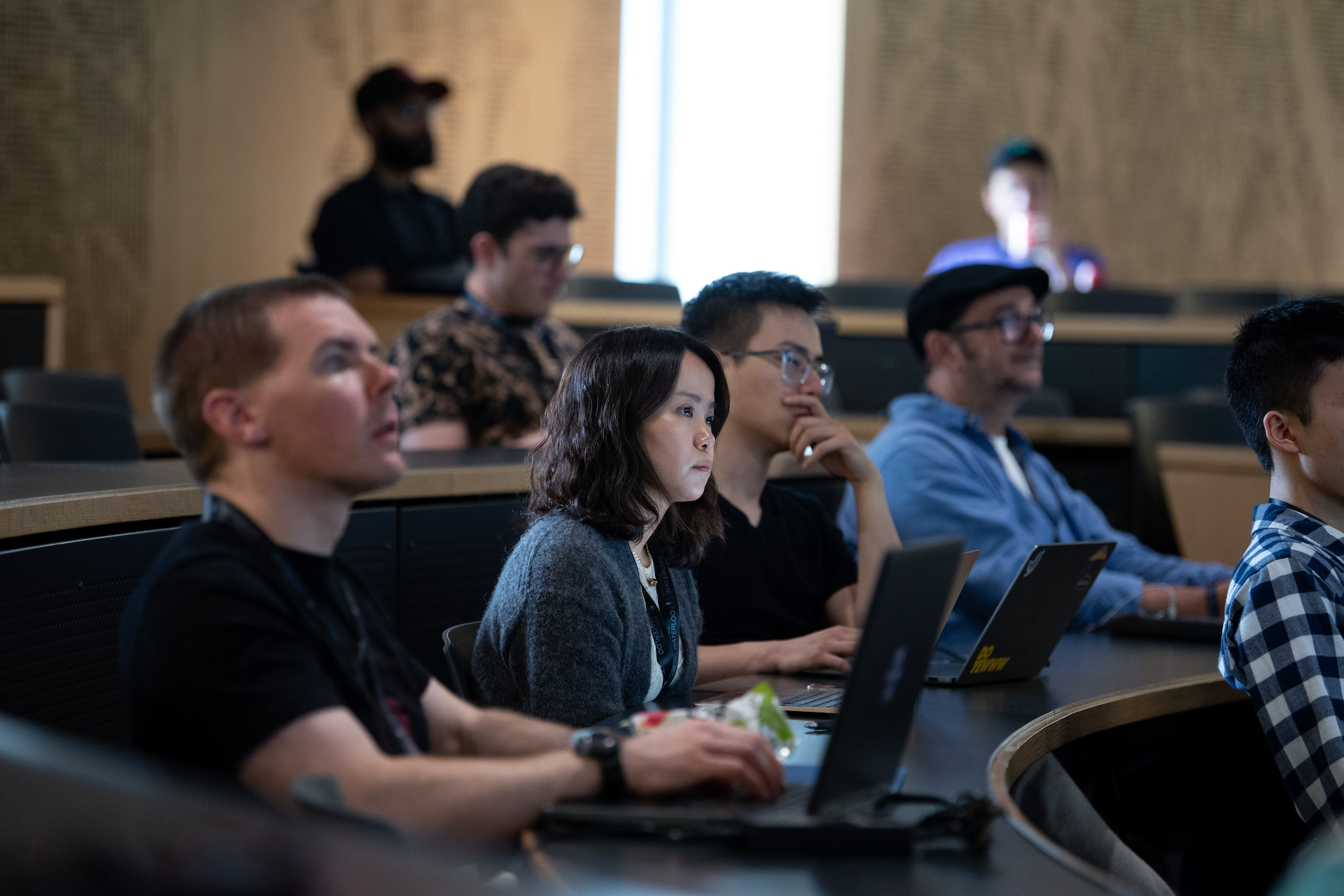
People attend a workshop at an ETHGlobal event at Wilfrid Laurier’s Lazaridis School of Business and Economics in Waterloo, Ont., on June 23. Photo: Laura Proctor for The Logic
Hackathons are a staple of the programming world, bringing newbies and experts together to create software projects in a short period of time, usually 24 to 48 hours. The idea is to motivate people to finish a project with the carrot and stick of prizes and a hard time limit, while lowering barriers to participation by eliminating the need to pay for a hotel room or take time off work.
This is ETHGlobal’s third time hosting such an event in Waterloo—a now-legendary 2017 hackathon in the university town was the organization’s first. Today, the Toronto-based company has 15 full-time employees. Its staff and events are funded by grants from the Ethereum community and sponsorships—a big change from its early days.
Talwar, now 31 and a general partner at the Silicon Valley venture capital firm A.Capital Ventures, met Liam Horne while the two were studying physics and computer science at the University of Waterloo in 2013.
Interest in Bitcoin was growing at the time, and Talwar and Horne started participating in cryptocurrency forums on Reddit. They realized another frequent poster with some interesting ideas was also a University of Waterloo student—Vitalik Buterin, inventor of Ethereum.
After reading the Ethereum whitepaper, “I was like, ‘Oh, let me look up who this person is,’” Talwar says. “It turned out that he was … a student and he was living on campus.”
Talwar and Horne had already started a different hackathon for students, called Hack the North, which is still running. They were inspired by University of Waterloo students’ frustration with having to travel to other universities for such events, despite attending a university with a strong engineering culture, he says.
The pair decided to host an Ethereum hackathon at the University of Waterloo in mid-October of 2017, bringing the blockchain’s community of developers scattered across the globe together in person for the first time. Talwar says they were expecting 100 to 150 people—and more than 2,000 signed up, with just 500 able to attend because of the venue’s capacity.
The most prominent project to come out of the first ETHGlobal Waterloo was CryptoKitties, a blockchain-based game that allows users to breed and collect digital cats. The game eventually became so popular it clogged the network—and the team that created it went on to form the Vancouver-based NFT company Dapper Labs, maker of the 2021 hit NBA Top Shot.
The best part of the 2017 hackathon was the spontaneous connections that came out of having the Ethereum developer community together in one physical space, Talwar says. He recalled people shouting across the room that they were having trouble with an app or a software library, only to have the creator of that app or software library walk over to help fix the problem.
People attend an ETHGlobal event at Wilfrid Laurier’s Lazaridis School of Business and Economics in Waterloo, Ont., on June 23, 2023. Photo: Laura Proctor for The Logic
“It was just those magical moments you never thought would be possible,” Talwar said. “That was the goal of having the density of everybody in the space.” It inspired Talwar and Horne to found ETHGlobal in 2018 with Ethereum contributor Josh Stark, who later left the organization for a position at the Ethereum Foundation.
Six years after the first hackathon, ETHGlobal is back in Waterloo. Participants grab coffee, Clif bars and fruit from well-stocked tables, playing ping pong and perusing sponsors’ booths while they wait for the event to officially start.
Jerry Shi, founder and CEO of the Toronto-based venture fund Synergis Capital and a hackathon judge, says he was there “checking out the teams” and “scouting for the best.” He’s looking for investment opportunities, but also hoping to “get a horizontal gauge on what the market is, what everyone is interested in.”
Jeanne Shih, a full stack engineer on the Web3 video streaming platform Beem.xyz, is also there to “learn about what’s new”—as well as to win. She says she was attracted to ETHGlobal’s origin story and Canadian roots.
“It’s the one that started it all,” she says “I’m Canadian. So I’m proud that it’s the place of origin.”
There’s another draw for Shih—the presence of Buterin, who’s in attendance. Hackathon participants pack an auditorium that evening to hear him speak at the opening ceremonies.
Dressed in a T-shirt and sneakers with a sweatshirt tied around his waist, Buterin talks about what he considers Ethereum’s major challenges and barriers to adoption. He discusses privacy, scalability and competing with the convenience of centralized trading platforms.
Buterin says he hopes the hackathon participants will bear these challenges in mind as they design their projects.
“This is the sort of stuff the ecosystem really needs right now,” he says. “If people want to work on any of this, I will be very happy to see the results.”
Buterin’s talk ends, and following a reminder of the prizes up for grabs, the hackathon participants file out. It’s 9:30 p.m., and it’s time for the hackers to get to work.