BlackBerry announced late Monday that it’s considering spinning out one or more of its businesses as the iconic Canadian technology firm tries to revitalize investor interest.
Skip to content
 BlackBerry chair and CEO John Chen at the New York Stock Exchange in October 2017. Photo: AP Photo/Richard Drew

News
Why BlackBerry is considering slicing up the pie
After a decade under CEO John Chen, shares have failed to return to the glory of smartphone-making era
BlackBerry chair and CEO John Chen at the New York Stock Exchange in October 2017. Photo: AP Photo/Richard Drew
BlackBerry announced late Monday that it’s considering spinning out one or more of its businesses as the iconic Canadian technology firm tries to revitalize investor interest.
Shares of the Waterloo, Ont.-based company popped more than nine per cent Tuesday on news of the possible breakup. BlackBerry did not share details about what potential plans could look like, but CEO John Chen said in a release that the board and management agreed to a review because the company’s earnings and revenue growth isn’t “fully reflected in the market’s current valuation.”
Theo Peridis, a professor at York University’s Schulich School of Business, said when a company says it’s “exploring strategic options,” it may mean, “What we are doing internally is not working….our strategy’s not paying off, our shareholders are complaining.”
Catch up quick: BlackBerry faces a turning point, after agreeing in March to sell tens of thousands of its smartphone-related patents and focus even more on its wide-ranging software business, which does everything from emergency flood-detection sensors to government cybersecurity to vehicle driver-assistance.
Related Articles


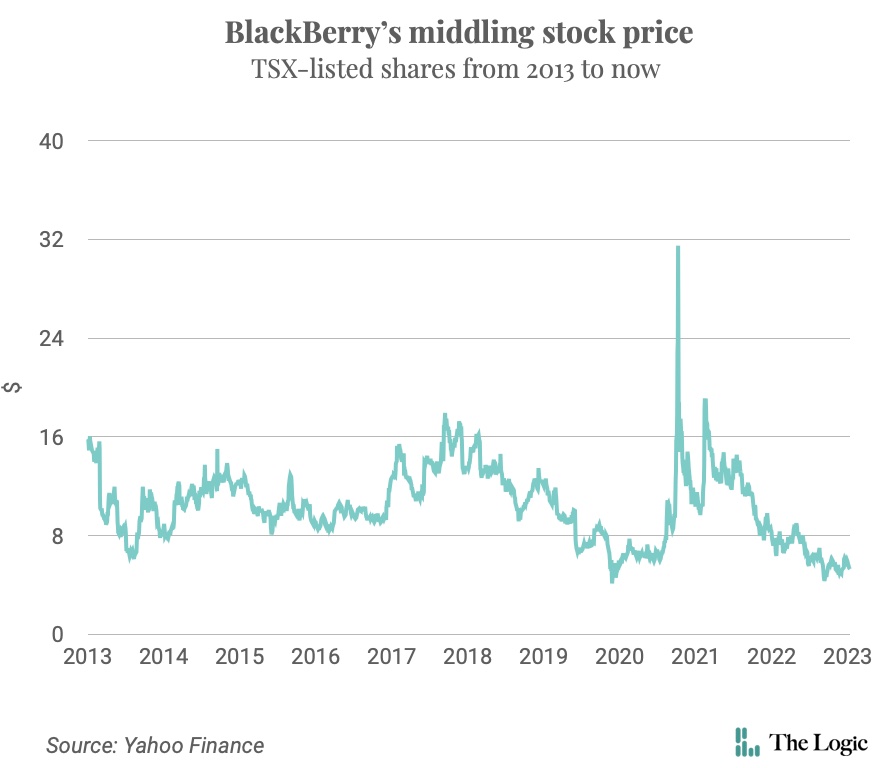
Since joining the company, Chen has been credited for engineering a turnaround of its failing smartphone business and capturing the attention of main street investors, who briefly turned BlackBerry into a “meme” stock. But a decade later, Chen’s making another turnaround effort—this time with its shares that have struggled to recreate the glory of BlackBerry’s smartphone era.
Cybersecurity is its biggest business, bringing in $88 million in revenue for the quarter ending Feb. 28. But it has lower margins than the smaller internet-of-things division, which includes its automotive operating systems, QNX and BlackBerry Ivy. And the cybersecurity business slowed amid “a challenging quarter for closing large deals in the government space,” Chen said.
Reasons to slice up the BlackBerry pie: Ning Su, an associate professor at Western University’s Ivey Business School, said peeling off divisions has become a business trend with investors rewarding companies like Alibaba and General Electric for splitting up, allowing each spinoff to focus on its core strengths.
Peridis said that while reviewing strategic options can be code for “we’re up for sale,” a breakup can also signal that expected synergies between divisions never materialized.
What’s next: Negotiations come as the depressed Canadian mergers and acquisitions market tries to rebound—and as Chen’s contract runs out in November.
BlackBerry will try to sell investors on its progress on May 17, when it hosts a virtual analyst day with a “comprehensive overview” of its long-term strategy, and in a live Q&A for retail investors on May 23.



Loading...
Thanks for sharing!
You have shared 5 articles this month and reached the maximum amount of shares available.
CloseThis account has reached its share limit.
If you would like to purchase a sharing license please contact The Logic support at [email protected].
CloseGift the full article!
You have gifted 0 article(s) this month and have 5 remaining.
Recipients will be able to read the full text of the article after submitting their email address. They will not have access to other articles or subscriber benefits.
Photo: AP Photo/Richard Drew
Most Popular This Week




In-depth, agenda-setting reporting
Great journalism delivered straight to your inbox.
News
Adam Waterous proposes massive crude exports to Asia by rail through northern B.C.
Briefing
Rivals may be ‘horrified’ to realize how exposed their investments are to AI, Aviva CIO warns
Shopify, Sequoia co-lead US$200M investment in online-selling platform Whop
Amid revenue gains, 1Password bets on tools to protect data from AI agents
Best business newsletter in Canada
Get up to speed in minutes with insights and analysis on the most important stories of the day, every weekday.
Exclusive events
See the bigger picture with reporters and industry experts in subscriber-exclusive events.
Membership in The Logic Council
Membership provides access to our popular Slack channel, participation in subscriber surveys and invitations to exclusive events with our journalists and special guests.