Crypto Quarterly is The Logic’s recurring series assessing the overall state of the crypto market, with a focus on Bitcoin, Ethereum, Flow and Cosmos’s Atom, four cryptocurrencies with strong ties to Canada.
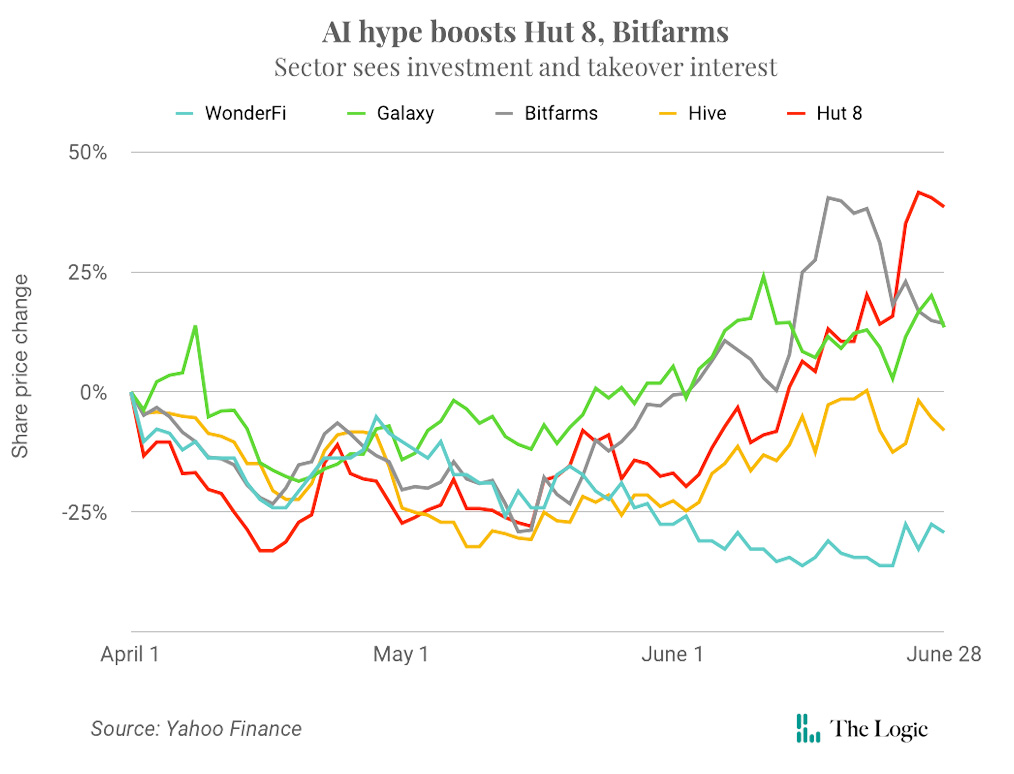
Hut 8 and Bitfarms, two Bitcoin mining companies with significant Canadian operations, posted double-digit share-price increases in the second quarter. But investors’ excitement was over their potential role in an entirely different industry: AI.
Talking Points
- Digital asset prices were down in the second quarter, but Canada-linked Bitcoin miners Hut 8 and Bitfarms soared as excitement about the sector’s potential to power the AI boom grows
- Crypto prediction market Polymarket posted a record-breaking US$111 million in volume in June and has become an alternative to traditional polling for tracking the ups and downs of the U.S. presidential race
Following a huge rally in the first quarter of 2024, Bitcoin ended the second quarter down about 15 per cent compared to the beginning of the period. Typically, that’s bad news for Bitcoin miners—but Toronto-founded Hut 8 returned almost 39 per cent over the same period, while Toronto-based Bitfarms’ stock was up about 14 per cent.
Investors in crypto mining companies are turning their attention from the price of Bitcoin to potential diversification into another hot investing trend. Ben Harper, director of derivatives at the Bitcoin mining software and services firm Luxor Technology, said that’s because Bitcoin miners are really just data centres, which can be employed for any number of uses—including producing valuable and scarce processing power, called compute, for AI.
“There is huge demand globally for any type of compute,” he said. “The owners of that infrastructure are going to benefit, even if they’re not quite in that business, at least yet.”
Hut 8 is already in the AI business as part of its revenue diversification strategy. It’s planning to expand that business with the help of a US$150-million funding deal from New York investment firm Coatue, announced in late June.
Bitfarms recently appointed a new CEO, Ben Gagnon, who said in a release he’s planning to expand into AI. The company is fending off takeover interest and an attempted board shakeup from investor Riot. Consolidation in the sector is on the rise amid AI excitement.
Meanwhile, Vancouver-based Hive Digital Technology’s stock dropped eight per cent—a return that placed it well behind its two competitors, but ahead of Bitcoin’s 15 per cent decline. Hive’s AI business line is relatively new and digital currency mining still makes up the bulk of its revenue, pulling in US$111 million in 2023 compared to US$3.4 million for AI, according to full-year financial results released in late June.
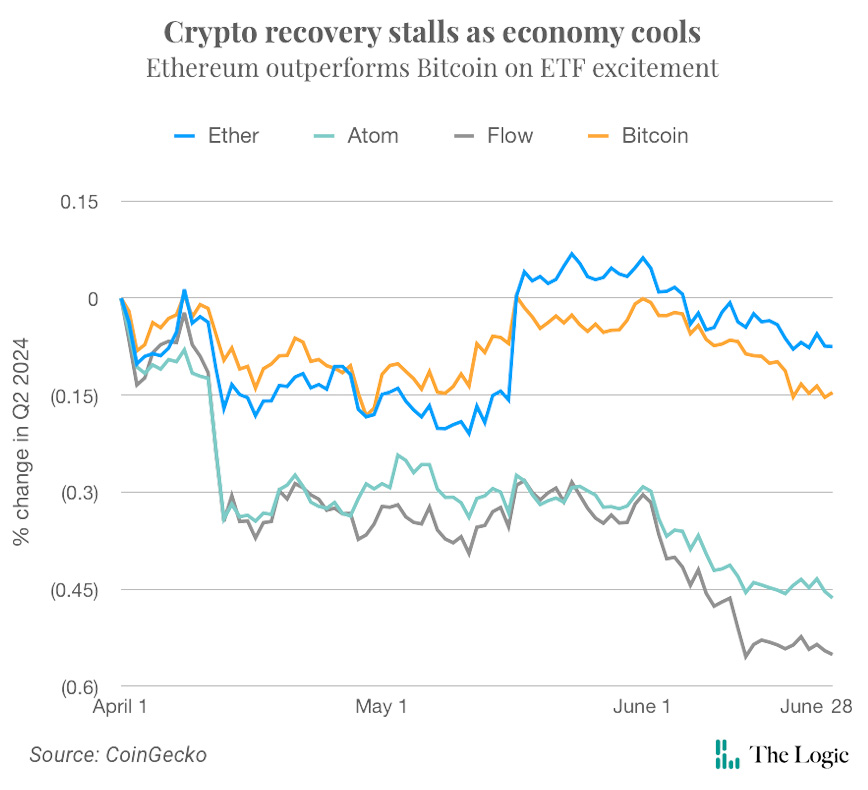
It was also a down quarter for the other digital assets tracked by Crypto Quarterly, but after a streak of Bitcoin dominance, Ether’s performance was the best of the bunch. The native cryptocurrency of the Ethereum blockchain dropped 7.5 per cent between the first and last days of the quarter, while altcoins Atom and Dapper Labs-linked Flow fell 46 and 55 per cent, respectively.
Rising interest rates and a cooling economy have dampened Bitcoin’s performance, as have creditor payments from bankrupt trading platform Mt. Gox, which collapsed in 2014. Meanwhile, the U.S. Securities and Exchange Commission’s surprise late May approval of proposals from Cboe, NYSE Arca and Nasdaq to list exchange-traded funds tracking the value of Ether gave that digital asset a boost.
Sebastien Davies, market strategist at Vancouver-based AQN Digital, a digital assets investment fund manager, said most are assuming “there’s no way an Ether ETF will be as successful” as the blockbuster performance of Bitcoin ETFs, which launched in the U.S. in January. However, he said the positive reaction to the SEC’s Ether ETF approvals suggests their launch would likely bring in new buyers and lift its price.
In order to succeed in the long term, cryptocurrencies will need to develop more than just new financial vehicles for betting on them. The second quarter of 2024 has seen one use case rise in popularity, although it’s still linked to gambling and speculation.
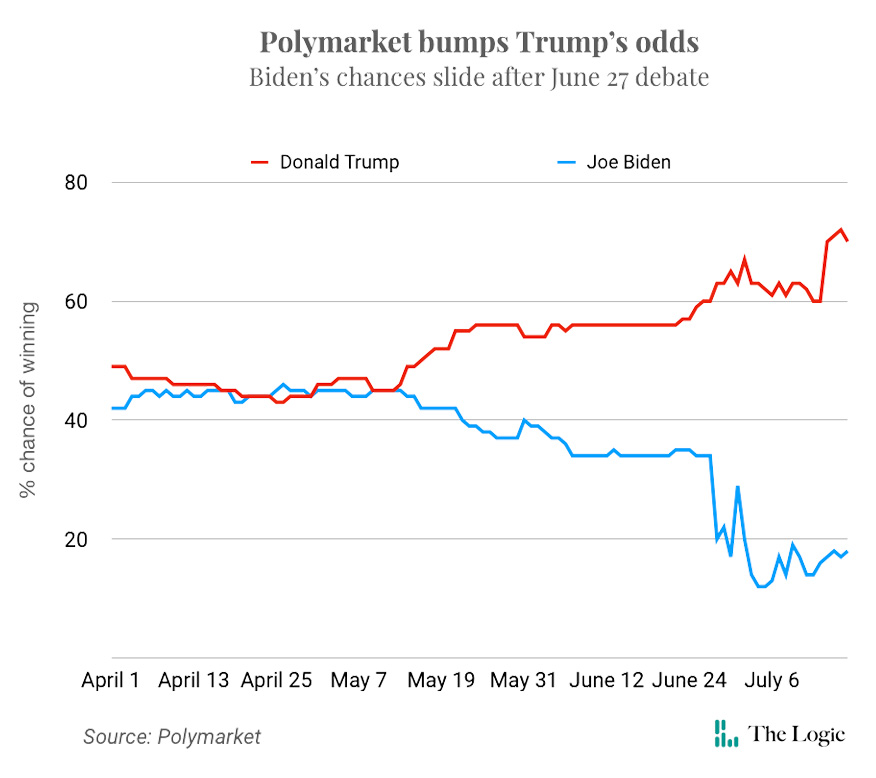
Prediction market Polymarket, which lets users place bets on the outcome of world events using crypto, posted a record-breaking US$111 million in volume in June. Polymarket’s breakout success was fuelled by speculation on the outcome of the U.S. presidential election and has become an alternative to traditional polling for tracking the race’s ups and downs.
Polymarket put Trump’s odds of winning the election in November at a then-high of 70 per cent following a failed assassination attempt at a Pennsylvania rally Saturday. Traffic on the site spiked during the June 27 presidential debate—which sparked a wave of speculation that Biden’s mental acumen was slipping and that he would drop out—prompting it to briefly crash.
Zack Pokorny, a research analyst at crypto financial services firm Galaxy Digital, wrote in a research brief that crypto boosters have long cited prediction markets as a possible use case for blockchains. “Their censor/tamper resistant, transparent and global nature makes them well suited for the task, as they allow for the unfiltered casting of opinion on any topic from anyone, anywhere,” he wrote.
Davies said Polymarket has achieved something impressive—but regulators are likely taking note of all the headlines.
“Polymarket has found product market fit, one of the most impressive instances of that in crypto. I wish it wasn’t about speculating on random events,” he said. “Clearly there’s something there. We’ll see if there’s a regulatory response.”