The biggest names in energy laid out their 2022 spending plans over the last few weeks. As one might have predicted, those plans are awash in oil and gas. But many companies, like Calgary-based pipeline giant Enbridge, also outlined goals to continue widening their renewables portfolios. Meanwhile, billions of dollars are being poured across the industry into massive carbon-capture and -storage (CCS) projects in a bid to drive down emissions. Here’s what else we learned about the oil patch’s energy transition:
Skip to content
News
What the oil patch’s spending plans reveal about the energy transition
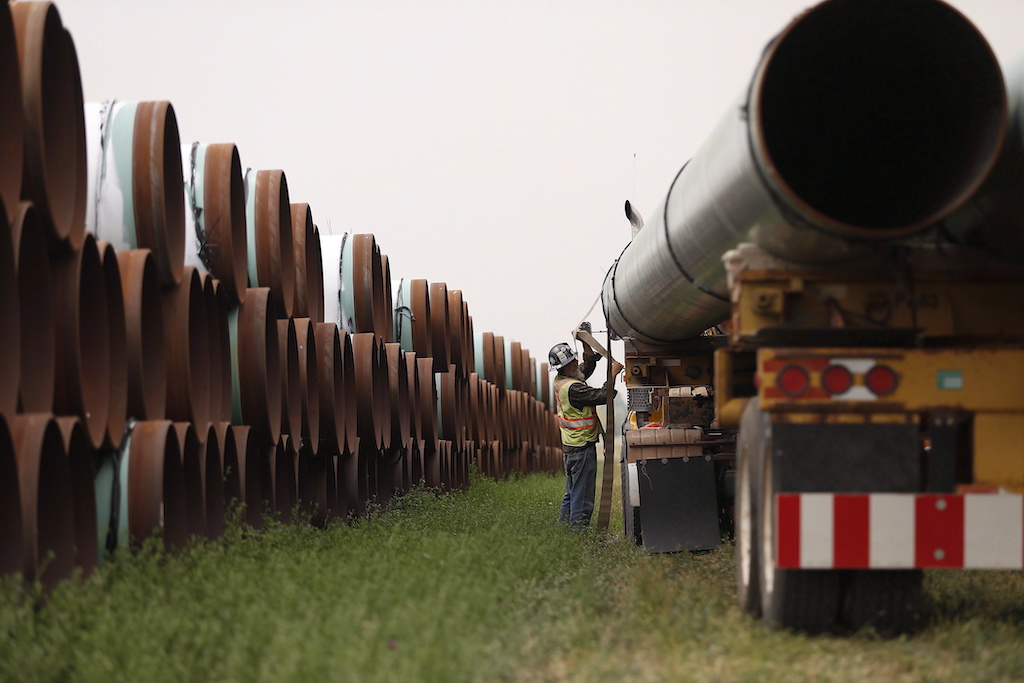
A supervisor/operator for Enbridge loads pipe at a storage facility just west of Morden, Man., in August 2018. Photo: The Canadian Press/John Woods
The biggest names in energy laid out their 2022 spending plans over the last few weeks. As one might have predicted, those plans are awash in oil and gas. But many companies, like Calgary-based pipeline giant Enbridge, also outlined goals to continue widening their renewables portfolios. Meanwhile, billions of dollars are being poured across the industry into massive carbon-capture and -storage (CCS) projects in a bid to drive down emissions. Here’s what else we learned about the oil patch’s energy transition:
- Enbridge detailed $1.1 billion in new capital projects, including $100 million toward an offshore wind farm off the southern coast of France. The company said it would spend another $200 million on six new solar-powered pumping facilities along its pipelines. (The stations have traditionally run on natural gas.) Last month, Enbridge announced a partnership with Capital Power to build a CCS project near Warburg, Alta., that could store up to three million tonnes of emissions per year.
- As Alberta’s oil patch looks to diversify its revenue base and drive down greenhouse gas emissions, TC Energy plans to reduce emissions 30 per cent by 2030, and reach net zero by 2050, largely by continuing its investment in low-carbon and renewable sources like hydro. Both pipeline companies have become major investors in renewables; Enbridge now boasts 23 wind farms and 17 solar installations in its portfolio.
- Oil producers made similar pledges. Suncor Energy is targeting 10 million tonnes’ worth of annual emissions cuts by 2030, and has said it would achieve net zero by 2050. The company has already invested heavily in CCS and electric-vehicle infrastructure. (Suncor has installed enough charging stations along the Trans-Canada Highway to support an entire cross-country trip in an EV.)
- Cenovus Energy, another oil-sands giant, is targeting a 35 per cent reduction in absolute emissions by the end of 2035. The company told investors this week that it was eyeing CCS projects alongside other potential partners in the oilsands.
All hype? Oil companies emphasized their emissions targets and tech investments, but fossil fuels are likely to dominate their bottom lines for years to come. Spending plans outlined by Enbridge, like other companies, remain largely focused on maintenance and cost-cutting on existing oil-related operations. In 2020, just four per cent of Enbridge’s earnings came from renewables; pipelines accounted for 55 per cent, and energy transmission 45 per cent. Completing its clean transition will cost billions—and take years. Yet, daunting as it may seem, the transition could bring billions in fresh opportunities, according to a recent report.



Loading...
Thanks for sharing!
You have shared 5 articles this month and reached the maximum amount of shares available.
CloseThis account has reached its share limit.
If you would like to purchase a sharing license please contact The Logic support at [email protected].
CloseGift the full article!
You have gifted 0 article(s) this month and have 5 remaining.
Recipients will be able to read the full text of the article after submitting their email address. They will not have access to other articles or subscriber benefits.
Photo: The Canadian Press/John Woods
Most Popular This Week




In-depth, agenda-setting reporting
Great journalism delivered straight to your inbox.
News
Adam Waterous proposes massive crude exports to Asia by rail through northern B.C.
Briefing
Rivals may be ‘horrified’ to realize how exposed their investments are to AI, Aviva CIO warns
Shopify, Sequoia co-lead US$200M investment in online-selling platform Whop
Amid revenue gains, 1Password bets on tools to protect data from AI agents
Best business newsletter in Canada
Get up to speed in minutes with insights and analysis on the most important stories of the day, every weekday.
Exclusive events
See the bigger picture with reporters and industry experts in subscriber-exclusive events.
Membership in The Logic Council
Membership provides access to our popular Slack channel, participation in subscriber surveys and invitations to exclusive events with our journalists and special guests.







