Skip to content

Canada's Business and Tech Newsroom

  • Professional Subscription
  • Partnerships & Advertising
  • Licensing & Syndication
Log In Subscribe
Welcome,
  • My Account
  • Log Out
  • Business
  • Tech
  • National
  • The Big Read
  • Briefings
  • Commentary
Search
Log In Subscribe
Welcome,
  • My Account
  • Log Out
News

U.S. tech groups urge Ottawa to hold off on digital-services tax plan

Katherine Tai, confirmed Wednesday as the new U.S. Trade Representative, inherits several longstanding irritants in her country’s commercial relationship with Canada. Along with disputes over softwood lumber and procurement rules, there’s a more recent issue on her desk: Ottawa’s plans to tax tech giants.  

Two major industry organizations representing large U.S. tech companies have urged Washington’s trade office to intervene against Canada’s digital-services tax (DST), first promised in the Liberals’ 2019 election platform then proposed in the November 2020 fall economic statement. Meanwhile in Ottawa, Big Tech firms likely to be affected have been lobbying senior government officials on tax issues.

News

U.S. tech groups urge Ottawa to hold off on digital-services tax plan

By Murad Hemmadi
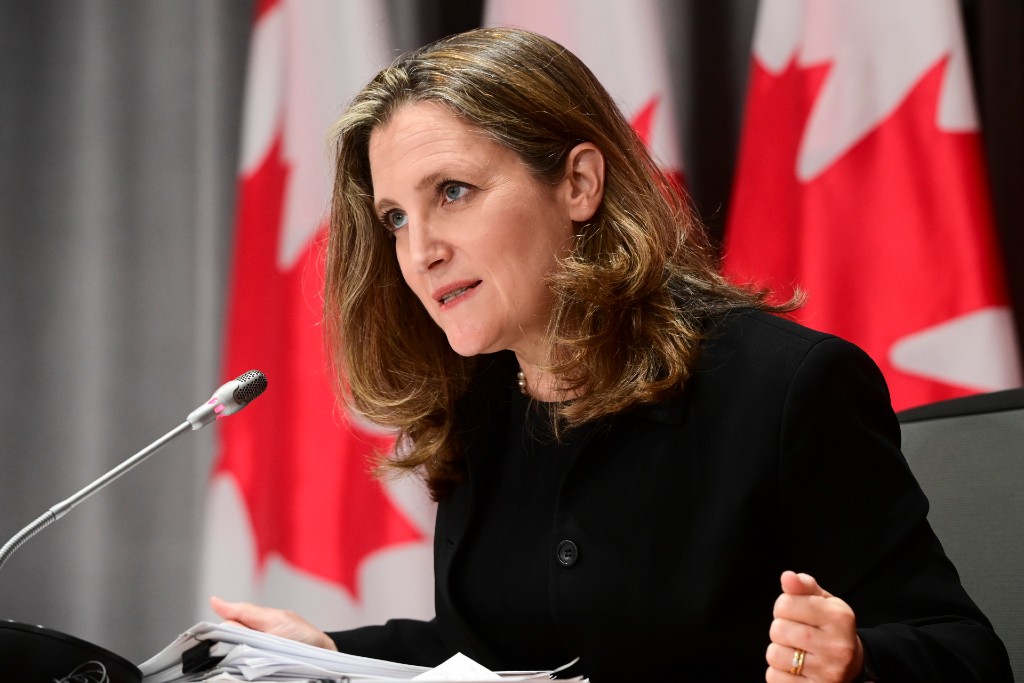
Minister of Finance Chrystia Freeland holds a press conference on Parliament Hill in Ottawa in September 2020. Photo: The Canadian Press/Sean Kilpatrick
Mar 18, 2021
A A
A Small A Medium A Large
Share

Gift

Share

Katherine Tai, confirmed Wednesday as the new U.S. Trade Representative, inherits several longstanding irritants in her country’s commercial relationship with Canada. Along with disputes over softwood lumber and procurement rules, there’s a more recent issue on her desk: Ottawa’s plans to tax tech giants.  

Two major industry organizations representing large U.S. tech companies have urged Washington’s trade office to intervene against Canada’s digital-services tax (DST), first promised in the Liberals’ 2019 election platform then proposed in the November 2020 fall economic statement. Meanwhile in Ottawa, Big Tech firms likely to be affected have been lobbying senior government officials on tax issues.

Talking Point

U.S. tech groups oppose Ottawa’s plan for a new digital tax, calling for Canada to instead focus on OECD-led negotiations on changes to the international tax system. Large foreign tech companies have also been lobbying federal officials on tax issues since Finance Minister Chrystia Freeland proposed the measure in the November 2020 fall economic statement.

The OECD and G20 are currently leading negotiations involving more than 135 countries to change the way multinational corporations are taxed. The new system would allow countries to levy taxes on firms that earn revenues within their borders, even if they don’t have a physical presence there, and ensure businesses pay a minimum amount on their earnings globally. The fall economic statement positioned Ottawa’s measure—a “tax on corporations providing digital services” starting in January 2022—as a fallback in case the negotiating countries fail to reach a consensus this year. 

Canada is not alone. France and the U.K. began collecting their DSTs last year, while the USTR has investigated digital-sales taxes “adopted or under consideration” by eight countries as well as the European Union. 

While tech industry groups and some companies have backed the OECD-led process in principle, they have opposed individual governments’ domestic levvies. 

Ottawa’s proposed tax is “a discriminatory trade barrier,” said Jordan Haas, director of trade policy at the Internet Association (IA). The Washington, D.C.-headquartered industry lobby represents 43 tech firms including Airbnb, Groupon, Match Group and Uber. 

According to the IA, country-specific measures unfairly target tech firms, are based on revenue rather than profit, and can lead to businesses being taxed more than once if they already have a physical presence in a country. “We strongly encourage the Canadian government and all governments who are proposing these unilateral taxes to … work within the OECD to find [an] international outcome,” Haas told The Logic. There’s “frustration attached” to Ottawa’s move, given Canada and the U.S. recently agreed to protections for companies conducting online commerce across North American borders in the USMCA’s new digital-trade chapter.  

Trade lawyers have said Ottawa could enact a DST-like policy without contravening the agreement. 

Canada’s measure and others like it “contravene longstanding international tax principles” and often “present trade barriers,” said Megan Funkhouser, director of policy for tax and trade at the Information Technology Industry Council (ITI). The OECD process is “the best forum [to] address these tax challenges associated with the digitalization of the economy.” The Washington, D.C.-based organization’s 77 members include Apple, Salesforce and Verizon. (Amazon, Facebook, Google and Twitter are members of both groups.)

In separate October 2020 submissions to the USTR’s annual survey on barriers to U.S. exports, the IA and ITI called for it to push Canada not to implement a DST. 

Large foreign tech firms have also been lobbying the Canadian government directly. In November 2019—the month after the Liberals won the federal election—Facebook, Google and Twitter each updated their lobbyist registrations to indicate they planned to communicate with the government on digital or tech taxes. 

Since the fall economic statement, representatives of Amazon and Google—companies that may also be affected by changes to sales tax for digital products and services—have each twice contacted Tyler Meredith, Finance Minister Chrystia Freeland’s director of economic strategy, and twice dealt with senior officials in the department’s tax-policy branch. 

Amazon will “work with” Ottawa on implementing a new DST “in a manner that aligns with similar taxes Amazon already collects in other jurisdictions,” said Amazon spokesperson Kristin Gable. “We strongly encourage the movement toward a new comprehensive international framework through the OECD for how multinational companies are taxed,” said Google spokesperson Lauren Skelly, adding that the company is “in active conversations” on the issue with the Canadian government. 

Facebook also backed the OECD process. “Unilateral approaches to tax, like the DST, have potential to create significant uncertainty for both foreign and domestically based multinational companies,” said spokesperson Meg Sinclair, citing the OECD’s October 2020 estimate that trade disputes prompted by such measures could reduce global GDP by more than one per cent annually.

Gift the full article

The Liberals’ 2019 election proposal, modelled on the French levy, would have charged three per cent on revenue from selling online advertising and user data on firms with $1 billion or more annually in global sales. Freeland’s office declined to specify how the version of the tax proposed in the more recent fall economic statement will be structured. Since “global digital giants operate at the international level, a multinational approach will ensure these corporations pay taxes wherever they do business,” said Freeland spokesperson Katherine Cuplinskas, noting that the tax will be implemented “until an acceptable common approach is agreed upon and comes into effect.”  

At a January meeting on the OECD framework, Freeland called for participating countries to reach a deal by July. While the administration of former U.S. president Donald Trump sought to slow those negotiations and threatened retaliatory tariffs against countries that imposed DSTs, new Treasury Secretary Janet Yellen indicated starting with her confirmation hearings that the Biden administration is committed to the international effort. 

G20 finance ministers and central-bank governors will likely discuss the international effort at a scheduled July meeting.

#Amazon #digital-services tax #Facebook #federal government #Google #Information Technology Industry Council #Internet Association

Loading...

Thanks for sharing!

You have shared 5 articles this month and reached the maximum amount of shares available.

Close
This account has reached its share limit.

If you would like to purchase a sharing license please contact The Logic support at [email protected].

Close
Want to share this article?

Upgrade to all-access now

Close
Gift the full article!

You have gifted 0 article(s) this month and have 5 remaining.

Copy link and gift
Copy Link
Email to a friend
Send Email
Gift on Social Media

Recipients will be able to read the full text of the article after submitting their email address. They will not have access to other articles or subscriber benefits.

Photo: The Canadian Press/Sean Kilpatrick

Most Popular This Week

A diptych showing Mark Carney on the left, and CIBC CEO Harry Culham on the right.
News

Diversifying trade requires banks to take bigger risks, official advised Carney before CIBC meeting

By Joanna Smith
The image shows the inside of Toronto Stadium on a sunny day. The rows of seats are empty; an empty green field is visible.
News

Toronto and Vancouver aren’t getting a World Cup bookings boom

By Chaimae Chouiekh
A yellow ambulance is pictured outside of a hospital in Montreal. A red sign in the foreground reads, “Urgence / Emergency.”
Commentary: Quebec Ink

Quebec just found out what not having digital sovereignty really means

By Martin Patriquin
An image of Mark Carney standing in front of a red podium with the words "AI for All / L'IA pour tous." He is wearing a suit and tie. In the background, people wearing scrubs and white coats are visible.
Special Report

Canada’s new AI strategy sets lofty goals for adoption and growth

By Murad Hemmadi and Laura Osman

In-depth, agenda-setting reporting

Great journalism delivered straight to your inbox.

News

Canadian mother sues OpenAI claiming ChatGPT encouraged her daughter’s suicide

By Martin Patriquin

Briefing

Canada to publish list of imports at risk of being made with forced labour

By Joanna Smith   |   Jun 12, 2026 | 4:05 PM ET

TMX Group acquires RAFI Indices for $683M

By Anita Balakrishnan   |   Jun 12, 2026 | 3:29 PM ET

Ikea invests in Toronto food startup NS/TX Industries’ US$10.5M fundraise

By Catherine McIntyre   |   Jun 12, 2026 | 3:26 PM ET

Best business newsletter in Canada

Get up to speed in minutes with insights and analysis on the most important stories of the day, every weekday.

Exclusive events

See the bigger picture with reporters and industry experts in subscriber-exclusive events.

Membership in The Logic Council

Membership provides access to our popular Slack channel, participation in subscriber surveys and invitations to exclusive events with our journalists and special guests.

Recent Popular Stories

Commentary: Quebec Ink

Quebec just found out what not having digital sovereignty really means

By Martin Patriquin   |   Jun 8, 2026
A yellow ambulance is pictured outside of a hospital in Montreal. A red sign in the foreground reads, “Urgence / Emergency.”
News

OMERS investment chief departs for Singapore’s Temasek

By Chaimae Chouiekh   |   Jun 10, 2026
The Big Read

We found every data centre in Canada

By Murad Hemmadi, David Reevely, Aleksandra Sagan, Chaimae Chouiekh, Martin Patriquin and Catherine McIntyre   |   Apr 8, 2026
Four vertical slices of aerial view photos. From left, a building in downtown Toronto housing several data centres, a picture of the Albertan wilderness where the proposed Wonder Valley data centre would go, a lit-up QScale data centre in Quebec, and a data centre at a Hydro-Quebec dam.
News

Diversifying trade requires banks to take bigger risks, official advised Carney before CIBC meeting

By Joanna Smith   |   Jun 9, 2026
A diptych showing Mark Carney on the left, and CIBC CEO Harry Culham on the right.
News

Canada’s surprise plan to buy Saab command jets leaves competitors seeking answers

By David Reevely   |   May 29, 2026
A closeup of a scale model of a jet covered in pixellated camouflage, with sensor equipment attached to the top of its fuselage. There are civilians and uniformed military personnel milling in the background.
The Big Read

ApplyBoard faces a reckoning as Canada’s immigration boom turns into a bust

By Claire Brownell and David Reevely   |   May 27, 2026

Canada's most influential executives and policymakers are reading The Logic

  • CPP Investments
  • Sun Life Financial
  • C100
  • Amazon
  • Telus
  • Mastercard
  • bdc
  • Shopify
  • Rogers
  • RBC
  • General Motors
  • MaRS
  • Government of Canada
  • Uber
  • Loblaw Companies Limited
logic-logo

Canada's Business and Tech Newsroom

100% human-crafted journalism

Newsroom

  • News Tips
  • AI Policy
  • Editorial Disclosures
  • Story Pitches

Company

  • About Us
  • Terms of Service
  • Privacy Statement
  • Corporate Information

Contact

  • Contact Us
  • Advertise
  • FAQs
  • Work at The Logic

© 2026 The Logic Inc. All Rights Reserved.

Trusted by leaders

Error

Account creation failed.

Please email us at [email protected].

Create Account

[wppb-register form_name=”cozmo-registration-form-for-modal”]

I do have an account
Login
or

[wppb-login]

I don’t have an account