For more than a decade, The Metals Company has sought to turn the ocean’s depths into the next big critical minerals mining hub. Last week, the Vancouver firm came one step closer to achieving that goal.
Skip to content

News
Trump’s trade war with China has triggered a deepsea mining gold rush
Vancouver mining firm The Metals Company hopes to tap into a trove of critical minerals that could be worth hundreds of billions
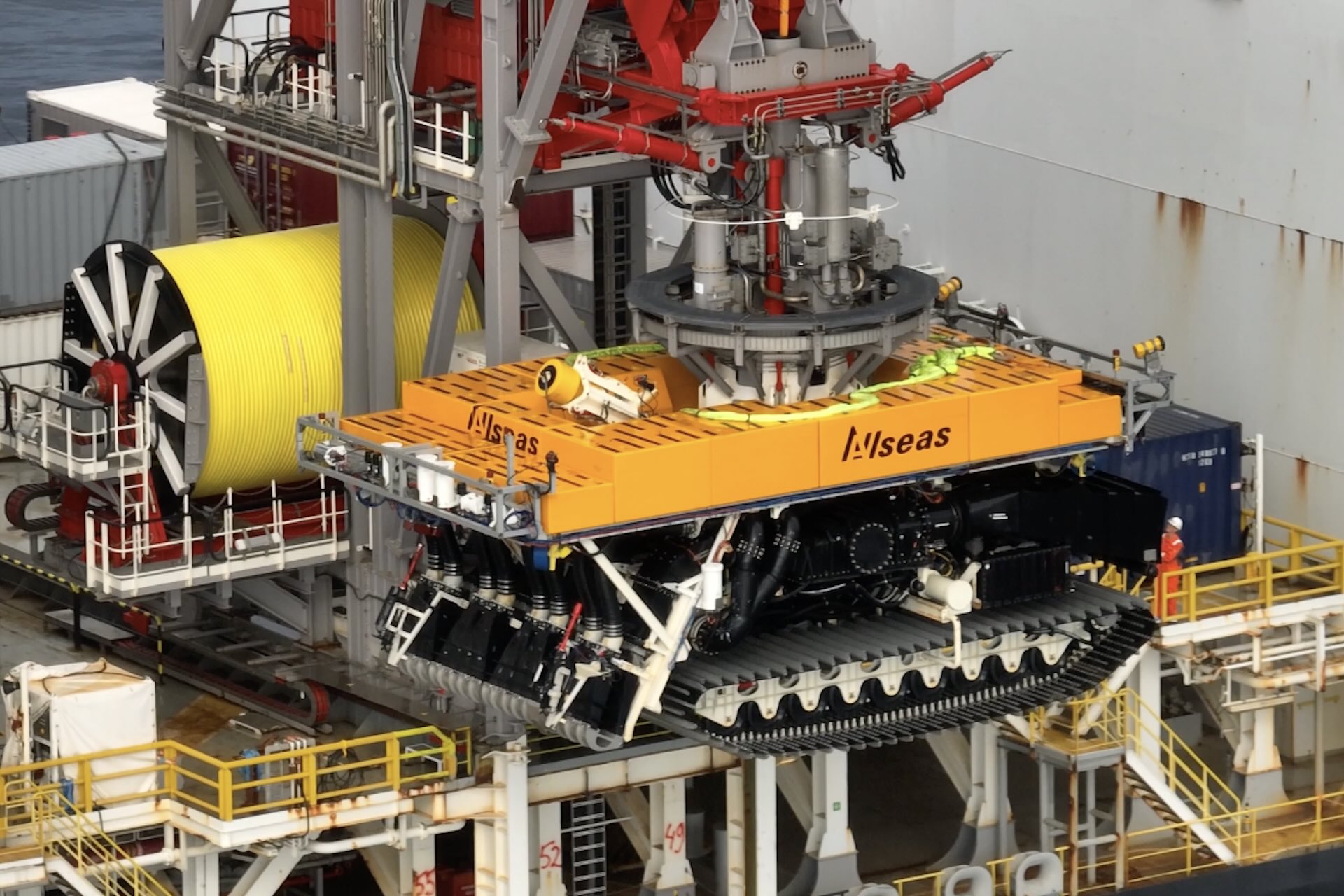
The Metals Company’s submersible robot being lowered to the water; the machine gathers mineral-rich “nodules” from the ocean floor, which are then pumped to a ship on the surface. Photo: Screen grab from Vimeo/The Metals Company
For more than a decade, The Metals Company has sought to turn the ocean’s depths into the next big critical minerals mining hub. Last week, the Vancouver firm came one step closer to achieving that goal.
Using submersible robots, The Metals Company thinks it can collect potato-sized clumps of nickel, cobalt, manganese and copper from the sea floor. If successful, the small deepsea exploration startup could be among the first to tap into a reservoir estimated to hold a colossal 20 billion tonnes worth of critical minerals.
Talking Points
- Nasdaq-listed Vancouver startup The Metals Company officially applied for deepsea mining rights last week after U.S. President Donald Trump moved to speed up seabed mineral prospecting
- CEO Gerard Barron has framed deepsea mining as a way to combat Beijing’s control over strategic minerals
On Tuesday, The Metals Company officially applied for deepsea mining rights with U.S. authorities, a move that came days after U.S. President Donald Trump issued a directive aiming to hasten mining and exploration activity on some seabeds.
The executive order is part of the Trump administration’s wider efforts to combat China’s dominance of the critical minerals market, particularly those needed to make strategic products like batteries, smartphones and computer chips.
Related Articles

Tapping into metals-rich seabeds could also help jolt the company’s stock, which has yet to return to its debut price ever since it went public on the Nasdaq via special purpose acquisition vehicle (SPAC) in 2021. The SPAC deal, led by Dallas-based Sustainable Opportunities Acquisition Corporation, had originally valued The Metals Company at US$2 billion, but today its market cap sits at US$1.1 billion as broader environmental concerns and regulatory delays have kept the deepsea mining sector from entering the commercial stage.
The Metals Company’s shares remained mostly unchanged in the days following its application, hovering around the US$3.10 mark. Its shares initially debuted around US$10.
Trump’s order seeks to hasten mining development in parts of the Clarion-Clipperton Zone, a 5,000-square-kilometre region in the Pacific containing vast mineral deposits in the form of metallic rocks, or nodules. Producing just one tonne of the estimated 20 billion in the region could yield US$300 billion in GDP contributions, according to The Metals Company’s estimates.
However, the directive also runs afoul of a United Nations legal framework that seeks to govern matters like maritime rights and ocean resource extraction. Under that framework, all mineral development requires permission from the International Seabed Authority. (The United States is not a signatory to the treaty—called the United Nations Convention on the Law of the Sea, or UNCLOS—and has resisted joining since the 1980s on economic and national security grounds.)
In response to Trump’s order, The Metals Company submitted an application with the National Oceanic and Atmospheric Administration, a separate Washington-based deepsea regulator, for a mining permit and two exploration permits in the Clarion-Clipperton.
The company did not respond to The Logic’s request for an interview.
In testimony before the U.S. House Committee on Natural Resources earlier this week, The Metals Company CEO Gerard Barron framed deepsea mining in the region as a way to combat Beijing’s control over strategic minerals.
Such efforts could “transform [America’s] dangerous mineral dependence on foreign adversaries” in a matter of years, he said, while boosting domestic industry.
“Imagine revitalized shipyards building and repairing a fleet of U.S. flagged production, survey, supply and transport vessels,” Barron said. “Imagine a new generation of American mariners, offshore production engineers and operators as well as deepsea scientists.”
Using technology built by Swiss-based Allseas, The Metals Company aims to eventually use autonomous robots mounted on tracks resembling those of World War II tanks. The robotic technology, which completed pilot tests in 2022, can operate several kilometres below surface and collect thousands of tons of nodules rich in cobalt, nickel and other minerals.
In response to Trump’s order, the International Seabed Authority said Trump’s executive order applies to territories that fall under the purview of UNCLOS. It said that The Metals Company’s recent permit application “is for mining in the deep sea outside of the jurisdiction of the United States.”
“Its issuance is also surprising because for over 30 years the US has been a reliable observer and significant contributor to the negotiations of the International Seabed Authority, actively providing technical expertise to each stage of the development of the ISA regulatory framework,” the group’s statement said.
If the U.S. forges ahead with deepsea mining, it would mark the revival of an effort that started in the 1960s. Private companies explored deep waters for minerals and tested seabed mining methods throughout the 70s and 80s, while the U.S. National Oceanic and Atmospheric Administration began developing environmental and technical guidance on deepsea mining around that time.
Yet, the industry has failed to take off due to environmental concerns and a lack of clarity around resource extraction rights in international waters. Ecological groups, including the International Union for Conservation of Nature, have raised concerns about resource depletion and habitat destruction that deepsea mining could cause.
The International Seabed Authority, for its part, has issued 22 permits to explore for metals-rich nodules on the ocean floor, including to a subsidiary of The Metals Company. The agency has not yet issued a commercial mining license to extract resources on the ocean floor.



Loading...
Thanks for sharing!
You have shared 5 articles this month and reached the maximum amount of shares available.
CloseThis account has reached its share limit.
If you would like to purchase a sharing license please contact The Logic support at [email protected].
CloseGift the full article!
You have gifted 0 article(s) this month and have 5 remaining.
Recipients will be able to read the full text of the article after submitting their email address. They will not have access to other articles or subscriber benefits.
Photo: Screen grab from Vimeo/The Metals Company
Most Popular This Week



In-depth, agenda-setting reporting
Great journalism delivered straight to your inbox.
News
A tech firm born from post-Brexit trade chaos sets its sights on Canada
Briefing
Dozens of Canadian researchers join chorus of scientists calling for a global AI oversight
TC Energy strikes deal with Indigenous groups for ownership stake in Coastal GasLink pipeline
Canada’s Tailscale taps Google Moonshot alum to lead sovereign AI push
Best business newsletter in Canada
Get up to speed in minutes with insights and analysis on the most important stories of the day, every weekday.
Exclusive events
See the bigger picture with reporters and industry experts in subscriber-exclusive events.
Membership in The Logic Council
Membership provides access to our popular Slack channel, participation in subscriber surveys and invitations to exclusive events with our journalists and special guests.