KANANASKIS, ALTA.— U.S. President Donald Trump was mid-flight when he suggested the conflict between Iran and Israel was not the only reason he left the Group of Seven summit one day early, thwarting leaders seeking face time with the self-appointed dealmaker and disrupting the carefully laid plans of his Canadian host.
Skip to content


News
Trump-less G7 summit produces consensus on AI, quantum and critical minerals
The U.S. endorses narrow resolutions on key issues
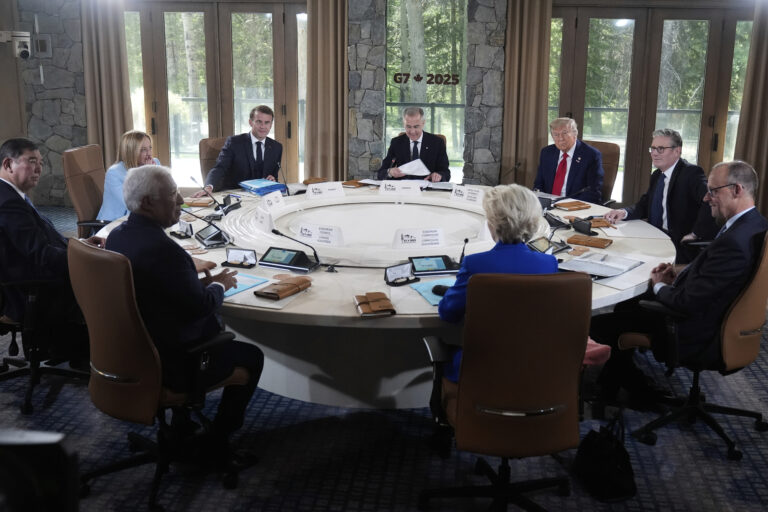
Prime Minister Mark Carney, centre, carried on leading the G7 summit after U.S. President Donald Trump, second from right, departed on Monday night. Photo: The Canadian Press/Adrian Wyld
KANANASKIS, ALTA.— U.S. President Donald Trump was mid-flight when he suggested the conflict between Iran and Israel was not the only reason he left the Group of Seven summit one day early, thwarting leaders seeking face time with the self-appointed dealmaker and disrupting the carefully laid plans of his Canadian host.
“We did everything I had to do at the G7,” Trump told reporters Monday aboard Air Force One. He’d been asked what he needed to do in Washington, D.C., that could not be handled remotely from Kananaskis, Alta., where leaders were set to discuss Ukraine and energy security on Tuesday.
Talking Points
- G7 leaders reached consensus on critical minerals, artificial intelligence, quantum computing and other areas in joint statements endorsed by U.S. despite the early departure by President Donald Trump
- There was no joint G7 statement on Ukraine, but Prime Minister Mark Carney announced more support for President Volodymyr Zelenskyy’s defence against Russia
Prime Minister Mark Carney, who held a lengthy one-on-one meeting with Trump that had his team feeling positive about the direction of Canada-U.S. trade talks, had to do without the president. The show went on, albeit without its quintessential showman.
John Kirton, founder of the University of Toronto’s G7 Research Group, said Trump’s early exit might have actually improved discussions among the remaining leaders, as it removed potential distractions on the second day of the summit.
“On the whole, I think it’s a good thing,” he said in an interview.
In response to reporters’ questions on Tuesday, Carney framed Trump’s decision to leave as a necessary one given the rapid escalation of the Israel-Iran conflict.
“It’s difficult to manage a military crisis,” he said. “It’s rather exceptional of course, we’re here in Kananaskis, in Alberta. Mr. Trump felt it was better to be in Washington, and I can understand that.”
Leaders indeed reached consensus on issues ranging from critical minerals to migrant smuggling to quantum computing. Among them:
- Artificial intelligence: The leaders’ statement on AI focused heavily on promoting adoption of the technology, promising programs to make it easier for governments and small businesses to use it. Past summits focused more on setting common global guidelines for AI.
- Critical minerals: Member countries agreed to create a standardized market for critical minerals as a way to track things like labour costs and environmental damages that aren’t typically accounted for in the free market. The measure, among other proposals, is part of Western nations’ efforts to combat China’s control of the market for strategic minerals needed to make products like EV batteries and smartphones.
- Quantum: The countries will try to advance another set of disruptive technologies, promising to boost public and private investment in quantum R&D and commercialization. A new working group with academics and business leaders will steer cooperation in the field.
Related Articles


The U.S. had endorsed each of those statements, as many of the details were negotiated before the summit, and U.S. Treasury Secretary Scott Bessent stayed at the summit after Trump left. Carney had asked leaders to craft a series of short joint statements on specific negotiated outcomes, rather than aiming for a lengthy, catch-all communiqué that could have been derailed by disagreement over thorny issues, such as what to do about Russia’s war with Ukraine.
‘Unwavering’ support
Ukrainian President Volodymyr Zelenskyy was an early addition to the summit’s expanded guest list. Trump, who infamously chided Zelenskyy in the Oval Office yet resolutely avoids criticism of Russian President Vladimir Putin, was long gone by the time Zelenskyy arrived Tuesday morning.
The summit concluded without a joint G7 statement on Ukraine, although the conflict was mentioned prominently in the summary that Carney released as chair of the group. It says G7 nations are “resolute in exploring all options” in search of a peace deal between Ukraine and Russia. The summary also states that Russia must accept a ceasefire, as Ukraine has.
Heading into his own meeting with Zelenskyy on Tuesday, Carney said Canada and other allies would apply “maximum pressure” to Russia in support of Ukraine.
Canada will provide $2 billion in direct military support, Carney said, while sanctioning about 40 Russian entities and 200 vessels in Russia’s “shadow fleet” used to conduct undercover military or trade operations. Canada will also lend Ukraine $2.3 billion—funded by interest charged on frozen Russian assets—to help it rebuild. This spending is part of Carney’s promise to meet its two-per-cent NATO target, with Ottawa’s defence budget expected to surpass $9 billion in the current fiscal year.
“To be absolutely clear, this support will be unwavering until we get a just peace for Ukraine and the Ukrainian people,” Carney said.
Other relationships
The Canada-U.S. relationship was not the only one Carney hoped to nurture this week. India’s Prime Minister Narendra Modi, whose government Canada has accused of orchestrating the 2023 killing of a Canadian Sikh activist in British Columbia, was among the non-G7 leaders invited to the gathering. He and Carney met Tuesday, and a readout from the Prime Minister’s Office said they discussed deepening engagement in areas such as the “digital transition” and critical minerals, and would work towards restoring diplomatic services in each other’s countries.
Mexico’s President Claudia Sheinbaum, who had been hoping to meet Trump at the summit, was also scheduled to meet Carney on Tuesday. Mexico and Canada, whose relations were strained last fall, are bracing for the coming review of the North American free-trade pact.
Weighing in from afar
Trump did not let distance stop him from musing further on Canada-U.S. relations and talks to forge a new economic and security relationship, in which Ottawa is pushing the U.S. to lift all tariffs on Canadian goods.
In Kananaskis on Monday morning, Trump had described himself as “a tariff person,” adding that Carney “has a more complex idea, but also very good.” When asked aboard Air Force One what he meant by that, Trump said: “Well, they get too complex on the deals and they never get done.”
“Complexity is in the eye of the beholder sometimes,” Carney said Tuesday.
The prime minister declined to clarify whether Canada would retaliate should it fail to secure a new trade and security deal with the U.S. inside a proposed 30-day window, but suggested the timeline could help the countries reach an agreement.“Quite often in negotiations, having a form of deadline is helpful to concentrate the mind,” he said Tuesday.
On Monday, Trump had also repeated his argument that Canada would be better off if it joined the U.S. “I think it’s a much better deal for Canada, but you know, it’s up to them,” he said on the plane. Otherwise, Trump said, Canada will have to pay tariffs, and some US$71 billion to participate in his proposed “Golden Dome” defence system—US$10 billion more than his previously stated price.
Carney said Canada’s potential participation in the system remains part of “live, ongoing discussions,” and that ballistic missile defences are needed more and more to defend against Russia and other potential aggressors.
With files from Murad Hemmadi in Toronto
Editor’s note: This story has been updated to remove incorrect information provided by the Prime Minister’s Office.
On Tuesday afternoon, a PMO spokesperson told a group of reporters that there was no joint G7 statement on Ukraine because the U.S. had tried to weaken the language in a proposed draft.
On Tuesday evening, Emily Williams, another PMO spokesperson, retracted the earlier comments and said no proposed joint statement on Ukraine had ever been circulated among the G7 delegations. Williams said Canada had always intended the summary Carney released as G7 chair to include a section on Ukraine. However, she said, no joint statement had been proposed because, “given the U.S.’s unique position as a country in the midst of direct work to broker peace, it was clear that it would not have been feasible to find language that all G7 partners could agree to in that context.”



Loading...
Thanks for sharing!
You have shared 5 articles this month and reached the maximum amount of shares available.
CloseThis account has reached its share limit.
If you would like to purchase a sharing license please contact The Logic support at [email protected].
CloseGift the full article!
You have gifted 0 article(s) this month and have 5 remaining.
Recipients will be able to read the full text of the article after submitting their email address. They will not have access to other articles or subscriber benefits.
Photo: The Canadian Press/Adrian Wyld
Most Popular This Week




In-depth, agenda-setting reporting
Great journalism delivered straight to your inbox.
News
Panel decries Canada’s chaotic way of funding world-class science
Briefing
AI is pushing insurers to become asset managers, Canadian CEOs say
Trump administration faces lawsuit over 50% tariffs on Canadian goods
Canada-U.S. trade war to reduce real GDP by 1.4% over 2024 levels after five years: PBO
Best business newsletter in Canada
Get up to speed in minutes with insights and analysis on the most important stories of the day, every weekday.
Exclusive events
See the bigger picture with reporters and industry experts in subscriber-exclusive events.
Membership in The Logic Council
Membership provides access to our popular Slack channel, participation in subscriber surveys and invitations to exclusive events with our journalists and special guests.





