OTTAWA — A sizable chunk of former prime minister Justin Trudeau’s innovation agenda could soon come to an end, with more than a dozen government programs set to expire over the next two years just as the new Liberal government under Mark Carney prepares to slash the federal budget.
Skip to content


News
More than a dozen Trudeau-era innovation programs have an uncertain future under Mark Carney
Programs aimed at intellectual property, and diversity, are due to sunset soon
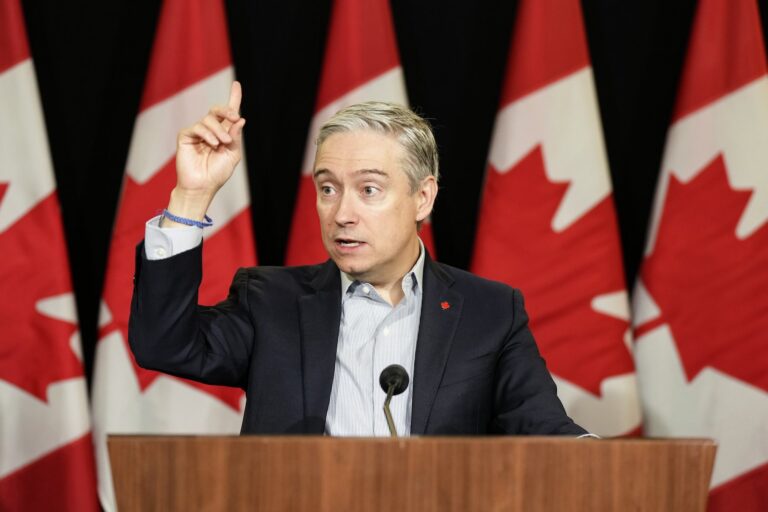
Mélanie Joly, the minister responsible for Innovation, Science and Economic Development Canada, at a news conference in Ottawa in October, 2023. Joly was foreign affairs minister at the time. Photo: The Canadian Press/Adrian Wyld
OTTAWA — A sizable chunk of former prime minister Justin Trudeau’s innovation agenda could soon come to an end, with more than a dozen government programs set to expire over the next two years just as the new Liberal government under Mark Carney prepares to slash the federal budget.
The Logic used an access-to-information request to obtain a list of 22 innovation programs set to run out of funds. Some of the programs on that list, which was prepared by Innovation, Science and Economic Development Canada (ISED) in December, have already been earmarked for new funding, according to a planning document that the department published in May.
The plan shows that 15 are in limbo, awaiting decisions that likely won’t be made public until the government tables a budget sometime in the fall. ISED is in the process of reviewing the programs, department spokesperson Riyadh Nazerally said in an email.
Talking Points
- More than a dozen Trudeau-era innovation programs are due to run out of funding soon, leaving the renewal of those programs uncertain in the face of big government budget cuts
- The programs include skills training for diverse youth, women’s entrepreneurship supports, and efforts to develop and protect Canadian IP
The programs that could end include a pair of efforts to develop and retain Canadian IP, both of which are due to expire at the end of the fiscal year in March. The list also includes digital skills classes for underrepresented youth, a fund to expand women’s participation in venture capital, affordable internet for low-income families and seniors, and more.
Altogether, the sunsetting programs represent about $4 billion in funding over several years, though $3.2 billion of that total goes toward a single program, the Universal Broadband Fund, which is used to build high-speed internet infrastructure in rural communities.
As ISED mulls whether to renew the funding, it must also gradually shave 15 per cent off its budget over the next three years as part of a government-wide spending review.
Related Articles


Big government cuts hurt the prospects of some of those programs making it into the budget, said Tom Goldsmith, the founder of Orbit Policy, a consultancy firm focused on innovation. “I think that’s a big risk,” he said, especially as the government has signalled it will deprioritize Trudeau-era hallmarks like diversity and inclusivity in favour of an economy-driven mandate.
The summer has seen a flurry of meetings between senior department officials and program proponents as they make the case for continued funding.
“Our concern is just making sure that this does not get lost in the shuffle,” said Actua CEO Jennifer Flanagan, whose non-profit receives funding to deliver ISED’s CanCode program. The program funds coding and AI skills training for youth and teachers from diverse backgrounds.
The focus on equity, inclusion and diversity are still an important part of the program, Flanagan said, but her pitch to the new iteration of the Liberal government is focused on the economic benefits as she competes for limited dollars.
“It is a feel-good program, but it is also critical to our economy,” she said. In her meetings with the government, she emphasized the importance of training future talent to drive Canada’s digital industries. “I’m not sure how anyone can justify not investing in AI skills at this point in our global evolution.” She doesn’t just want to see the program funding reinstated, she’s advocated for it to be increased from $39.2 million over two years to $100 million over three years.
Other programs vying for funding renewals include efforts to promote diversity in the public sector workforce through retraining, help diverse entrepreneurs sustain their small businesses, and give new grads initial work experience.
Goldsmith said some are due for reform, but that the department should be wary about arbitrarily axing them. “One of the problems of our innovation system is cutting and starting and cutting and starting lots of initiatives,” he said. The instability can prevent organizations from innovating and improving their offerings, he said.
Council of Canadian Innovators president Benjamin Bergen said it makes sense for the government to be strategic about where it spends tax dollars, and believes the Liberals should prioritize programs that drive wealth. “All of the wealth and opportunity is no longer in labour, it’s actually in the ownership of IP and data,” he said.
The government set up a $30 million pilot program in 2018 called the Patent Collective to help cleantech companies create and protect intellectual property. In 2022 it also launched the $90-million ElevateIP program to help start ups strategically manage their IP. Both are due to sunset in March 2026.
If both those programs were to disappear, it would be “really detrimental,” said Mike McLean, CEO of the Innovation Asset Collective (IAC), the not-for-profit that operates the Patent Collective. There is overlap with other government IP programs, he said, but the organizations are in talks about how they can consolidate some of their education and grant projects.
His organization has worked with about 400 small and medium-size businesses over the last few years to educate them on IP, offer specific guidance, and grants to put that guidance into practice. IAC has also developed its own patent portfolio and offers insurance to help companies defend against litigation.
McLean said he’s always concerned about competing for funding, and this round of renewals is no different. “There are a number of government priorities around housing, around defence, that aren’t always tied to innovation, aren’t always tied to intellectual property,” he said. “It’s our job to show the impact we’re making and how we can, in fact, help some of those other priorities move forward.”
His pitch to department staff pulls from Carney’s mandate letter to ministers, which calls on them to prioritize diversifying trade markets and redefine Canada’s commercial relationships. Canadian IP will be key to competing in global markets, McLean said. “We have some new ideas of how we can make a greater impact in the future with some of the new government priorities.”
To that end, IAC is also looking for more funding. “I think if we can get in the $10- to $20-million annually range, we can do some really significant things,” he said, including building up a patent portfolio large enough to be a strategic asset to Canada.
As unnerving as it is for some groups to face the prospect of losing out on millions in government funding. McLean sees the pressure as a good thing.
“We’re being forced to make a pitch for a greater impact,” he said. “The government’s challenging things and forcing us to show that we’re actually performing.”
With files from Murad Hemmadi in Toronto



Loading...
Thanks for sharing!
You have shared 5 articles this month and reached the maximum amount of shares available.
CloseThis account has reached its share limit.
If you would like to purchase a sharing license please contact The Logic support at [email protected].
CloseGift the full article!
You have gifted 0 article(s) this month and have 5 remaining.
Recipients will be able to read the full text of the article after submitting their email address. They will not have access to other articles or subscriber benefits.
Photo: The Canadian Press/Adrian Wyld
Most Popular This Week




In-depth, agenda-setting reporting
Great journalism delivered straight to your inbox.
Commentary
Carmichael: Canadian ignorance about India is a strategic weakness
Briefing
Aritzia shares pop after earnings rise 204%
First Nation in Alberta goes to court over fast-tracked oil pipeline
Chinese EV maker Geely Auto Group to launch in Canadian market in 2027
Best business newsletter in Canada
Get up to speed in minutes with insights and analysis on the most important stories of the day, every weekday.
Exclusive events
See the bigger picture with reporters and industry experts in subscriber-exclusive events.
Membership in The Logic Council
Membership provides access to our popular Slack channel, participation in subscriber surveys and invitations to exclusive events with our journalists and special guests.