Steve Hasker wants you to know that Thomson Reuters is a tech company.
In the three years since he became CEO of the Toronto-headquartered firm, it has invested some US$600 million in modernizing the way it does business.
Steve Hasker wants you to know that Thomson Reuters is a tech company.
In the three years since he became CEO of the Toronto-headquartered firm, it has invested some US$600 million in modernizing the way it does business.

With $10B in dry powder and an eye on AI, the Toronto-based media and legal titan plans more big bets
Steve Hasker wants you to know that Thomson Reuters is a tech company.
In the three years since he became CEO of the Toronto-headquartered firm, it has invested some US$600 million in modernizing the way it does business.
The company—publicly traded on the New York Stock Exchange, with a market cap of over US$60 billion, it is controlled by Canada’s richest family, the Thomsons—has been slowly shifting focus since the late 1990s. The 2008 merger of Thomson Corp. and Reuters Group solidified the new company, with its roots in newspapers, radio stations and news wires, as a provider of real-time financial news, and of data analytics and workflow services for law, accounting and corporate professionals.
While the company has been building tech-based tools for its clients for decades—like Westlaw, its online legal-research service—under Hasker, Thomson Reuters has pushed further into establishing itself as a tech firm.
It comes as the Thomson family diversifies its wealth further away from the traditional media assets on which it made its fortune (it still owns The Globe and Mail). That includes substantial tech investments through the family’s Thomvest Ventures fund, as well as Thomson Reuters’s inaugural US$100-million VC fund, launched in 2021.
Hasker, an Australian expat who left New York to take the job in Toronto in March 2020, said he was attracted to the role in part because of the company’s strong portfolio of assets. “Outside of Canada, it’s the biggest company that nobody’s ever heard of,” Hasker said in an interview with The Logic earlier this month at Thomson Reuters’s gleaming new Toronto office. But he was also drawn to a company culture he described as both “intellectually rigorous” and “caring.”
Hasker has helped the firm accelerate growth in its three key segments—legal, corporates, and tax and accounting services—and oversaw a two-year “change program,” through which he said it reduced costs by about US$500 million. Now he’s sharpening the company’s focus on artificial intelligence—with US$10 billion in dry powder to spend.
In the interview, the CEO unpacked the company’s big bets on generative AI and how the technology—if applied correctly—has the power to transform Thomson Reuters, and the industries it serves.
This interview has been edited for length and clarity.
Thomson Reuters just wrapped up a two-year “change program” focused on digital transformation. What did that program entail?
We invested just under US$600 million. A lot of it was a shift to the cloud. We were able to make a pretty wholesale shift away from on-premise legacy software and the use of mainframes and so forth, to cloud-based for the majority of our products and revenues. And that will largely be completed this year. The second part of it is, through the pandemic, we noticed our customers’ demand for digital sales and service and support went up. So we invested in creating those capabilities, and in some cases, those capabilities are lower-cost to operate.
How does the company look different than it did before starting that program?
The 10 years prior to the pandemic, the company grew at about two or three per cent on average, and this year we’re growing at five and a half to six per cent. Our Big Three [legal, corporates, and tax and accounting services] is growing at about seven per cent this year. So it’s both reduced our cost, and it’s lifted our organic growth rate. That’s given us confidence to move faster and invest more in the changing environment.
You announced recently that the company will spend at least US$100 million a year on artificial intelligence. Why this much money and why now?
This is what we need to spend to equip ourselves for a generative AI-driven environment. That is different from the [US$100-million] venture fund. We’ve invested about a third of that in seven or eight different small investments, which tend to be focused around our big three segments and around AI.
We also have what I’d loosely describe as dry powder of US$10 billion available to us over the next 36 months, which is a result of two things: one, cash-generative capacity of our core businesses, and also our sell-down of our London Stock Exchange group stake.
When we look at those three sources of capital—all of which, to varying degrees, are pointed at this tech transformation—we have a growing sense of excitement and anticipation as to what we’ll be able to do with and for our customers in this space.
How are you thinking about AI differently than you were a year ago, or when you started this job?
As a company, we’ve been investing in AI for 30 years. Westlaw was one of the first to put a natural-language search algorithm on the front of a database, and that happened in the early 1990s. And so we’ve truly been a pioneer in the application of AI and machine learning. We have a very sizable lab group of talented data scientists, software engineers, AI experts around the world, including here in Toronto. So this is not new to us. What’s new, though, is a very real sense that large language models are able to do more, and a greater depth and breadth of tasks, with and for professionals. That’s exciting to us, because we are the leading provider of content-driven software to lawyers, to tax and accounting professionals, and increasingly to risk and compliance professionals, and to consumers of news.

What does the accessibility of generative AI tools mean for competition in this space? How do you differentiate yourself?
We found generative AI is significantly better when it is tuned and corrected by accurate content. So you take the large language model and all of its capabilities, and you’re able to train and tune it using Thomson Reuters content. That puts the value we can provide to customers on steroids.
Secondly, we have spent almost 100 years as a company working closely with legal professionals, understanding how they think and work and how they interact with technology. So our ability to help train those models and train the interfaces around those models to be valuable to lawyers is not something that’s easily replicated. If we invest appropriately, we have the right talent, and we get our product roadmaps right, our competitive advantages ought to grow, not shrink, in this environment. But it’s definitely like any tech transformation: it’s going to provide lots of opportunities for innovation, and in some cases, disruption.
As you’re pursuing AI so ambitiously, how do you ensure that these technologies are ethical and effective?
It’s about transparency. The solution that’s being presented, how was it reached? What are the cited sources, and can they be tracked and traced back to their original premise? For example, it will be very important for the legal industry to state that a machine cannot be a practising attorney—it cannot assume the rights and responsibilities of a practising attorney. And where a particular legal answer is being produced by machine, it needs to be labelled as such. And where it’s been produced by a machine, but edited and checked by a human, that needs to be labeled as such, and where it’s been produced by a human alone, that should be labeled as such. It’s very important that we are able to show our customers how we’ve used large language models, where our proprietary content has been relevant, and where our expertise has been overlaid.
Since becoming CEO, you’ve also dealt with shareholder pressure over claims that the U.S. Immigration and Customs Enforcement (ICE) used your company’s data tool Clear to track and arrest immigrants. How have you addressed those concerns?
There’s one particular shareholder group here in Canada who wanted us to sign up to the UN Guiding Principles on Business and Human Rights, which we’ve done. I’d like to think that any controversy around Clear is behind us. I think we were swept up in a broader set of problems to which we have not contributed.
Are you referring to how ICE was using the technology?
No. There was a contract between Thomson Reuters Clear and the Department of Homeland Security, ICE, under President Obama’s administration. Clear was sort of used effectively during that period. The usage of Clear did not change when President Trump stepped in, but of course, the temperature went up very significantly around activities at the border, and so did the pressure on Clear and other providers of data, even though the contracts had been in place and the permitted uses did not change.
Does Clear have a contract with Homeland Security now?
No. [Editor’s note: After this interview, Thomson Reuters spokesperson Kent Carter clarified that the company does currently have a contract with the Department of Homeland Security.]
TR did a round of layoffs before you joined. Has the company laid off workers during this more recent period in which other tech firms have slashed jobs?
As part of our change program, we did—it sounds like cute language—but we did some workforce shifts. We built up centres of excellence in parts of the world, starting with Toronto, and we lightened up some sort of engineering and software resources elsewhere. If you were to go to various of our locations, you would see that some [employment numbers] have gone up and some have gone down, but net, our employee count has risen by about 1,000 from the start of the pandemic to now.
What kind of company do you envision TR being in five years?
Our aspiration is to play a key role in helping transform four professions: legal, corporates, tax and accounting and news. To make workers more efficient, more effective. To improve job satisfaction. To allow people to get home earlier at night.
Editor’s note: This story has been updated to clarify Hasker’s comments about Thomson Reuters’ contract with the U.S. Department of Homeland Security.
Loading...
You have shared 5 articles this month and reached the maximum amount of shares available.
CloseIf you would like to purchase a sharing license please contact The Logic support at [email protected].
CloseYou have gifted 0 article(s) this month and have 5 remaining.
Recipients will be able to read the full text of the article after submitting their email address. They will not have access to other articles or subscriber benefits.
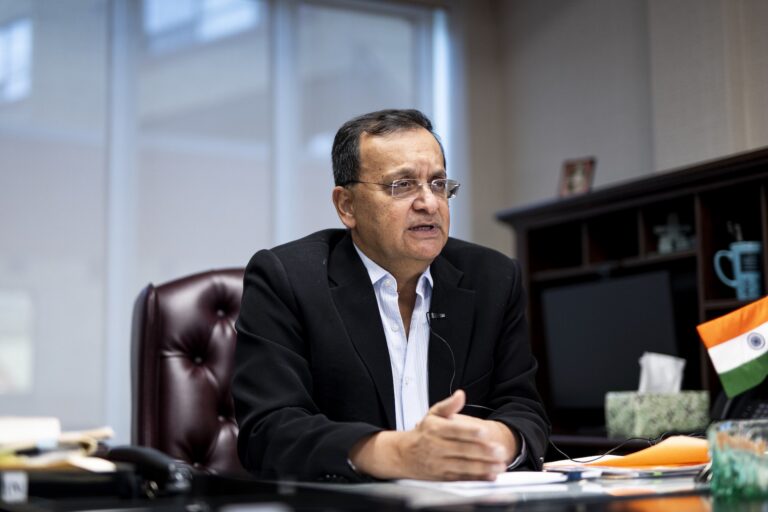
Photo: Nick Iwanyshyn for The Logic
In the three years since Steve Hasker became CEO of Toronto-headquartered Thomson Reuters, it has invested some US$600 million in modernizing the way it does business.
Great journalism delivered straight to your inbox.
Get up to speed in minutes with insights and analysis on the most important stories of the day, every weekday.
See the bigger picture with reporters and industry experts in subscriber-exclusive events.
Membership provides access to our popular Slack channel, participation in subscriber surveys and invitations to exclusive events with our journalists and special guests.