The federal and British Columbia governments invested a combined $72.75 million in Vancouver’s Aspect Biosystems this month, supporting a $200-million expansion. Aspect is working on technology it calls “bioprinting,” to grow replacement cells to reinforce damaged human livers and pancreases.
Skip to content

The Interview
‘Almost sci-fi’: B.C.’s innovation minister Brenda Bailey on artificial human organ cells—and what could grow from them
How the province aims to build up its bioscience sector, and what the minister is playing on her phone (when she gets a chance)
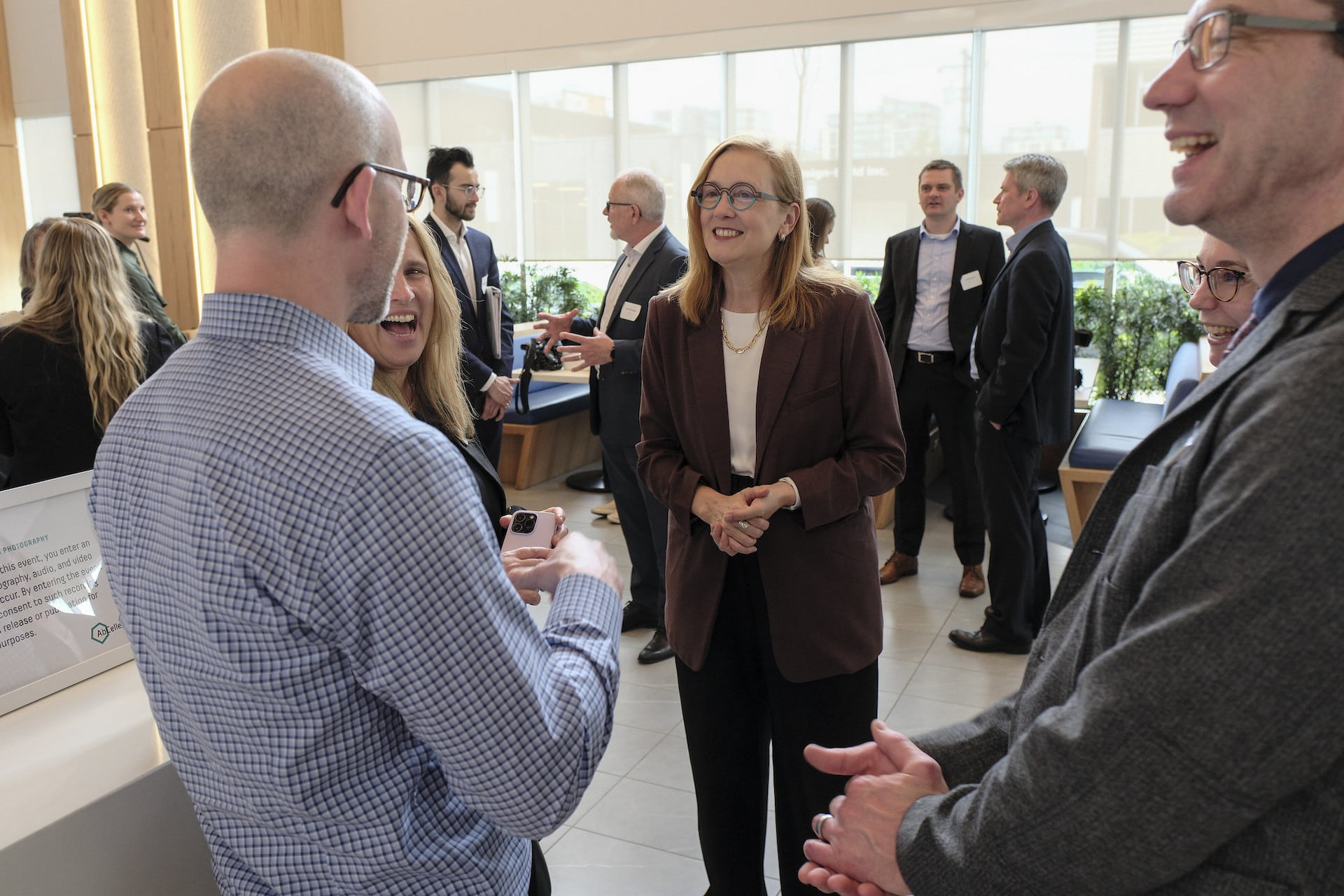
B.C. Innovation Minister Brenda Bailey at the Vancouver offices of drug developer AbCellera, in May 2023. Photo: Handout | B.C. Government via Flickr
The federal and British Columbia governments invested a combined $72.75 million in Vancouver’s Aspect Biosystems this month, supporting a $200-million expansion. Aspect is working on technology it calls “bioprinting,” to grow replacement cells to reinforce damaged human livers and pancreases.
Brenda Bailey, B.C.’s minister of jobs, economic development, and innovation, talked to The Logic about how the large public investment in a company that doesn’t yet have a marketable product is meant to juice the province’s health technologies sector.
Talking Points
- Already home to biotech leaders like Stemcell Technologies and AbCellera, British Columbia is seeking to parlay those successes into a West Coast life sciences ecosystem with links to Asia and U.S. partners from Washington state to California
- At the same time, the video game sector, where Innovation Minister Brenda Bailey worked for years, is struggling, and she worries about losing jobs that draw young people into tech
It’s part of a strategy in life sciences and biomanufacturing, she said, that involves backing technologies with potential to have global impact—to improve the well-being not only of British Columbians but people around the world.
The interview has been edited for length and clarity.
In describing the province’s approach, Bailey recalled an international IP lawyer telling her, “You know that you’re working with really cutting-edge science when you go to register a patent and there’s white space.”
Bailey continued: “What Aspect is doing is so unique and almost sci-fi … “
It reminds me of something from a William Gibson novel.
Yeah, I’ve actually sat at a breakfast counter and he was two people down and I was so excited, I couldn’t even speak.
The Aspect technology really is so cutting edge that it’s a white space.
Related Articles
One of the applications is allowing the body to create its own insulin again after it’s not been able to, and this obviously has implications for diabetes. Insulin was a Canadian creation, and we didn’t protect that intellectual property. That is largely owned now by Novo Nordisk in Denmark. Novo Nordisk is the largest investor in Aspect. This is potentially insulin 2.0.
Aspect’s products are preclinical at this point. There are lots of really good ideas in the research phase that once they’re tried in animals or in humans, they don’t pan out. So why is this a good investment for the government of Canada and the province of B.C.?
We have faith that the science is going to be applicable, and even if it fails in one particular area, it will be applicable in others.
But also, building out the life-sciences sector. Aspect has already grown to 100 people and they’re going to grow more. We expect them to grow to 300, at least. Those are really well-paying jobs for British Columbians.
We have long been hewers of wood and carriers of water and those things are always going to be important, but we also need to ensure that B.C. is taking advantage of the extraordinary talent and inventions and innovations that are happening in the knowledge economy. We haven’t always done that well.
Is it any challenge to attract businesses run by people who would ordinarily think of being in the Eastern time zone as really important, or being close to the existing, strong clusters of these businesses?
By far the largest export and import relationship with Asia is in British Columbia, vastly larger than what you see on the East Coast. Our relationship to California is incredibly strong. You see that all the way down the Cascadia corridor.
Yes, there is some regionalism that happens, and it benefits us.
Bailey was previously an executive in the game industry, as chief operating officer of Deep Fried Entertainment, co-founder of Silicon Sisters Interactive and executive director of industry association DigiBC. The Vancouver area has been a Canadian centre for video game development but has been through many rough years. Global giants like Electronic Arts and Sega have moved in and back out and the post-COVID tech retrenchment has hit the games sector hard.
What does the future of the video game industry look like in British Columbia?
God, I love the sector so much, it hurts me to see what’s happening there right now. Phoenix Labs was probably one of my favourite companies, because of their devotion to quality, their playfulness. Timbre Games hurt my heart. Especially since those were not indie studios, but 100-plus-person studios.
There’s a lot going on in the video game industry all at once and it’s hard to tease apart which specific components are leading to the volatility. Here’s my opinion so far.
I think that Disney is such a massive player and holds so many IPs that when [its CEO] Bob Iger decides to make cuts, it has implications all over. They own Marvel and Star Wars.
I think there’s a bit of an amalgamation and contraction happening in the industry worldwide—we saw layoffs at Xbox, for example. People played more games during COVID, and they’re playing less now—that makes perfect sense—but it’s not enough to explain the level of impact that we’re seeing.
On the other hand, kind of like when there’s a fire in a forest, there’s rejuvenation and growth.
Sometimes I get asked the question, ‘Why does it matter? Who cares if we make video games?’ I see video games as the Trojan horse to technology. I started in games in 2003. I have seen so many leaders and technologists from our video game sector go on to start other really impactful companies.
But I also think that video games get a bad rap. There are some that deserve that bad rap, but so many are a really joyful experience that builds community and drives creativity.
It also important that girls play video games, because there’s been research at the University of Utrecht and University of Alberta that shows that young people who play video games have a very significant increased likelihood of going into STEAM [science, technology, engineering and math fields, but including an arts component]—not just video games or technology, but broadly, they have a bigger likelihood of going into medicine or engineering or life sciences.
I can’t let it go without asking you what the last game you played was.
Bailey took a moment to look through the apps on her phone.
I was just playing “Glory of Generals,” a protect-your-castle–style strategy game. Oh, this one was quite fun—“Dragonheir” by SGRA. That was quite a cool game. It’s a beautiful quest game with D&D elements but the art is better than the gameplay, sadly.
What do you like about it?
I love anything set in a medieval world where you get to fight dragons with swords. That’s my cup of tea.
My life is so full. I work 14-hour days. So if I can have a 15-minute hit, have a very fun good video game that makes me laugh—anything with a bit of humour, or a little bit of horror genre—I love all that stuff.



Loading...
Thanks for sharing!
You have shared 5 articles this month and reached the maximum amount of shares available.
CloseThis account has reached its share limit.
If you would like to purchase a sharing license please contact The Logic support at [email protected].
CloseGift the full article!
You have gifted 0 article(s) this month and have 5 remaining.
Recipients will be able to read the full text of the article after submitting their email address. They will not have access to other articles or subscriber benefits.
Photo: Handout | B.C. Government via Flickr
Most Popular This Week




In-depth, agenda-setting reporting
Great journalism delivered straight to your inbox.
The Big Read
Alberta’s referendum is just the start of the turmoil
Briefing
EverWind plans $10B data centre and wind development in Nova Scotia
Canada ready to force Stelco to sell its Canadian operations, Joly says
Feds plan a 60 MW defence-oriented data centre for Ottawa
Best business newsletter in Canada
Get up to speed in minutes with insights and analysis on the most important stories of the day, every weekday.
Exclusive events
See the bigger picture with reporters and industry experts in subscriber-exclusive events.
Membership in The Logic Council
Membership provides access to our popular Slack channel, participation in subscriber surveys and invitations to exclusive events with our journalists and special guests.






