Somewhere between the scents of light cologne wafting from Piaget and David Yurman and buttery popcorn popping at Kernels, there’s a whiff of new-car smell in the air.
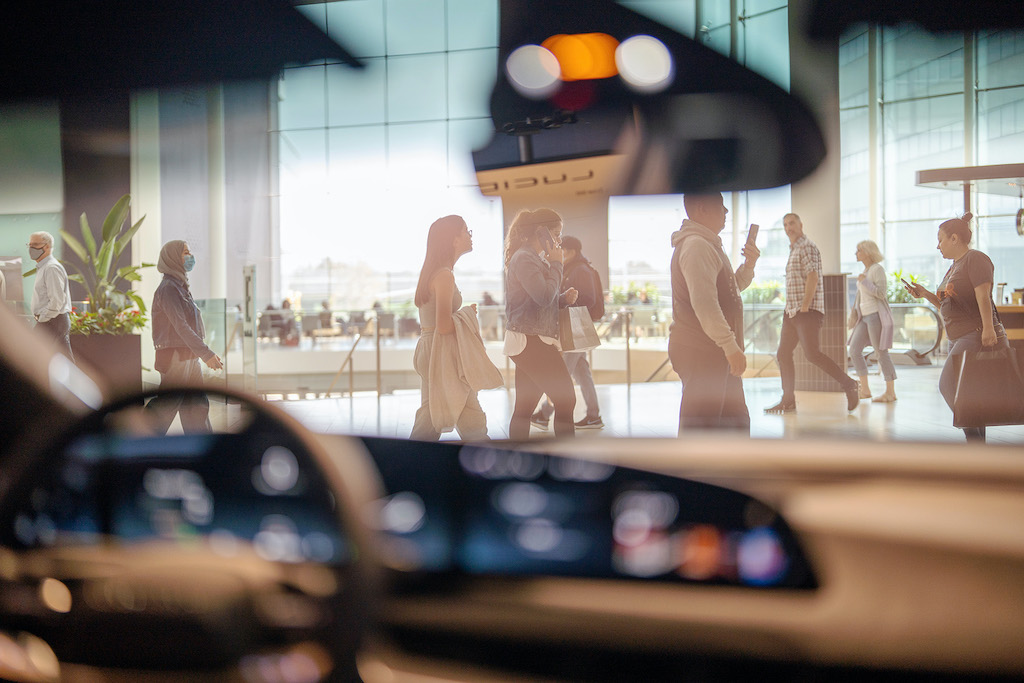
That’s where VinFast’s SUVs are displayed at Yorkdale Shopping Centre, the Toronto-area mall that will eventually house a permanent vehicle showroom for the electric-vehicle maker. VinFast’s retail roadshow, which will also make the rounds to the Park Royal Shopping Centre in West Vancouver, is at least the fourth EV installation at Yorkdale alone over the past year, joining Lucid Motors, Tesla and replacing a Nissan pop-up that included the Ariya EV.
Talking Point
Malls and the auto industry grew hand in hand for decades. Now, as shopping centres try to draw customers back post-pandemic, and new auto companies seek to educate consumers about electrification, EV showcases are popping up as tenants.
Mall showrooms, made famous by Tesla, are gaining popularity with carmakers as they try to educate consumers about new EV models despite their lack of inventory to fill a dealership lot. At the same time, malls are seeking to recover from the pandemic and hoping to draw back wary online shoppers with something new.
Jane Domenico, Colliers’s senior vice-president and national retail-services lead for real estate management in Canada, said these shops are cropping up against the backdrop of a larger trend, as mall developers have adopted more “mixed-use” properties with workplaces, residences and shopping in the same area.
Sherif Masood, national vice-president of retail asset management at Oxford Properties Group, which manages Yorkdale and co-owns it with the Alberta Investment Management Corporation, said malls are increasingly looking past fashion to what he called “alternative” tenants like automotive, spa or digitally native brands like Warby Parker that will drive regular foot traffic.
“I’d say there’s been a very concerted shift in … our merchandising mix, or our tenant offerings. So we’ve had a very purposeful move toward what we call alternative uses, and today, just shy of 10 per cent of our total [gross leasable area] is dedicated toward alternative uses,” said Masood, adding that it includes food and beverage, entertainment, medical and educational spaces.
“Automotive and retail are not necessarily a new thing. But what is newer is this idea of electric vehicles, putting showrooms in malls.”
Masood expects the trend will continue as he’s seen a “stronger push” for the shops.
It’s a poetic renaissance for the auto and mall industries, which grew together in the post-war North American suburbs. For suburbanites, trading in city centres for white-picket fences meant getting in the car to reach high-street shops. It’s no surprise that new malls with massive parking lots were prime real estate for attracting car buyers. Car clubs and shows began meeting at malls, and showcases remained popular in the 1970s, ‘80s and ‘90s, Domenico pointed out.
Now, as electrification and e-commerce disrupt each industry, respectively, the two industries are leaning on each other again.
Lucid Motors is one of the newest EV companies to open a showroom inside the Yorkdale Shopping Centre. Photo: Photos by Justin Greaves for The Logic
At some malls, like West Edmonton, dealerships are taking advantage of vacancies to expand their retail footprint and get follow-on traffic from shoppers. At others, there’s a single vehicle showcasing its wares in a low-pressure environment, with most of the actual car-purchasing happening online.
Canadians are becoming more comfortable with online vehicle shopping, according to an early May survey of 1,520 Canadian adults. Thirty per cent of respondents told Kijiji Autos pollsters that they would be comfortable completing a car purchase or lease online without going into a dealership, while 77 per cent said they would do online research before their purchase. Forty-four per cent reported not receiving all the information they needed during the car-buying process and feeling pressured to make a decision.
“I’ve spent a lot of time personally going to dealers and buying cars and whatnot. It’s not the most pleasurable experience, if you’re there, and you’re kind of there for two, three hours … with nothing really around you, nowhere to go to think about your decision,” said Masood.
Tesla CEO Elon Musk has long tried to distance the company from the traditional-dealership experience, which he said would be a disadvantage to new automakers. The firm needed to educate consumers when they were in an “open-minded buying mood,” rather than shoppers who were steeled for negotiations, he wrote in 2012.
“Our product specialists could not sell you a car today under any circumstances, as Model S is already sold out several months in advance,” he wrote. “Our stores are designed to be informative and interactive in a delightful way and are simply unlike the traditional dealership with several hundred cars in inventory that a commissioned salesperson is tasked with selling.”
Tesla has sold reservations online since it first began opening stores in malls and has largely forgone traditional advertising. The industry brushed off the company’s mall storefronts early on, with dealers arguing that being good at making cars doesn’t mean you’re good at making sales. The showrooms couldn’t sell in some areas due to laws banning manufacturer-owned dealers. But a decade of legal battles involving manufacturer-owned dealerships later, automakers like Honda and Ford are now rethinking their own dealership models.
Shoppers walk past the Tesla showroom inside the Yorkdale Shopping Centre in May 2022. Mall showrooms, made famous by Tesla, are gaining popularity with carmakers. Photo: Photos by Justin Greaves for The Logic
Ford CEO Jim Farley said last week that he plans to scrap most ad spending and to sell EVs online only at a fixed price. Dealers would forgo inventory in the future for direct-to-consumer sales—a model he said was inspired by Tesla. Last month, Honda unveiled its EV sales strategy, including a pared-down concept of a dealership.
At Yorkdale, VinFast’s EVs are just prototypes without test drives, so the only purchase that shoppers can make on site is a $250 deposit. But the atrium showroom includes a seating area where weary shoppers can caffeinate with free after-lunch ca phe sua nong and ask questions about the subsidiary of the Vietnamese conglomerate Vingroup.
It’s these types of novelty displays that malls hope will revive shoppers’ interest in window shopping after two years of getting in and out of shops as quickly as possible amid the pandemic.
An EV shop “gives that extension of the shopping trip. And that’s really important for the health of our retailers,” said Colliers’s Domenico, giving the example of a group trip to the mall, where some folks aren’t actively shopping but want to rest and browse.
“It’s why, when I saw a Ferrari parked at the grocery store, I stopped and took a look at it. These are beautiful machines, and if you have an interest in them, or just an interest in something well built or something cool-looking, it just adds to the excitement, right?”
With few vehicles out on the road, EV makers are also still trying to define their brands in the consumer milieu, perhaps aided by mall displays sidled up to Lululemon or Rolex.
“The mall is a familiar place for people to interact. Have lunch, you can see your friends, do your shopping, and you can also see the electric car and just become a little bit more acquainted with it,” said Aniseh Sharifi, co-founder of the digital-marketing company Fierce Media, who has a background in retail and auto-dealership marketing and is also a board member of the Electric Vehicle Society.
“Whether they want that to be luxurious or an adventurous story, whatever they’re trying to convey, they can do that with pop-ups and the boutique-style shops that they’re creating in various locations. And they can have some flexibility and take control of the narrative.”
VinFast’s SUVs are displayed at Yorkdale Shopping Centre, the Toronto-area mall that will eventually house a permanent vehicle showroom for the electric-vehicle maker. Photo: Photos by Justin Greaves for The Logic
At Yorkdale, shopper Blair Gallant tested out a virtual reality mockup of a Lucid Air vehicle in a shop that included placards explaining battery technology, Lucid-branded clothing and a coffee-table display of South Korean stationery and high-end watches. Gallant doesn’t own an EV yet, but he purchased Lucid’s stock based on researching different companies in anticipation of his next vehicle purchase.
“I just feel like that’s the way the future is going, and gas prices are insane right now,” he said, calling the VR driving experience “incredible.”
“Lucid was the one that impressed me the most.”
These displays attract not only consumers but also influencers, Domenico noted. That may become more important as automakers like Ford pare their sizable ad budgets and upstarts try to compete for exposure. The cleantech entrepreneur Phil De Luna was among the influencers tapped in marketing campaigns for Polestar last year during its expansion into Canada. The joint venture of Volvo Cars and China’s Geely, which was founded in 2017, has locations at the Park Royal mall, Toronto’s “Mink Mile” luxury shopping street and in Laval, Que., flanked by traditional dealers like BMW. It will also deliver cars directly to consumers for test drives.
“There’s a greater appetite for more genuine stories [from influencers]—rather than paying for a model, being able to find folks who have their own networks, amplify those voices,” said De Luna. “The genuine story, the reach and demographic—it’s more economical. I think you’re starting to see this trend with a lot of other brands that are trying to reach younger consumers.”
Like automakers, malls also want to be seen going green. Domenico said shopping centres are clamoring to snag charging-station installations. Yorkdale not only housed Canada’s first Tesla store, but now deploys Teslas for its security fleet, and has been getting more automaker interest to sponsor its valet services.
“When Tesla launched their Model 3 … we had a lineup at Yorkdale that was, I want to say, 250 people deep. You had to line up to get your name to put a deposit down so you’d be one of the first people to get that car,” said Masood. “Those people knew what they wanted.”
Read Shift—The Logic’s authoritative weekly newsletter on automotive technology industry news—for more; and if you know someone who should be reading it, they can sign up here.