As gridlock grinds Torontonians down, businesses are trying to lure top talent not just with the best office spaces, but also the smoothest commutes. It’s a shift that’s not just driving companies out of aging office space, but also leaving some brand new, eye-wateringly expensive developments largely empty.
Skip to content

 Toronto’s Queen Street at rush hour in May 2023. Construction of the downtown Ontario Line has further snarled up the city’s already congested streets. Photo: The Canadian Press/Chris Young
 Office space at The Well, a massive mixed-use development in downtown Toronto, remains 40 per cent unoccupied more than two years after it opened to tenants. Photo: RioCan/Handout

The Big Read
The real reason behind Toronto’s giant, empty offices
Canada’s biggest city has a surplus of aging office space that nobody wants to pay for—and a congestion crisis that’s making even the shiniest towers a tough sell
Before the pandemic, Toronto’s downtown office vacancy rate was 2.5 per cent. Today, it’s almost 15 per cent. Photo: The Canadian Press/Chris Young
Before the pandemic, Toronto’s downtown office vacancy rate was 2.5 per cent. Today, it’s almost 15 per cent. Photo: The Canadian Press/Chris Young
As gridlock grinds Torontonians down, businesses are trying to lure top talent not just with the best office spaces, but also the smoothest commutes. It’s a shift that’s not just driving companies out of aging office space, but also leaving some brand new, eye-wateringly expensive developments largely empty.
Office vacancy rates remain stubbornly high throughout downtown Toronto—and the city’s abundance of low-quality office space and ongoing construction chaos is to blame. While Class A towers—the newest, flashiest buildings, with top tenant services and amenities—had a 13.6 per cent vacancy rate as of Q4 2024, that figure jumped to 17.4 per cent and 18.7 per cent for Class B and C buildings, according to a report from Newmark Research. The disparity is especially pronounced in the financial core, where the Class C vacancy rate of 34.1 per cent is nearly triple that of Class A properties.
Talking Points
- About 15 per cent of office space remains vacant in downtown Toronto. Before the pandemic, the city’s downtown office vacancy rate was just 2.5 per cent.
- A flight to quality explains many of Toronto’s empty offices, commercial real estate experts say. But downtown construction and muddled return-to-office policies are deepening a divide between the city’s shifting financial district and the rest of the downtown core.
Across Toronto’s downtown, about 15 per cent of office space is vacant. Before the pandemic, the city’s downtown office vacancy rate was about 2.5 per cent.
There’s no question that a flight to quality explains many of Toronto’s empty offices, commercial real estate experts say. But there’s more to the story. Downtown construction, combined with varying return-to-office trends across industries, is deepening the divide between the city’s shifting financial district and the rest of the downtown core.
“We’re not really overbuilt; we’re under-demolished,” said Jeremiah Shamess, head of the private capital investment group for professional services firm Colliers. Shamess attributes Toronto’s wonky downtown office space dynamic to the city’s office replacement bylaw, which makes it difficult to demolish functionally obsolete office buildings for residential rezoning.
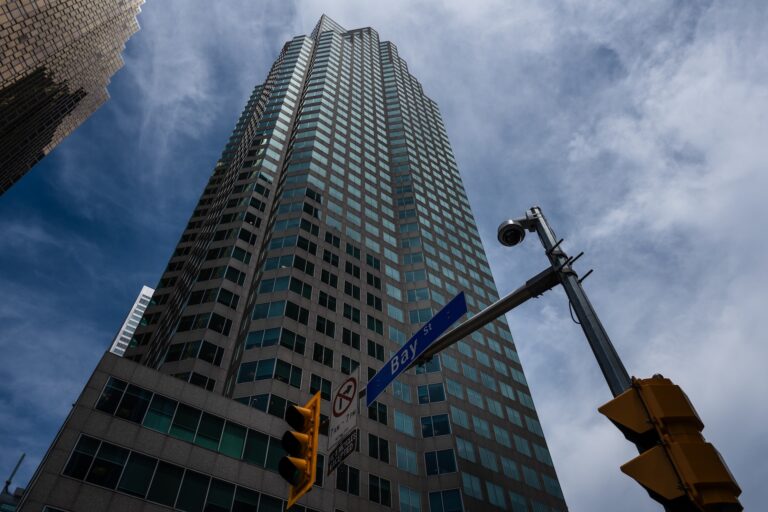
Amid the flight from older office buildings to newer and better ones, a new financial district has taken shape. “The Bay Street corridor used to be all one thing. But now, owning a building on Bay and Queen is very different from owning one on Bay and Front,” said Ben Haythornthwaite, director of Greater Toronto Area market analytics for CoStar Group. Where the financial core used to be concentrated between Queen and King streets, south of King is where most of the action is today.
Related Articles


It’s not by chance that south of King is now home to some of the most desirable office space in Toronto. Daily commuters want ready access to the Gardiner Expressway and Union Station, and they’re venturing further south to find it. Where the five city blocks between Queen and Front Streets may once have had a trivial impact on workers’ commute times, construction on the Gardiner and ongoing transit infrastructure expansions have sharply intensified gridlock in Toronto’s downtown core.
Congestion has been especially pronounced since May 2023, when Ontario Line subway construction closed off a critical stretch of Queen Street to vehicular traffic for at least four and a half years. “I sat in a car trying to get from Queen to Wellington, and it took 45 minutes just to get to King,” Haythornthwaite said of a recent commute. “I ended up getting out and walking.”
Financial firms have shown that they’re more than willing to pay a premium for the privilege of a prime location. Although the pension funds and asset managers that own much of Toronto’s downtown office buildings have been hesitant to lower headline rents, vacancies are currently lowest where rents are highest. “The gut feeling is that it should be an inverse correlation—as rent increases, space demand should go down. But that doesn’t fit the current circumstances,” Haythornthwaite said.
Companies have figured out that in order to attract the best people, they must provide spaces and locations that match industry standards. The Canada Pension Plan’s investment arm, CPP Investments, is a prime example. Last year the firm made one of the largest office deals since the pandemic, inking a lease on 330,000 square feet in the second tower of the new CIBC Square development at 141 Bay St.
A Q2 2024 market report by Colliers suggests a decade-long lease in the building south from CPP’s current digs at 1 Queen St. E. will cost the firm upwards of $300 million. But that just might be the cost of staying competitive. “If you have the option to work at CIBC, where you can walk straight from Union Station into the office, or work at CPP and spend an hour and a half in gridlock on Bay Street, the choice becomes clear,” Haythornthwaite said.
Outside the financial core, empty offices reflect the impact of painful commutes and general industry trends. That’s especially true of the southern stretch west of Spadina to Liberty Village, which stood as a pre-pandemic hotspot for Toronto’s fast-growing tech and creative firms. These sectors have since been rocked by market volatility and downsizing. This, combined with an embrace of remote and hybrid work, has cratered demand for office space.
Case in point: downtown west office vacancies are 21.4 per cent, according to Newmark Research, compared with 8.1 per cent in downtown south.
Although building owners likely have tough decisions ahead of them, Toronto’s generally sluggish return to the office may be prolonging the pain. A 2024 Centre for Cities report found that Toronto lagged behind other global cities in the number of days full-time workers spent in person, averaging 2.7 office days per week compared with 3.5 in Paris and 3.1 in New York. Analysts predict that as more companies either return to the office full-time or solidify hybrid work plans, the office real estate market should stabilize.
Of all Toronto’s downtown office buildings, none represents the city’s perplexing real estate reality better than The Well. The massive mixed-use development, which borders Front, Wellington, and Spadina and was welcoming office tenants in the summer of 2022, had leased more than 250,000 square feet of office space to Shopify prior to its completion. That same year, the e-commerce giant opted to keep a remote-first policy and announced it would not be moving in. It sublet the space instead.
The Well still hasn’t recovered. Nearly 40 per cent of office space at the site remained unoccupied as of last spring. Experts who spoke to The Logic suggested that the development’s location—in the hinterlands of the design district, about a 20-minute walk from Union Station—is largely what’s slowing uptake on this top-of-the-line build.
The Well’s struggles are also being felt at the 560,000-square-foot Portland Commons complex, which was completed last September at the northeast corner of Front Street West and Portland Street. The huge development created yet more supply in a market that isn’t necessarily looking for it—or at least, not yet. At the time of opening, the building was completely empty—as it likely remains at the time of writing.
Landlords have taken note. “You will see the landlords of buildings in tech- and creative-industry locations dropping rents, and adding massive inducements, to get tenants into their buildings,” Haythornthwaite said. “Conversely, headline rents are holding strong on the south Bay Street corridor. Anecdotally, I have heard that inducements are dropping and net effective rents have stabilized and, in some cases, have started to rise.” However, Haythornthwaite added that the impending trade war “will almost certainly have a big impact” and hamper the market’s recovery.
Tellingly, the companies that have found a home in The Well largely represent industries outside of those that dominate Toronto’s shifting financial core. Where Bay Street’s daily commuters might be put off by the building’s location, several of the tech and design firms that make up the bulk of The Well’s tenants view their new headquarters as an upgrade in quality, location, or both.
To wit, software company Intuit opened its 116,000 square foot office at The Well in August 2022 to mark its foray into the Canadian market—and, critically, deepening its access to Toronto’s tech talent pool. For Index Exchange, the global advertising supply-side platform, moving into The Well gave it 69 per cent more office space and an accessible location downtown—a boon for hiring engineers, according to Colleen Mullaney, the company’s director of workplace.
Architecture and design firm BDP Quadrangle also moved into The Well after outgrowing its previous head office just outside Liberty Village. “The location was another great benefit as it brought our team closer to the core of the city, which was a big draw for us—especially being in a Class A building,” said Marcella Au, the company’s retail and interiors lead for North America.
Toronto’s office winners and losers are part of transition, not a sign of a broken downtown core, experts say. “While ongoing construction is creating challenges, this is likely a temporary issue rather than a long-term shift,” Shamess said. Once new amenities, tenants, and restaurants arrive, “people will want to be downtown” and demand for office space will likely strengthen. A revitalized downtown core—consisting of multiple distinct office markets—is poised to emerge from the fray. In the meantime, the city’s developers and real estate investors will have to keep breathing through the chaos.
Loading...
Thanks for sharing!
You have shared 5 articles this month and reached the maximum amount of shares available.
CloseThis account has reached its share limit.
If you would like to purchase a sharing license please contact The Logic support at [email protected].
CloseGift the full article!
You have gifted 0 article(s) this month and have 5 remaining.
Recipients will be able to read the full text of the article after submitting their email address. They will not have access to other articles or subscriber benefits.
Photo: The Canadian Press/Chris Young
Toronto’s Queen Street at rush hour in May 2023. Construction of the downtown Ontario Line has further snarled up the city’s already congested streets.
Office space at The Well, a massive mixed-use development in downtown Toronto, remains 40 per cent unoccupied more than two years after it opened to tenants.
Most Popular This Week



In-depth, agenda-setting reporting
Great journalism delivered straight to your inbox.
Commentary
Carmichael: Was Chicken Little stirring panic, or just taking precautions?
Briefing
Carney plans to discuss US$135B defence bank with new U.K. prime minister
B.C. nearing federal MOU of its own as talks continue on Alberta’s West Coast pipeline
Quebecor urges CRTC to block Corus restructuring as part of takeover push
Best business newsletter in Canada
Get up to speed in minutes with insights and analysis on the most important stories of the day, every weekday.
Exclusive events
See the bigger picture with reporters and industry experts in subscriber-exclusive events.
Membership in The Logic Council
Membership provides access to our popular Slack channel, participation in subscriber surveys and invitations to exclusive events with our journalists and special guests.