It began as a surprise attack, with the redcoats setting out from Prescott, Ont., and across the frozen St. Lawrence River into Ogdensburg, N.Y., on foot shortly after sunrise. The British won the short-lived Battle of Ogdensburg on Feb. 22, 1813, removing the American threat to communication along the key route between Kingston and Montreal for most of the War of 1812.
Skip to content
 The War of 1812 reenactment of the Battle of Ogdensburg has become an annual event. Photo: Handout/Facebook
 Donald Trump addressing a rally in Plattsburgh in 2016. Photo: AP Photo/Elise Amendola

The Big Read
These U.S. towns on the front line of Trump’s trade war are already feeling the pain
From shoppers to shippers, border towns in upstate New York have built their local economies on trade with Canada. The drop in business is hitting them hard.
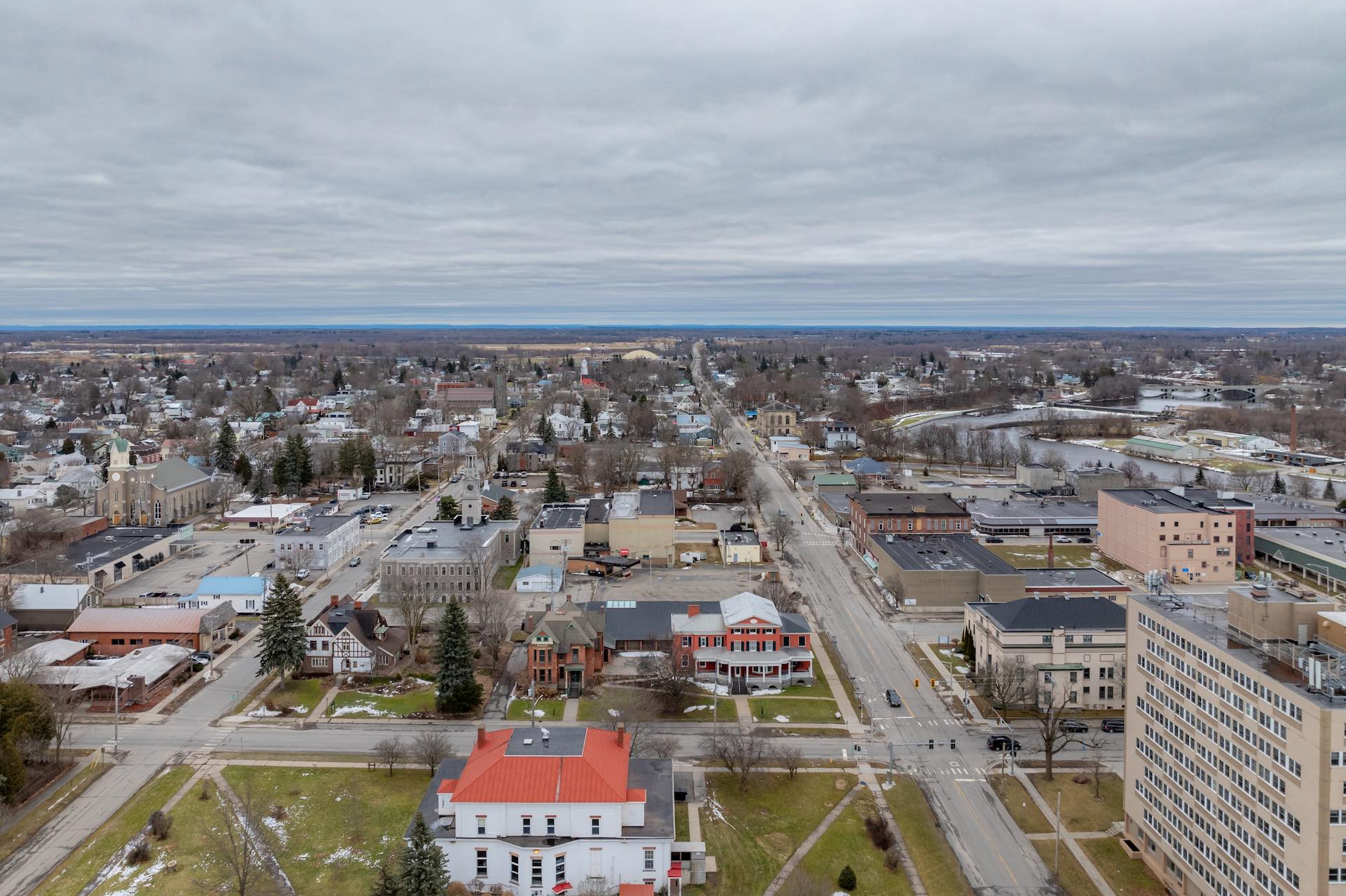
Ogdensburg, N.Y., has long been a place where residents of eastern Ontario saved some money on groceries, picked up parcels or caught flights from the airport. Photo: Shutterstock/Sealandsky
It began as a surprise attack, with the redcoats setting out from Prescott, Ont., and across the frozen St. Lawrence River into Ogdensburg, N.Y., on foot shortly after sunrise. The British won the short-lived Battle of Ogdensburg on Feb. 22, 1813, removing the American threat to communication along the key route between Kingston and Montreal for most of the War of 1812.
Barring the pandemic or other disruptions, history buffs from both sides of the border have gathered every February in Ogdensburg, home to about 9,300 people, to re-enact the battle that, despite fatalities on both sides, restored pre-existing commerce and friendly relations. “It’s been a great way for folks on both sides of the border to come together and celebrate our shared history,” says James Reagen, the co-owner of the Sherman Inn in Ogdensburg, whose website boasts its great location: “Nine minutes to Canada!”
Talking Points
- U.S. communities that rely on cross-border commerce are waiting to see effects of tariffs on Canadian goods hit their local economies
- Plattsburgh, N.Y., had long been pitching its proximity to Montreal to woo Canadian businesses to set up shop in the border city
He narrates the mock battle, which has become a popular annual event, with crowds cheering from the sidewalks despite the cold. The 2025 edition of the Battle of Ogdensburg, though, reflected a new reality for communities up and down a boundary normally bustling with the business of tourism and trade. Some Canadians chose not to come.
The U.S. Travel Association warned in February, shortly after President Donald Trump signed an executive order to impose steep universal tariffs on Canadian goods, that a 10 per cent drop in Canadian travel could cost 14,000 jobs and US$2.1 billion in spending. The falloff in visits did not take long.
Statistics Canada reports that 1.2 million Canadian residents returned from the U.S. in vehicles in February, a 23 per cent decline from February 2024. That is the second consecutive month of year-over-year decline. Before that, there had been no drop since March 2021, when severe COVID-19 travel restrictions were in place.
On March 27, in his capacity as Canada’s prime minister, Liberal Leader Mark Carney remarked that the economic compact that has bound this country to the United States, improving the lives and fortunes of residents in both countries, is over. For Canadians, Carney was stating the obvious. For American communities along the borderline, the truth is just starting to sink in.
The Ogdensburg-Prescott International Bridge opened in 1960, making it easy for someone in eastern Ontario to drive to Ogdensburg for the day to save some money on groceries, pick up a parcel ordered from a company that does not ship to Canada, or catch a flight from the airport. (To make things easier for Canadians, right now the airport parking is free.)
As a state, New York gave its electoral college votes to Democratic presidential nominee Kamala Harris. St. Lawrence County, home to Ogdensburg, voted in a big way for Trump. Now in the White House, Trump has threatened several layers of tariffs on Canadian goods, prompting Ottawa to retaliate with tit-for-tat duties on many of the consumer products shoppers might previously have purchased on one of those trips.
Related Articles


“Cross-border traffic is huge because our Canadian neighbours come across and they shop in our stores, they eat in our restaurants, and they buy gas. If traffic is down, then it’s down for everybody,” says Laura Pearson, the Ogdensburg community co-ordinator for the St. Lawrence Chamber of Commerce, from her office not far from where the battle re-enactment takes place. “It’s going to be a huge ripple effect that we don’t even realize yet.”
Last October, Josh Follett and his wife, Tiffany, bought the Little Italy Pizzeria—an Ogdensburg restaurant that had long been popular with Canadian visitors. The previous owner was from Montreal. He had handed out bridge passes to customers spending a certain amount to save them from paying the toll on their way back to Ontario, but the restaurant paused that during the pandemic. Picking it up again is on Follett’s to-do list, but he is monitoring the number of Canadians coming through his doors before deciding.
Traffic into Ogdensburg took a nosedive when the border was shut down for non-essential travel during the COVID-19 pandemic and is still recovering. Steve Lawrence, executive director of the Ogdensburg Bridge and Port Authority, shared toll-collection data showing that 28,897 passenger vehicles crossed the bridge into the U.S. in March, which is down about 24 per cent from March 2024. It is also 35 per cent below what it was in March 2019. Given how badly the pandemic affected traffic, the port authority has been using 2019—the last “normal” year, says Lawrence—as a baseline. They were ready to move on from that, but now the tariffs have upended things again. “I’m heartbroken over what’s happening,” he says.
Other communities are nervous, too. About 190 kilometres to the east lies Plattsburgh, N.Y., whose official sales pitch to potential employers for the last quarter century has been that it is “Montreal’s U.S. suburb.” The North Country Chamber of Commerce, headquartered in Plattsburgh, estimates its region houses upwards of 100 physical locations of Canadian businesses, plus firms focusing on cross-border trade, which together employ 10 to 15 per cent of the working population.
Now, North Country Chamber of Commerce CEO Garry Douglas sees his town as the “front line” of the trade war, among the first, but not the last, American cities expecting harm from thickening trade barriers. “Our region is a really key microcosm of how integrated the U.S. and Canadian economies are. It isn’t quite so visible on a macro level, but it’s very visible here.”
Since the U.S. began putting tariffs on Canadian goods in early March, there have been mounting disruptions in manufacturing and tourism. It has been hard to break ground on spring and summer construction projects, according to the chamber, with the U.S. “holding” the region in a trade war instead of moving toward resolution.
Douglas worries the jobs he and his colleagues spent decades creating are now at risk. The region, which spans five counties and Akwesasne Territory, has more than 50 transportation equipment and aerospace manufacturers. Forty per cent of them are U.S. subsidiaries of Canadian companies, Douglas says. Then there are the warehouses, distributors, customs brokers, law firms, bankers, visa consultants and insurance brokers that have cropped up nearby.
North Country could benefit if Canadian companies move operations to U.S. cities like Plattsburgh to avoid tariffs. But Douglas says the other ills of a trade war aren’t worth it. In a spiral of tit-for-tat measures, he notes, the region could be cut off from Canadian goods it needs to sustain itself—energy and fuel piped in from Quebec and Ontario, say, or asphalt and other goods from the Port of Montreal. For every couple of Canadian businesses that cross over, Douglas says, “there are 1,000 bad things that are tied to our economic integration. So there is no net positive, whatsoever.”
Ogdensburg sees a lot of business in the form of individual buyers and sellers. Jesse Mitchell is director of business development for Strader-Ferris International, a cross-border customs brokerage, shipping and logistics company that owns MyUSaddress.ca. Because American e-commerce companies do not always consider it worthwhile to ship to Canada, MyUSaddress.ca allows Canadians buying something online from a U.S. retailer to have it shipped to a warehouse in Ogdensburg, where they can go pick it up. Or, they can pay to have it shipped to the company’s location in Prescott, where it can be picked up or delivered via FedEx.
Mitchell, who lives in Ottawa, said the service has about 50,000 registered users, some of whom use it once a week. As of March 28, he hadn’t seen a reduction in business. “It’s going to take some time for this to filter through,” he predicts.
Canadian consumers cutting their smaller U.S. online purchases is one thing. The bigger threat to border towns, Mitchell says, is what could happen to cross-border shipping in general, especially with universal tariffs in place. “For some companies, they’re going to have to stop shipping altogether.”
“Our Canadian neighbours shop in our stores, they eat in our restaurants and they buy gas. It’s going to be a huge ripple effect that we don’t even realize yet.”
Mitchell notes the fentanyl-related tariffs still apply to goods not considered compliant with the United States-Mexico-Canada Agreement (USMCA). Many businesses never considered it worthwhile to do the paperwork needed to prove compliance, since Canadian goods previously entered the U.S. with little to no duties anyway. There is now a big rush for companies to go through all that red tape. Companies who ship products not covered by USMCA because they are made with parts from other countries are also taking a hit, says Mitchell. “Those companies are suddenly uncompetitive in the U.S. marketplace and are seeing their orders crumble away.”
Ogdensburg Mayor Michael Tooley welcomed the news on April 2 that Trump had extended Canada’s partial reprieve from universal tariffs as a sign both the U.S. and Canadian governments are talking. In an email to The Logic the next day, he noted how important Canadians coming over for tourism and shopping are to the local economy. “It appears the current situation has hurt us,” he wrote, referring to the decline in bridge traffic.
Tooley knows the cut might be deeper than that. “It’s unfortunate the relationship between our countries is currently strained,” he wrote. “I only hope this strain does not become personal, and that the friendship between our friends in Southern Ontario and New York’s North Country will remain strong and survive this current challenge.”
The Battle of Ogdensburg in 1813 was an act of war, but the re-enactment has long been a symbolic act of friendship. It too began as a surprise: in 1984, Robin Morris, then-editor of the Prescott Journal, arrived unannounced on a bus with some friends to stage a battle on the shoreline. Reagen, then-editor of the Ogdensburg Journal, remembers startled seniors from a nearby residence ringing his newsroom to ask why there were redcoats in the park. The mystery was solved when the two editors met a while later and became great friends.
Ryan Clark, a cook from St. Catharines, Ont., and captain of the 49th Grenadiers, a War of 1812 re-enactment group, said there were some jitters ahead of this year’s Battle of Ogdensburg. “Everyone was obviously a little apprehensive,” he says. While some people stayed home, Clark says, the show went on. The Americans and Canadians were customarily good to each other, right down to the traditional salute at the end of the battle: “To our gallant friends.”



Loading...
Thanks for sharing!
You have shared 5 articles this month and reached the maximum amount of shares available.
CloseThis account has reached its share limit.
If you would like to purchase a sharing license please contact The Logic support at [email protected].
CloseGift the full article!
You have gifted 0 article(s) this month and have 5 remaining.
Recipients will be able to read the full text of the article after submitting their email address. They will not have access to other articles or subscriber benefits.
Photo: Shutterstock/Sealandsky
The War of 1812 reenactment of the Battle of Ogdensburg has become an annual event.
Donald Trump addressing a rally in Plattsburgh in 2016.
Most Popular This Week




In-depth, agenda-setting reporting
Great journalism delivered straight to your inbox.
Commentary
Carmichael: Canadian ignorance about India is a strategic weakness
Briefing
Aritzia shares pop after earnings rise 204%
First Nation in Alberta goes to court over fast-tracked oil pipeline
Chinese EV maker Geely Auto Group to launch in Canadian market in 2027
Best business newsletter in Canada
Get up to speed in minutes with insights and analysis on the most important stories of the day, every weekday.
Exclusive events
See the bigger picture with reporters and industry experts in subscriber-exclusive events.
Membership in The Logic Council
Membership provides access to our popular Slack channel, participation in subscriber surveys and invitations to exclusive events with our journalists and special guests.