
Listen Now
0:00
OTTAWA — Sue Dusome began to think her husband Barry might be going crazy. Night in and night out, he would hole up in the hobby room off their home in Hillsdale, Ont., with the couple’s 11-year-old son Wyatt, flipping over playing cards as they perfected the rules for a new kind of poker. “He’d be out there forever,” she says. “I’m like, ‘What are you doing?’”
Her concerns only grew as Barry embarked on a seemingly more quixotic mission: a single-handed, years-long battle with Canada’s patent office to win the rights to his game.
Talking Points
- For nearly two decades, Barry Dusome single-handedly battled the Canadian Intellectual Property Office to secure the rights to a new kind of poker he invented with his son, but his recent court victory is an even bigger win for AI and and software inventors
- The patent office changed the rules this month in ways that will make it easier to patent more abstract inventions, citing Dusome’s case among its reasons
The idea for High Hand Hold ’Em came to Dusome in 2005, when he and Wyatt were watching poker on TV at their home about 25 kilometres north of Barrie. The players on the screen seemed detached from the game, hidden behind their glasses and hoods. Most didn’t make it through the round because they folded early.
“What High Hand Hold ’Em does is change the math for everyone,” says Dusome, a real estate broker. “I basically came up with it to try to keep everybody involved in the game right to the end.”
Related Articles

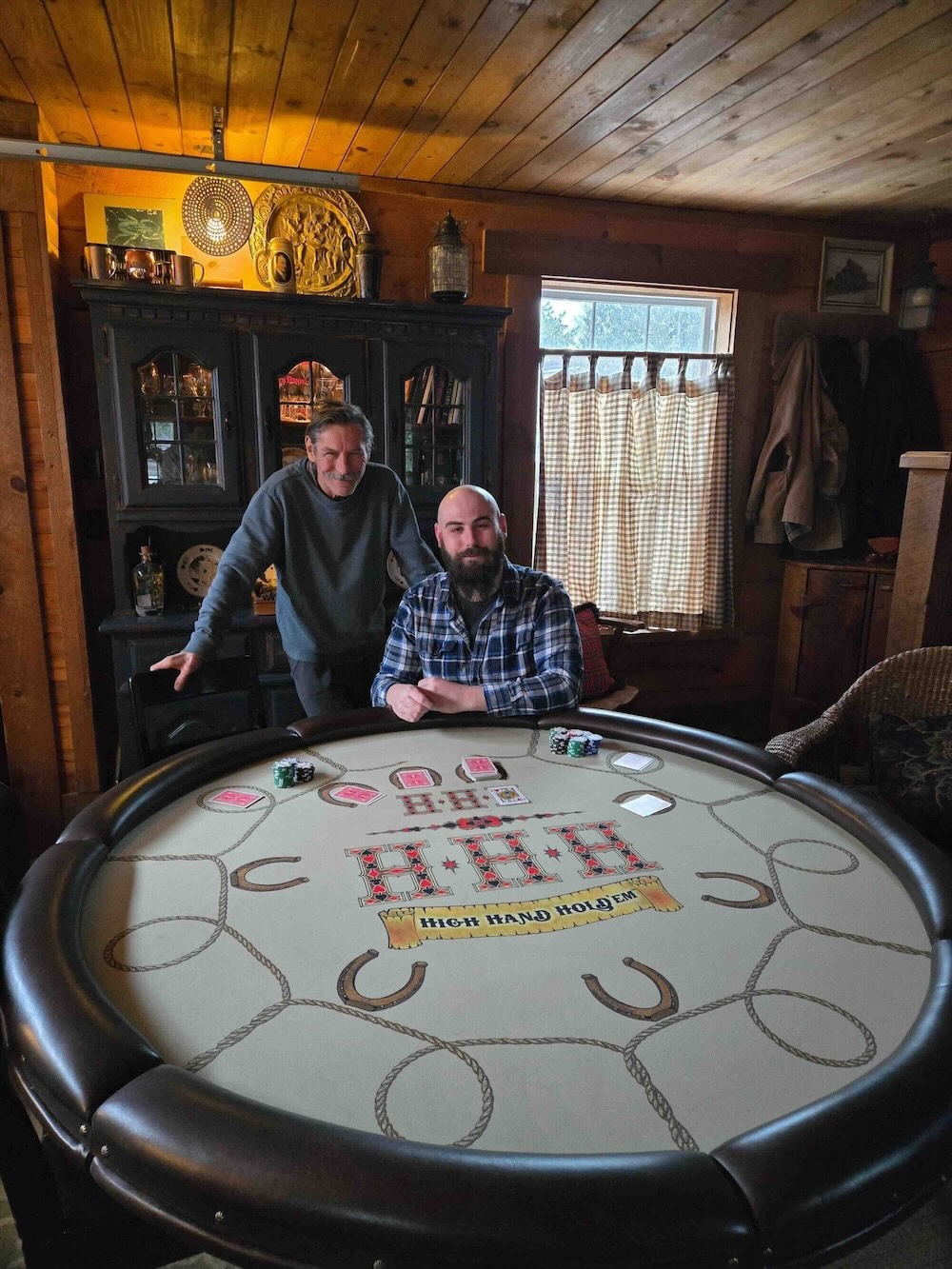
He describes his game as a combination of Texas Hold ’Em and the casino mainstay pai gow poker, with a few elements of cribbage. It allows only six players, each of whom gets seven cards rather than the five in standard versions of poker.
Dusome had high hopes that major betting sites would pick up the game, and dreamed of watching poker champions playing it on TV. So he patented the digital and physical versions in the United States. But when he tried to secure the rights in Canada, he ran into a barrier: the Canadian Intellectual Property Office (CIPO) registers only things that fall within a narrow—some say antiquated—list of categories. A poker game isn’t an “actual invention,” it found, and it rejected Dusome’s claim.
To put it mildly, he wasn’t about to fold. For 17 years, Dusome argued with the patent office, winding his way through its processes to no avail, before appealing to Federal Court, where he represented himself. “I just wouldn’t go away,” he says. Late last year, almost two decades after he and Wyatt nailed down the elements of High Hand Hold ’Em in their hobby room, a judge ruled in his favour, saying that the patent commissioner’s approach fails to recognize certain types of inventions. That’s especially true of inventions that create something new out of existing elements, the court found, like cards or a computer.

The implications of Dusome’s victory go beyond the poker table. For years, developers of software and, more recently, artificial intelligence, have run up against the same rigid understanding of what qualifies as an “actual invention” that Dusome did in trying to turn his idea into something he can sell or license. Major companies with well-funded legal teams have fought court battles over the issue, with varying success, but Dusome’s recent win helped change the way the patent office evaluates the next generation of technology, paving the way for more AI and software patents in Canada’s lagging IP ecosystem.
“It’s about settling the law, and once the commissioner is following the rules then everyone’s going to know what the ground rules are,” Dusome says.
Like software, Dusome’s poker game doesn’t fit neatly into any of the five invention categories set out in Canada’s patent law: art, process, machine, manufacture or composition of matter. “If those terms sound really weird and archaic, it’s because they come from 1793,” says Jason Hynes, president of the Intellectual Property Institute of Canada’s (IPIC) board of directors. “Thomas Jefferson in the United States helped write the U.S. version of the Patent Act, and that language that was from 1793 is still the basis for that analysis in Canada.”
That leaves patent commissioners with the unenviable job of interpreting rules ill-suited to inventions that can’t be seen or touched, like the rules for a card game or a proprietary algorithm. The office has typically played it safe by using a stringent test for what counts as a patentable invention, he says.
That’s not to say Canada doesn’t patent AI or software, and the federal government is looking for ways to encourage more patent activity in the space. Hynes says it could start by broadening the rules: “It’s becoming increasingly difficult to get AI-type patents through.”
As it stands, Canada now lags behind peer countries in IP holdings for artificial intelligence, despite starting the race from a relatively strong position and sustaining its status as a centre of AI research. In 2024, the country stood eighth in a ranking of AI patent activity by the World Intellectual Property Organization, behind the U.K. and Germany.
The U.S. system has grappled with the same issue, but President Donald Trump’s new patent office director declared the debate over on his first day on the job. “These have been areas of great, but in my view unproductive, debate—too often dismissed as ‘mere business methods’ or ‘ineligible diagnostic practices,’” United States Patent and Trademark Office director John Squires said in a September speech.
The first two patents he issued were for crypto and medical diagnostic technologies, spaces in which inventions had often been rejected for falling outside the scope of what is considered patentable in the U.S. “I wanted to send a clear message with the first two patents issued on my watch,” Squires said. “The U.S. patent office is open for business, especially for the technologies of tomorrow.”
In Canada, the issue isn’t so much that the patent office is too strict, but that it hasn’t followed the courts’ advice as technology evolved, IPIC argues. In a landmark case that started in the 1990s, Amazon fought for the rights to its “one-click” buying process, which lets customers make purchases with the single click of a mouse using stored billing and payment information. The patent office rejected the claim, deeming it a business practice, not an invention. The Canadian Life and Health Insurance Association and the Canadian Bankers Association argued at the time that letting Amazon’s patent go ahead could open the floodgates to companies acquiring rights to ideas or even mental steps involved in completing a task, which could wreak havoc on their sectors.
Amazon took the fight to the Federal Court of Appeal, which ruled that CIPO didn’t get the decision quite right, and ordered the commissioner to reconsider. Amazon got the patent in 2011, but the decision-making criteria the patent office was supposed to apply remained unclear.
In 2022 the Federal Court weighed in on a case involving Benjamin Moore’s computerized system for helping people decide on paint colours. Again, the court said the patent office’s approach missed the mark, but this time it offered up a new three-part test to determine whether a “computer implemented” invention was worthy of a patent.
That test didn’t last long—the Federal Appeal Court struck it down a year later. In the decision, Justice Johanne Gauthier said it is impossible to define the full spectrum of possibilities for an invention that relies on a computer. “This is especially so, considering that the technology is becoming more and more complex with quantum technology and the advent of artificial intelligence,” she wrote.
The appeal court ordered the patent office to take another look at Benjamin Moore’s claims, which commissioners rejected again.
Dusome referenced both of those cases in his fight for his poker game, and won a decision ordering the patent office to reconsider his patent application for High Hand Hold ’Em.
In her ruling, Justice Allyson Whyte Nowak found that the patent commissioner was wrong to judge the invention based only on the abstract rules, and that the patent office shouldn’t have disregarded the physical element of the game just because there was nothing novel about the cards themselves. The commissioner made the same mistake with the digital version, and should have considered the computer part of the invention, Whyte Nowak said. “The commissioner should keep an open mind to the possibility that a novel business method may be an essential element of a valid patent claim,” she wrote.
Dusome still doesn’t have the patent office’s decision, but his court victory has evidently moved the needle: on March 24, CIPO announced it had changed its guidance about what constitutes an invention, citing his case among three that prompted the revision. The office will now look at the whole invention, not just the new bits, when trying to figure out whether it qualified for a patent. Abstract concepts are still not allowed, but a disembodied idea can be patented if it creates a discernible effect or change.
What benefit Dusome might gain should the patent office grant him rights to High Hand Hold ’Em is unclear. In her decision, Whyte Nowak questioned how much the patent is worth after the passage of so much time. Wyatt is now 30 years old, and working as a music producer in Toronto.
It could be worth a great deal, though, to inventors in the years to come. The Supreme Court is poised to weigh in soon on the complicated business of deciding what constitutes an invention in the modern age as part of a case between Belgium’s Johnson & Johnson Innovative Medicine and Montreal-based Pharmascience. Dusome’s unlikely court battle has laid some groundwork for how those questions will be answered. At this point, he’s less concerned with his card game than making sure the patent offices’ rules are clear. “The end game fight was for everybody else,” he says.













