Skip to content



News
Canada lags on patents right where Ottawa is placing its biggest bets
Patent claims in fields like AI and semiconductors have been slow, an analysis by the Conference Board of Canada found, while biotech and pharmaceuticals have been areas of strength
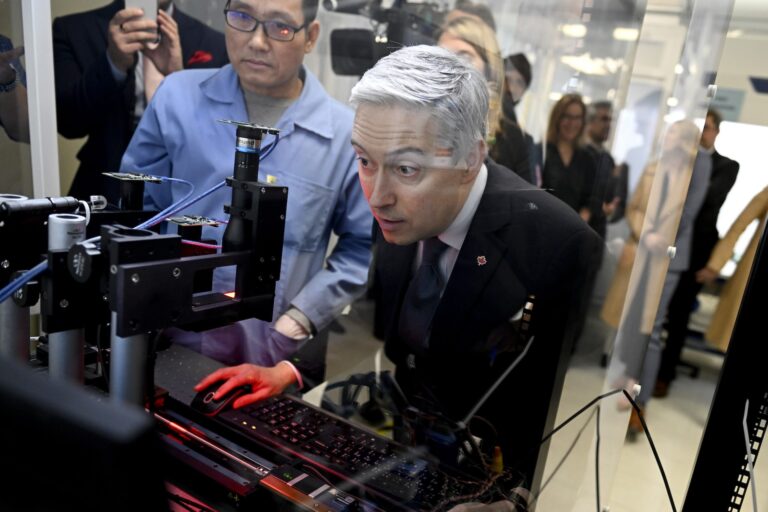
A researcher in one of the “self-driving” labs at the University of Toronto, which combines chemistry, automation and AI. Photo: Handout/Johnny Guatto/TAcceleration Consortium, University of Toronto
OTTAWA — Canada’s patent holdings are weakest in industries where it would most like to lead innovation, according to an analysis of data by the Conference Board of Canada, raising the question of where the country should focus its efforts to boost domestic IP.
Canada has lagged for years in growing and retaining IP compared to similar countries, ranking 17th this year in the World Intellectual Property Organization’s Global Innovation Index, just behind Estonia.
Talking Points
- An analysis by the Conference Board of Canada shows Canada’s patent holdings are weakest in some of the sectors where the government is keen to lead innovation, including AI, semiconductors and advanced manufacturing
- The lead researcher of the analysis suggests the government should play to its strengths in biotechnology, pharmaceuticals and environmental technology when devising policy
Researcher Zafer Sonmez took a novel approach to analyzing Canada’s patent holdings in the study earlier this year, comparing specialized expertise in particular sectors with the growth in that sector’s patent holdings to determine the innovative strength of particular industries. For example, a field in which Canada boasted both concentrated R&D capabilities and faster growth in the number of patents granted compared to other countries would score high in Sonmez’s analysis. He found Canada is particularly far behind in computer technologies like AI, semiconductors and advanced manufacturing.
All are the focus of federal programs run by Export Development Canada, the Business Development Bank of Canada and Innovation, Science and Economic Development Canada, Sonmez found.
Related Articles

He cautioned that some industries that appear to be lagging, including computer technologies related to AI, could be using other forms of IP protection that weren’t reflected in his analysis.
The results are intended to give policymakers a broad idea of which industries are leading and lagging when it comes to patent filings. The Conference Board recommends Canada focus on those areas of strength—like biotechnology, pharmaceuticals and environmental technology—that offer the highest potential return on investment, as the government renews its emphasis on retaining IP in critical industries.
“The lagging quadrant is the area where the Government of Canada should be the most selective in terms of supporting or implementing certain policies,” Sonmez said.
Another bright spot is nanotechnology, which has gained momentum, even if it still constitutes a relatively small share of Canada’s overall patent holdings.
While building on Canada’s strengths is important, anticipating the industries of the future should also be a government priority, said Louis-Pierre Gravelle, past president of the Intellectual Property Institute of Canada and deputy secretary general of Fédération Internationale des Conseils en Propriété Intellectuelle.
For AI in particular, Ottawa should encourage companies to file patents, he said, even though many firms feel the technology moves too quickly for patents to be effective. “When you’re filing a patent application where AI is involved, generally, you will not be limiting yourself to the very specific AI system that is currently being used today. Patent applications need to be future-proof,” he said.
Gravelle looked at the Conference Board’s data and recommendations and noted that some of the broad findings don’t reflect what he has observed personally. For example, civil engineering is listed as a relatively strong sector. “I see that there is some patenting activity in the oil and gas sector and in the mining sector, but even those modest patenting activities are dwarfed by some of the patenting activities of other companies around the world,” he said.
The government is in the process of reviewing its innovation programs as part of a government-wide cost-cutting exercise, and doesn’t intend to release the results until after the federal budget passes through the House of Commons.
The budget signalled, though, that intellectual property is central to the government’s innovation agenda and committed $182 million to renew programs that help companies build and manage their patent portfolios. That includes $22.5 million over three years for the Innovation Asset Collective’s Patent Collective, which is aimed at the cleantech sector; and $84.4 million over four years for Elevate IP, which helps startups leverage their IP. There is no word yet whether those programs will be adjusted to target different industries.
That sum also includes renewed funding for the National Research Council’s IP Assist Program, which helps small and medium-sized businesses develop IP strategies.
However, the Liberals appear to have shelved the idea of a patent box regime, which would offer companies a lower tax rate on income from domestic IP. The previous government promised the policy in the 2024 fall economic statement, and it was included in this year’s Liberal election platform as a way to stop made-in-Canada inventions from moving to the U.S.
When asked about what had become of the idea, Finance Department deputy spokesperson Marie-France Faucher did not answer directly, but pointed to several other R&D related tax incentives in the budget, including changes to the Scientific Research and Experimental Development Tax Credit. “Canada continues to monitor international best practices and remains open to new approaches to protecting competitiveness and supporting innovation,” Faucher said in a statement.
Gravelle said a patent box system will only be useful once firms start filing patent applications and profiting from them—that is, once the government’s other programs start yielding results.
Sonmez hopes to update his research every year or two to give policymakers a sense of how Canada’s patent holdings evolve as technology advances, and would like to see more companies move toward the leading quadrant. “That would indicate that companies are doing well,” he said. “They’re probably scaling.”



Loading...
Thanks for sharing!
You have shared 5 articles this month and reached the maximum amount of shares available.
CloseThis account has reached its share limit.
If you would like to purchase a sharing license please contact The Logic support at [email protected].
CloseGift the full article!
You have gifted 0 article(s) this month and have 5 remaining.
Recipients will be able to read the full text of the article after submitting their email address. They will not have access to other articles or subscriber benefits.
Photo: Handout/Johnny Guatto/TAcceleration Consortium, University of Toronto
Most Popular This Week




In-depth, agenda-setting reporting
Great journalism delivered straight to your inbox.
Commentary
Carmichael: Being boxed in will help Canada focus on what matters
Briefing
Rio Tinto gets nearly $165M in additional federal funds for Quebec aluminum
U.S. to lift tariffs on some Canadian products crucial to Maine: Collins
Carney warns of tech dependence after Starlink disruptions in Ukraine
Best business newsletter in Canada
Get up to speed in minutes with insights and analysis on the most important stories of the day, every weekday.
Exclusive events
See the bigger picture with reporters and industry experts in subscriber-exclusive events.
Membership in The Logic Council
Membership provides access to our popular Slack channel, participation in subscriber surveys and invitations to exclusive events with our journalists and special guests.






