At the Scotiabank Saddledome in Calgary, sports fans looking to buy a refreshment without missing much of the action can now pop into a store on the arena’s main concourse, scan a credit or debit card, take what they want and leave.
Same goes for Scotiabank Arena in Toronto. At two locations in the building, patrons can pick up a snack or drink without interacting with a cashier or scanning their purchases, completing their transaction instead through Amazon’s Just Walk Out system.
Talking Points
- Amazon’s seamless checkout technology, which doesn’t require customers to scan their items when shopping, arrived in Canada in late September at two stadiums, marking a new phase of expansion for self-checkout systems
- As consumers become increasingly comfortable sacrificing privacy for convenience, such “walk thru” shopping models are expected to become more common, especially as their cost to retailers comes down
The arrival of Just Walk Out in Canada in late September is the latest advancement in self-checkouts, technology whose uptake among consumers and businesses has been relatively slow and halting.
Amazon’s service operates through a combination of computer vision, product-weight sensors, generative artificial intelligence and other technology that monitors everything happening in the store to track which customers take what items with them. Visitors identify themselves as they enter by tapping a credit or debit card, or more recently their palm, and the system assigns them a one-time code for their visit.
Cameras mounted on the ceiling follow along, and the computer assigns a collection of pixels to each customer that updates should they remove a coat or take off a hat. Object-recognition tech and weight sensors track what they choose, from bigger items like sandwiches to smaller, harder-to-see ones, such as gum.
Cashierless systems have changed since their first appearance decades ago as somewhat of a customer nuisance, and are entering a new phase of expansion as they overcome consumer reluctance, privacy concerns and high costs. At the same time, technological advancement has paved the way for a new generation of “seamless” checkouts, faster and easier than even self-checkouts promised to be.
The self-checkout market in the U.S. is valued at between US$3.5 billion to US$4 billion, according to various estimates, and expected to grow in the mid-teens annually for several years. In Canada, where the pandemic prompted organizations to up their spending on self-checkout technology, one report projects expected annual growth at 12.2 per cent until 2030.
“I think we’re into a new era of checkout tech and now it’s going to be about trying to find ways of bringing that cost down,” said Doug Stephens, founder of Retail Prophet, a consultancy firm.
Within 10 or 15 years, he predicts, most major brands will use seamless checkout technology, meaning no lines, no scanning. “People are going to be walking through stores with their grandkids and saying, ‘Can you believe that we used to line up and we used to have to scan every item?’”
That aligns with Amazon’s vision. “People hated standing in line 50 years ago and they will hate standing in line 50 years from now,” said Jon Jenkins, vice-president of Just Walk Out at Amazon Web Services, the arm of the e-commerce giant responsible for the technology.
Still, the onset of self-checkouts has occurred in slow motion since its debut in 1986. Starting that July, for 14 weeks, a Kroger store in Atlanta tested a three-step system where customers scanned their own items, placed them on a conveyor belt to an employee who bagged their goods, and then paid for them at a separate cashier station. Digital payment systems smoothed the process further, but self-checkouts didn’t truly catch on until the turn of the millennium. Canada’s major grocers started installing the machines, promising customers they’d see more of them.
“People are going to be walking through stores with their grandkids saying, ‘Can you believe we used to line up and scan every item?’”
Though it was marketed as a convenience, Stephens noted, shoppers weren’t all thrilled with the change. “All it really does is take the labour that somebody not that long ago was being paid to perform and offloads that labour onto the consumer,” he said. Moreover, people often run into trouble using them, with items not scanning properly, and need to wait for a staff member’s help. Seamless checkout aims to remove those hassles.
The upside to businesses boils down to cost efficiency. Stores can employ fewer staff or retrain employees to work in other areas and provide better customer service, said Stephens. They can also reduce loss due to theft. At self-checkouts, it can be easy to steal. Customers can avoid scanning some items, or surreptitiously replace lower-priced ones with more expensive ones, he said. With seamless checkouts, that type of crime is harder to pull off. Amazon, for one, has seen the level of “shrink”—retail-industry speak for product lost to theft or other factors—decline at stores deploying its tech, said Jenkins.
Amazon Go—the company’s brick-and-mortar convenience store chain that uses its Just Walk Out system—first opened to the public in 2018, after two years of testing with Amazon employees only in Seattle. The system is now available in 70 of Amazon’s stores, including some Whole Foods locations, and more than 85 other retailers in the U.S., U.K, Australia and Canada.
The tech otherwise appears mostly in stores at stadiums, conference centres, theme parks, coffee chains and post-secondary campuses. All are venues where speed and convenience are at a premium. Airports are also a natural fit because stores can stay open for long periods without staff present, keeping costs down even when foot traffic is low.
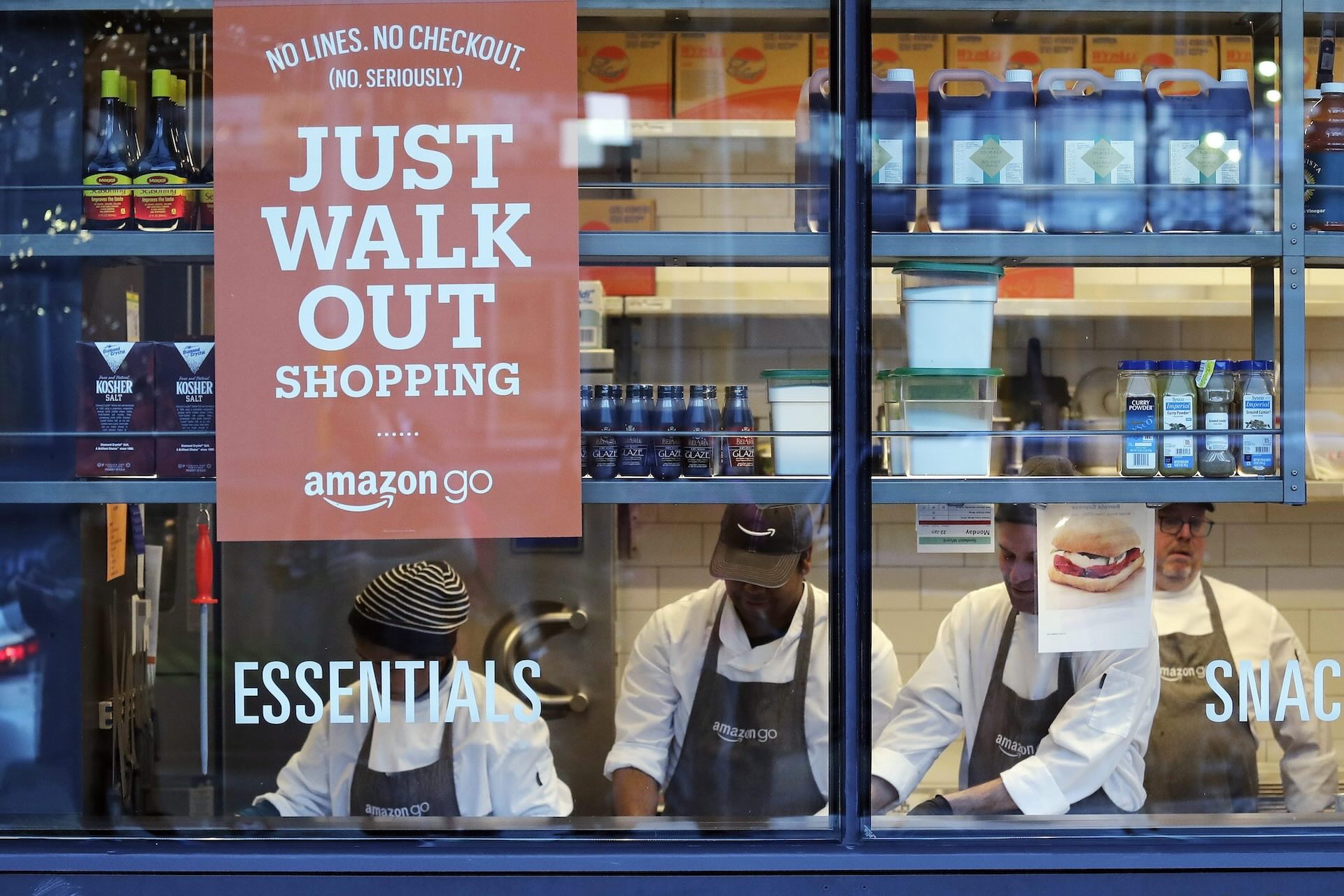
Workers at an Amazon Go store in Seattle. Photo: AP Photo/Elaine Thompson
Jenkins said the company is interested in bringing the technology to retail chains, but it will take time. He compared reception to it to the early response to Amazon’s online marketplace. “People were saying, ‘Gosh, it’s online commerce. You’re going to really type your credit card in on a website?’” Over time, shopping online became second nature. He expects a similar adoption curve for Just Walk Out.
As with many new uses of technology, privacy concerns arise. Amazon stresses that Just Walk Out does not collect biometric data, meaning physical traits such as fingerprints or iris scans. Its newer development, Amazon One—through which a customer identifies themselves by scanning their palm over a device—does. (The company has not put it to use in Canada.) Still, Amazon is facing a proposed class-action lawsuit in the U.S. claiming that Just Walk Out does collect biometric information without properly notifying customers, be it palm prints or body images. Jenkins said the company cannot discuss the details of the suit, but called the claims “factually inaccurate.”
Just Walk Out’s technology raises several concerns, according to the European Data Protection Supervisor, the EU’s independent data-protection authority. It is worried about vulnerable groups, like children, being exposed to the technology without additional safeguards; data being used for targeted advertising, direct marketing or other purposes; and constant surveillance becoming part of everyday life. Stephens acknowledged that appears to be the path society is headed down, if one connects the dots from Just Walk Out to Amazon One and onwards. “It leads to a future where you literally walk into a store without a wallet or a phone and simply take what you want, while paying with some part of your body,” he said.
Increasingly, though, people have become comfortable sacrificing privacy for convenience—“a devil’s bargain,” said Stephens, that younger customers in particular understand and are willing to make.
Another obstacle to mass adoption may be cost. Just Walk Out requires in-store hardware, such as cameras and sensors, and human reviewers working behind-the-scenes to ensure the tech operates smoothly. While Amazon declined to disclose the cost of the system, one grocer said it was quoted about US$240,000 per store to install the tech at several locations, reported The Information, a significant investment for many small or medium-sized retailers.
“It leads to a future where you walk into a store without a wallet or phone and simply take what you want, while paying with some part of your body.”
John Duoang co-founded Aisle 24, a cashierless grocery-store chain that opened in Toronto in 2016. It has since grown to more than two dozen locations in Ontario, Quebec and Alberta, with stores opening soon in Nova Scotia and B.C.
Customers require an app to enter—24 hours a day, seven days a week—and browse stock that features the wares of many small suppliers that target a young demographic. Niche products in the stores include protein puffs, pumpkin seed butter and pickle bites, which customers scan at a typical self-checkout station before seeing themselves out. Most never interact with the few staff members who visit briefly to tidy up. Aisle 24 has about 50,000 members to date.
The company’s founders discussed Just Walk Out with Amazon a few years after opening their first store, Duoang said, and took a look at similar systems developed by other companies. But the tech was either not quite ready, or too expensive, or both, he said. So they stuck with their model involving more conventional self-checkouts.
There isn’t a standard cost Amazon provides all retailers, said Jenkins, as the amount correlates to the size of the store. But his division has worked to reduce the cost, he said, adding, “It’s definitely not prohibitive.”
Aisle 24 is starting to consider some type of seamless checkout technology. Though stingy with details, Douang said the startup is in discussions with a company to add it to a pilot project with a Toronto health-care provider by early next year. After assessing its performance, they’ll decide whether to expand the tech to its other locations. “The bottom line is key, right?” he said.
Shopping options with other low-friction checkout systems are proliferating. At a Toronto Uniqlo location, shoppers can place their baskets down at the self-checkout and all their items pop up on the computer screen—no scanning required. They just pay, bag their purchases and leave thanks to the system’s use of radio frequency identification tags, which emit data wirelessly. Fans at Walk Thru Bru kiosks in Toronto’s Rogers Centre stadium can grab their drinks of choice from a fridge, place them on a tray and pay using their fingerprints, which they’ve pre-registered and linked to their payment cards.
There will always be exceptions, and outliers relying on old-school cash registers will remain, said Stephens. Still, he added, “I think in most environments, you’re going to go in and get what you want and leave.”
Amazon, for one, has big ambitions for the tech in Canada, including placing it at airports and post-secondary institutions. “There will definitely be more coming,” said Jenkins.
And while Duoang started out planning for several hundred Canadian locations, he has since expanded his vision potentially to several thousand. Aisle 24 is also considering a U.S. expansion, which it started planning in 2020 but paused due to the COVID-19 pandemic. The company is now in discussions with U.S. private equity firms about backing an international expansion, he said, adding, “We’re back on track.”