OTTAWA — U.S. President Joe Biden came to town on Friday to assure Canada that this country matters to his. In between oft-cited statistics about what we already are to each other—the length of the common border, the value of the trading relationship—he pledged a coordinated tomorrow.
Skip to content

Special Report
Biden makes case for new era of U.S.-Canada cooperation on chips, defence and critical minerals
‘We have an incredible opportunity to work together’
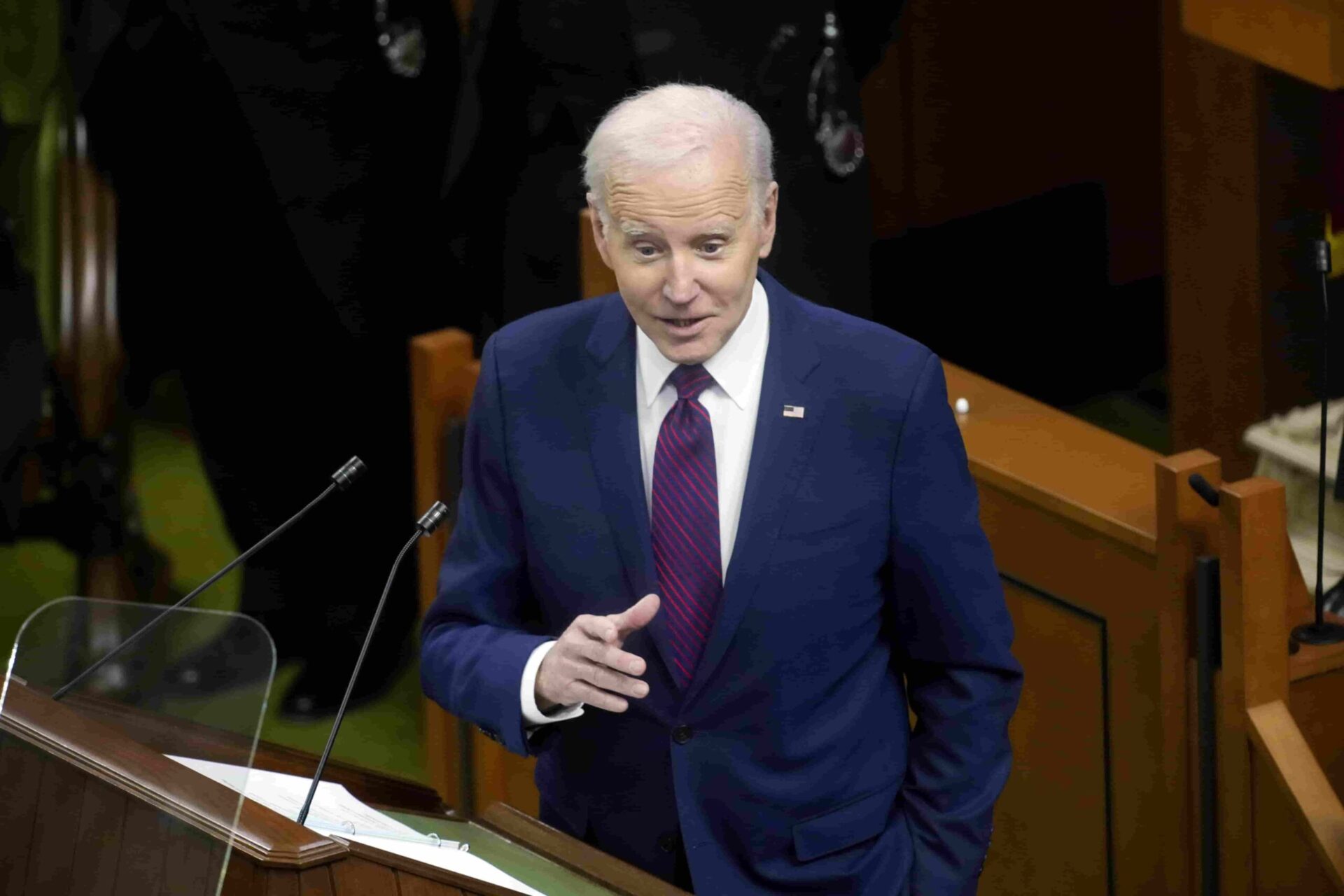
U.S. President Joe Biden delivers an address on Friday in Canada's House of Commons. Photo: AP Photo/Andrew Harnik
OTTAWA — U.S. President Joe Biden came to town on Friday to assure Canada that this country matters to his. In between oft-cited statistics about what we already are to each other—the length of the common border, the value of the trading relationship—he pledged a coordinated tomorrow.
It’s a future where “our supply chains are secure and reliable from end to end, because we’re creating the value at every step right here in North America,” he said in a speech to Parliament, citing the mining of critical minerals and packaging of semiconductors.
Talking Points
- Prime Minister Justin Trudeau welcomed U.S. President Joe Biden to Ottawa to make the case that their defence, economic and climate-change policies are linked, and in an age of growing protectionism, the two countries’ industries should be treated as one unit
- Biden responded in kind, pledging cooperation on semiconductors, critical-mineral supply chains, climate adaptation and international migration
The Biden administration’s US$369-billion Inflation Reduction Act and “Buy American” rhetoric during last month’s state of the union speech has raised concerns in Canada that the U.S. will suck up green investment. But Friday’s speech struck a reassuring tone.
“We have an incredible opportunity to work together, so Canada and the United States can source and supply, here in North America, everything we need for reliable and resilient supply chains,” Biden said.
In his speech, he announced a US$50-million incentive, under the U.S. Defense Production Act, to get U.S. and Canadian companies to invest in packaging semiconductors and printed circuits. Canada is to put $250 million into the effort through the Strategic Innovation Fund, a $100-million addition to money previously promised through the fund.
Between them, Prime Minister Justin Trudeau’s office later said, the two countries “will advance a cross-border packaging corridor, beginning with Canada and IBM providing a significant investment to develop new and expanded packaging and testing capabilities at its Bromont [Que.] facility.”
Related Articles


Innovation Minister François-Philippe Champagne called the new partnership—and Biden’s citation of it in his address—a “huge step” for both countries’ supply-chain resiliency. “This is not like [the] packaging at Amazon—this is really the very high-end value-added you can do in semiconductors,” he said, adding: “I expect my phone to ring quite a bit these days now that people will have heard the president.”
The cooperation is good, said the president of the Council of Canadian Innovators in a statement, but it brings risks.
“Let’s not forget the most crucial element: prioritizing Canadian companies with innovative intellectual property,” Ben Bergen said.
“If Canada wants to reap the economic benefits of the global semiconductor race, we need a new playbook with frameworks that fuel the growth of domestic companies in strategic niches and prioritizes long-term wealth creation.”
The president came to Canada intending to “reaffirm the United States’ enduring commitment to this U.S.-Canada partnership,” according to a pre-visit statement by administration spokesperson John Kirby. After rebuilding that relationship following tumultuous years under former president Donald Trump, he said, “this visit is about taking stock of what we’ve done, where we are, and what we need to prioritize for the future.”
Among those priorities, for the Biden administration, are increasing defence spending, racing to the top on clean energy and building “prosperous and inclusive” economies, Kirby said.
For Canada, the goal was to intertwine all those threads, linking Canada’s purchases of U.S. military equipment and contributions in North American air defence to burgeoning U.S. demand for raw materials that Canada supplies, as well as intermediate and finished goods this country can make—such as semiconductors and electric vehicles.
If we’re unified when it comes to defence, goes this thinking, we can be one unit when it comes to manufacturing, Canada can be on the inside of U.S. trade protectionism, and Canadians can benefit from the Biden administration’s industrial policy.
“Economic policy is climate policy is security policy,” Trudeau intoned in his opening act to Biden’s address, touching each of the main files the two leaders have opened during this trip. Trudeau hit the line again and again, reordering the nouns as he worked his way through the themes of his speech.
To illustrate, he cited an onlooker in the gallery, a Ukrainian immigrant living in Bridgewater, N.S. The federal government’s flagship innovation fund has awarded Michelin $44.3 million to expand plants in Bridgewater and nearby that will turn out tires for the EVs that Ottawa has spent billions more to get manufactured in Canada.
As the speeches continued in Parliament, the leaders issued a statement on the two countries’ new avenues of cooperation:
- Creating a new energy-transformation task force, co-chaired by Deputy Prime Minister Chrystia Freeland and Biden’s special coordinator for global infrastructure and energy security;
- Harmonizing standards for EV chargers;
- Building and fuelling safe small modular reactors and deciding how to store nuclear waste;
- Cleaning up the Great Lakes, with $420 million in Canadian funding being added to US$1 billion already allocated by the United States;
- Reaching a new treaty on the Columbia River Basin, which extends into British Columbia, focusing on flood management and clean power;
- Accelerating Canadian spending on NORAD modernization;
- Revising the Safe Third Country Agreement on asylum claims so as to cut the flow of irregular migrants into Canada at the unofficial Roxham Road crossing in Quebec. (Advocates for immigrants said it will endanger vulnerable people.) Canada is to accept 15,000 refugees from elsewhere in the Western Hemisphere, who typically reach the United States first.
In a news conference, Trudeau touted the energy-transformation task force—which has a one-year mandate—as key to integrating multiple Canadian and U.S. industries.
“This will include securing and strengthening electric-vehicle and critical-mineral supply chains and other areas to advance our collective energy security,” he said. “Of course, an integrated approach means creating good middle-class jobs for workers on both sides of the border that will make our collective economic growth stronger and more resilient.”
Western countries’ traditional argument in favour of their economic system has long had a flaw, Trudeau said.
“We sort of turned our back to the fact that it relied on cheap imports of goods or resources from parts of the world that didn’t share our values and weren’t responsible on the environment, or on human rights or on labour standards,“ he said. “What we’re doing right now is showing that we can and will build resilient supply chains between us and with friends around the world that adhere, every step of the way, to the values that we live by.”
Tackling the same issue, Biden—perhaps inadvertently—buttressed Bergen’s argument on what cooperation on semiconductors could mean in Canada.
“The idea that somehow Canada is put at a disadvantage because we’re going to probably be investing billions of dollars in their ability to package what is coming out of the semiconductor area—I don’t get it,” Biden said. “We greatly need Canada in terms of the minerals that are needed. If we don’t have a mineral to mine, you can mine them. If you don’t want to turn them into a product, we do.… I think we each have what the other needs.”
The news conference saw Trudeau take a question about the risk that TikTok, owned by China’s ByteDance, might be used as a tool by China’s government, and how he feels about his children using it.
“I am obviously concerned with their privacy and their security, which is why I’m glad that on their phones, that happen to be issued by the government, they no longer access TikTok. That was a big frustration for them. ‘Really, this applies to us too, Dad?’” he recounted. “‘Yes, I just did that.’”
All parents think about the effects of social media on their kids, Trudeau said, and the Liberal government is “carefully calibrating” upcoming legislation to try to combat online harms.
Following the news conference, the leaders headed to a dinner at the Canada Aviation and Space Museum, which has a Canadarm on display made for the U.S.-led Space Shuttle program. The guest list included Canadian celebrities who have been successful in the U.S. (such as Oscar-winner Sarah Polley and comic actor Eugene Levy), union leader Lana Payne, Marissa West of GM Canada, Patricia Gauthier of Moderna Canada and Joanna Griffiths of Knix.



Loading...
Thanks for sharing!
You have shared 5 articles this month and reached the maximum amount of shares available.
CloseThis account has reached its share limit.
If you would like to purchase a sharing license please contact The Logic support at [email protected].
CloseGift the full article!
You have gifted 0 article(s) this month and have 5 remaining.
Recipients will be able to read the full text of the article after submitting their email address. They will not have access to other articles or subscriber benefits.
Photo: AP Photo/Andrew Harnik
Most Popular This Week



In-depth, agenda-setting reporting
Great journalism delivered straight to your inbox.
The Big Read
Beacon is building an AI empire by fixing Main Street’s software
Briefing
Inovia raises US$200M for new VC fund as it eyes AI’s impact
43% of eligible Albertans voted ahead of Monday’s referendum
AI chip company Tenstorrent raises US$1.5B, valuing it at US$6.2B
Best business newsletter in Canada
Get up to speed in minutes with insights and analysis on the most important stories of the day, every weekday.
Exclusive events
See the bigger picture with reporters and industry experts in subscriber-exclusive events.
Membership in The Logic Council
Membership provides access to our popular Slack channel, participation in subscriber surveys and invitations to exclusive events with our journalists and special guests.







