Don’t be fooled by U.S. President Donald Trump’s recent promises to ease tariffs on foreign-made vehicles and parts so the U.S. auto sector can adjust. Car costs are still poised to rise by thousands of dollars per vehicle, posing a disadvantage to Canadian car manufacturers.
Skip to content

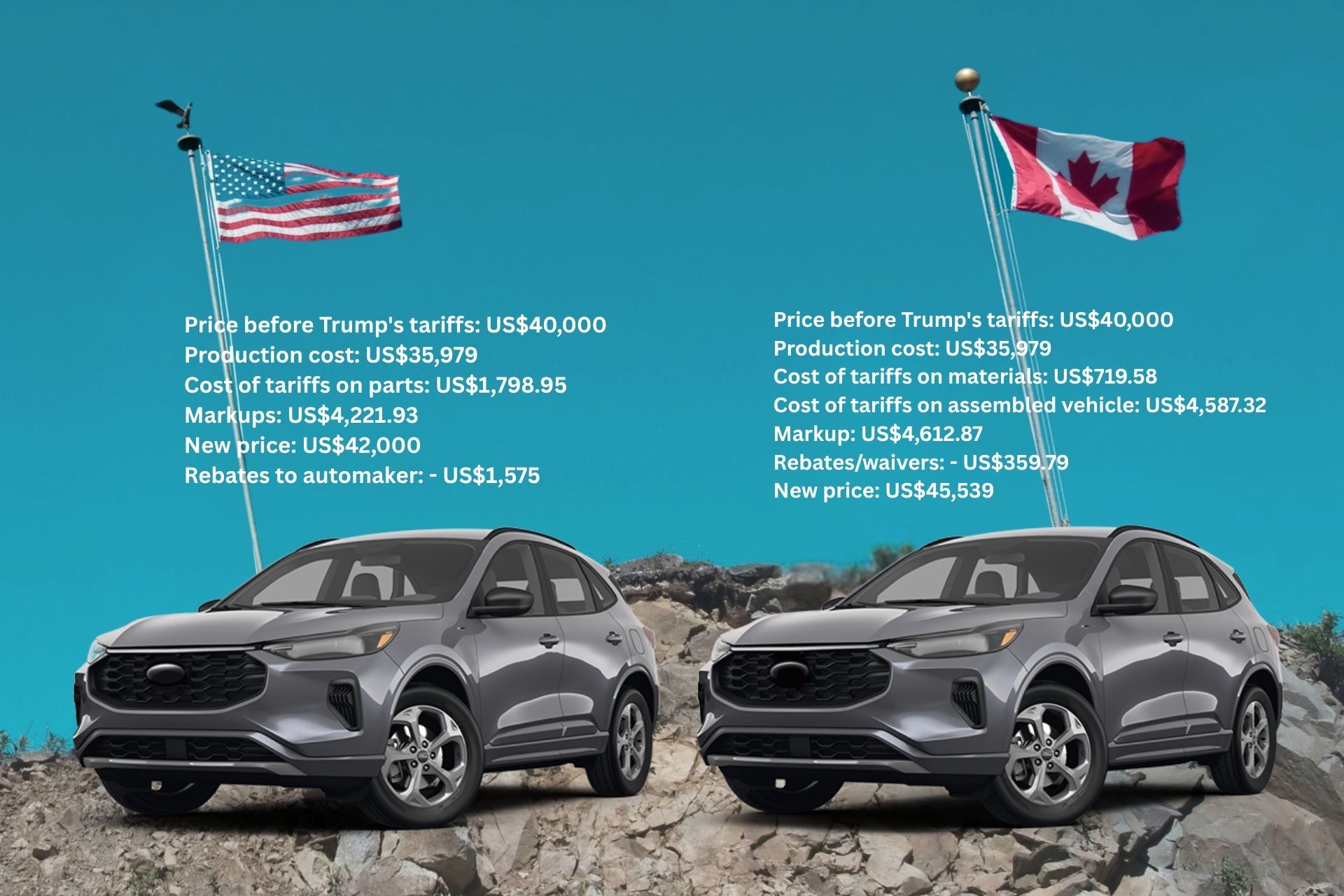 Photo: Illustration by Sumaiya Kamani for The Logic
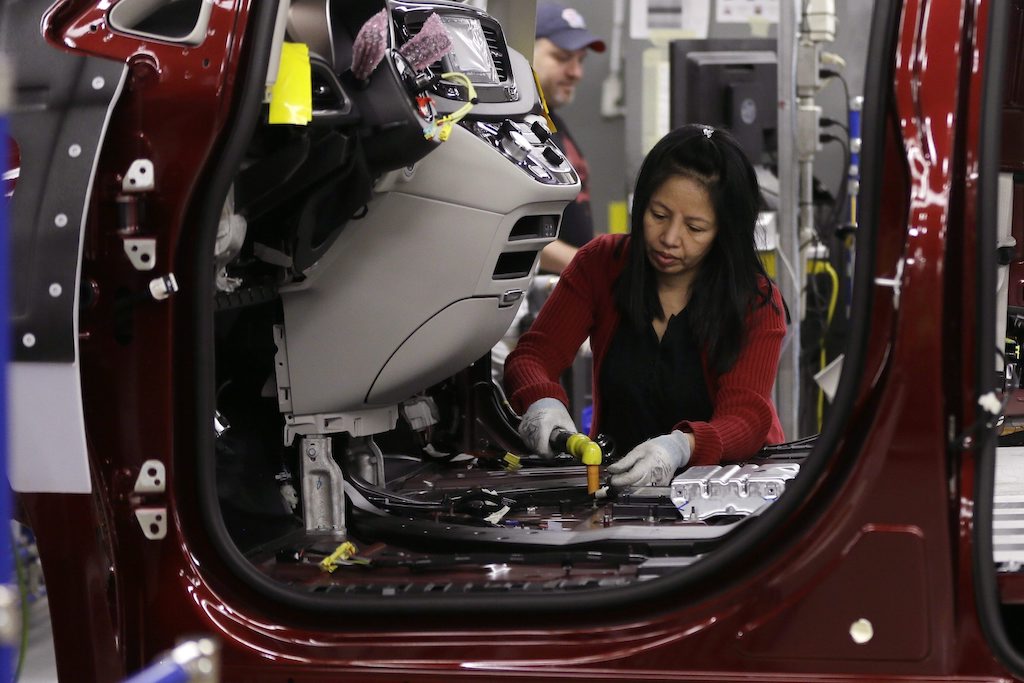 Stellantis's manufacturing plant in Windsor, Ont. Photo: AP Photo/Carlos Osorio
Special Report
How tariffs add thousands to the price of this Canadian-made SUV
We compared tariff costs on identical vehicles sold in the U.S.—one made in Canada, one south of the border. Canadian automakers should be worried.
Trump's tariffs mean a vehicle made in Canada could be much more expensive in the U.S. than an identical counterpart made south of the border. Photo: AFP via Getty Images/Geoff Robins
Don’t be fooled by U.S. President Donald Trump’s recent promises to ease tariffs on foreign-made vehicles and parts so the U.S. auto sector can adjust. Car costs are still poised to rise by thousands of dollars per vehicle, posing a disadvantage to Canadian car manufacturers.
That’s The Logic‘s finding from a dive into the constellation of costs, tariffs, exemptions, rebates and post-facto relief measures a North American automaker must now navigate before it slaps a price sheet on a vehicle.
Talking Points
- Tariff relief measures announced recently by U.S. President Donald Trump don’t entirely remove the burden of the levies on automobiles. The impact will depend on where a vehicle is assembled, which could be bad news for Canada’s car-making industry.
- To show why, we have compared the effects of tariffs on the prices of two hypothetical but identical SUVs—one built in Canada; the other in the United States
- Our findings show the tariffs and relief measures combine to put Canada’s auto industry at a considerable disadvantage
The purpose of the exercise is to show the likely impact of the tariffs as they currently stand. To do so, we have compared the cost and pricing effects on two hypothetical SUVs, which before the tariffs would have sold for US$40,000. One is built in Canada; the other in the United States. We have chosen this scenario because it reflects both real-world market conditions, and the immense complexity and variability of cost and pricing in the real-world automobile industry.
How variable are we talking? A recent estimate by U.S.-based Anderson Economic Group found that the overall tariff impact on a vehicle sold in the U.S. would be anywhere between US$2,000 to US$12,000, depending on its value, make and the country where it is assembled.
That’s a big range. But it’s a meaningful one to Canada’s auto industry, and its economy. According to Anderson, U.S.-made sedans like the Toyota Camry Hybrid will be least impacted, while vehicles like the Canadian-made Chrysler Pacifica van will see “medium” impacts of US$4,000 to US$8,000 added to production costs. Luxury imports will face the biggest price changes, the group estimates.
Related Articles

Why it matters: U.S. car buyers will feel some pain from their president’s tariff policy no matter the vehicle they purchase. From a Canadian perspective, the pain goes far beyond the pocketbook. Our exercise shows how hard it is for automakers to justify using Canadian auto assembly plants to make the same vehicles that would cost thousands less if they were made in the U.S.
To be sure, Canadian-made vehicles will fare better in the U.S. market than those made outside North America—which face 25 per cent tariffs on the full cost of the vehicle. And the calculation is going to differ for every vehicle.
But everyone from Unifor to the Canadian Chamber of Commerce has warned that if tariffs aren’t entirely lifted, we could see “less employment, domestic and foreign investment, and retirement savings for future retirees.”
To understand why, follow the journey of our two fictional SUVs that—in a not-so-fictional scenario—we’ll say were made across the Detroit River from each other.
Case 1: SUV made in Detroit
Retail price on Jan. 1, 2025 (before Trump’s tariffs): US$40,000
That price of US$40,000 would include markups applied after the vehicle is made. Based on standard industry practice we’ll assume it includes a manufacturer markup of seven per cent, and a dealership markup of 3.9 per cent.
That means our American-assembled SUV has a production cost of US$35,979—the starting point for this exercise.
Production cost: US$35,979
Step 1: Pay tariffs on parts that do not qualify for the USMCA
US$42,000
Final price of American-assembled SUV in the U.S.
Prior to the vehicle’s final assembly, automakers will have paid 25 per cent tariffs on parts from overseas manufacturing hubs, such as Japan, South Korea, Germany and China. Tariffed parts include powertrains, suspensions, steering and tires, as well as other parts like windshields, airbags, speedometers, locks and brake hoses that are not “wholly obtained, produced entirely, or substantially transformed in the United States.”
Importantly, U.S. Customs officials have been instructed to exempt Canadian and Mexican parts traded under the United States-Mexico-Canada Agreement (USMCA)—a bit of good news for parts-makers in both countries. Stellantis chief financial officer Doug Ostermann estimated that its U.S.-manufactured vehicles contain about 80 per cent USMCA-compliant parts.
Per Ostermann’s estimate, we’ll say it has 80 per cent USMCA-compliant parts that are tariff-free. That means the automaker likely paid 25 per cent tariffs on 20 per cent, or US$7,195.80 worth, of parts.
Cost of tariffs on parts: US$1,798.95
New production cost: US$37,777.95
Step 2: Pay tariffs on assembled vehicles
None, if sold domestically. The point of Trump’s tariffs is to encourage carmakers to assemble products in the U.S.
Cost: $0
Step 3: Add markups
Taking our new production cost of US$37,777.95, we’ll add back the seven per cent markup for the automaker and the 3.9 per cent dealership markup. There is some debate about whether automakers will absorb some of this cost, but in our scenario they try to maintain margins by raising the vehicle’s retail price.
Markups: US$4,221.93
Final price of American-assembled SUV in the U.S.: US$42,000
But wait, there’s more: The Trump administration is drawing up a process for carmakers to request tariff relief on vehicles made in the U.S., and aims to have it ready by May 29. The automaker would be eligible for rebates of up to 3.75 per cent of the sales price between April 3, 2025 and April 30, 2026.
It’s not yet clear what automakers will do when they get that money: invest in their supply chains, pass the savings on to future customers by taking a hit on margins, or perhaps offer other non-price incentives like electric vehicle chargers or extended warranties.
However they use it, it’s a notable advantage to the U.S. industry. In our scenario, a 3.75 per cent rebate would mitigate all but US$223.95 of the cost of tariffs on parts.
Cost reduction to automaker: – US$1,575
Case 2: SUV made in Windsor, Ont.
Retail price on Jan. 1, 2025 (before Trump’s tariffs): US$40,000
Since this vehicle is being built for sale at U.S. dealerships we will assume the production cost is the same as the Detroit-assembled car.
Production cost: US$35,979
Step 1: Pay tariffs on imported parts
US$45,539
Final price of Canadian-assembled SUV sold in U.S.
The Canadian government does not apply tariffs to auto parts shipped into Canada. It has, however, applied retaliatory tariffs to American steel and aluminum. And while Canadian auto parts maker Linamar estimated that both the U.S. and Canadian steel and aluminum tariffs will have minimal impact on the business, the Canadian Chamber of Commerce estimated that during previous steel and aluminum tariffs, product prices rose 1.6 for aluminum product prices and to 2.4 per cent for steel ones. To be safe, we’ve set aside two per cent.
Cost of tariffs on materials: US$719.58
Step 2: Pay tariffs on assembled vehicles
While Canadian parts are mostly exempt from tariffs if they end up in an American-assembled car, they are tariffed 25 per cent if they end up in Canadian-made cars that are sold in the U.S.
Stellantis’s Ostermann said cars imported from Canada and Mexico contain between 30 per cent to 50 per cent U.S. content. While Ostermann acknowledges this can vary by vehicle, we will use 50 per cent.
Cost of tariffs on non-U.S. content: US$4,587.32
New production cost: US$41,285.90
Methodology
Additional costs that we didn’t include:
- Legal, accounting and administrative fees to analyze tariffs compliance.
- Increased capital expenditures to expand U.S. supply chains before relief measures are phased out, as soon as 2027.
- Steeper tariffs on parts from China, a key supplier of batteries and electronics.
- Costs (or benefits) of changes to health-care costs and exchange rates this year between the U.S. and Canada.
- Costs or benefits from changes to tax policy.
- Tariffs on steel and aluminum imported into the U.S. We didn’t add tariffs for imported steel and aluminum into the U.S.-made vehicle, in the spirit of Trump’s April 29 order to minimize “stacking” tariffs. However, U.S. law firm Thompson Hine said it is still an “open question” on whether parts-makers that received exemptions under the USMCA for other tariffs will still have to pay steel and aluminum tariffs. U.S. Customs regulators planned to post guidance on that executive order by Friday.
Assumptions:
- Even if all the parts aren’t sourced in North America, the final vehicle is compliant with the U.S.-Mexico-Canada trade deal, exempting it from border-security related tariffs.
- Tariff costs were added directly to the sticker price and not subtracted from profits or distributed evenly across automakers’ lineups.
Step 3: Add markups
Once again, in our scenario, the automaker and dealership seek to maintain their margins by applying markups to the post-tariff amount.
Markups: US$4,612.87
New price: US$45,898.77
Step 4: Apply for remissions and relief
Under one of Trump’s executive orders, a vehicle subject to tariffs when it was imported from Canada may qualify for refunds on any “stacking” duties on its steel and aluminum content imported after March 4, and is expected to make the necessary updates to its system by May 16.
However, the refund only applies to the tariffs imposed by the U.S. (The Canadian government has said it will consider refunding or waiving its retaliatory tariffs under “exceptional and compelling circumstances,” such as goods needed for first responders.)
For the sake of simplicity, let’s say about half of the cost of the steel and aluminum tariffs is waived on the U.S. side.
Cost: – US$359.79
Final price of Canadian-assembled SUV sold in U.S.: US$45,539
What if these vehicles were sold in Canada instead?
The American-made vehicle would face the same cost increase for parts it imported to the U.S., plus a 25 per cent tariff on its U.S. content if it was sold in Canada. In our scenario, this would add US$6,825 to the cost of the car. The automaker could ask for that to be fully refunded, though, if it can prove that it is producing cars in Canada and hasn’t made cuts or paused work at Canadian factories.
The takeaway: Expect vehicle prices to rise even more than this, given the uncertainty around other costs (see our methodology). Our calculation is a simplified version of the one that’s confounding automakers around the world. We considered the at least five U.S. executive orders issued over the past three months and multiple customs notices and updates from both countries. But many of those rules remain unclear—so much so that at least six major automakers had to withdraw their earnings forecasts for the year during their recent quarterly reports.



Loading...
Thanks for sharing!
You have shared 5 articles this month and reached the maximum amount of shares available.
CloseThis account has reached its share limit.
If you would like to purchase a sharing license please contact The Logic support at [email protected].
CloseGift the full article!
You have gifted 0 article(s) this month and have 5 remaining.
Recipients will be able to read the full text of the article after submitting their email address. They will not have access to other articles or subscriber benefits.
Photo: AFP via Getty Images/Geoff Robins
Stellantis's manufacturing plant in Windsor, Ont.
Most Popular This Week




In-depth, agenda-setting reporting
Great journalism delivered straight to your inbox.
Commentary
Carmichael: Being boxed in will help Canada focus on what matters
Briefing
Rio Tinto gets nearly $165M in additional federal funds for Quebec aluminum
U.S. to lift tariffs on some Canadian products crucial to Maine: Collins
Carney warns of tech dependence after Starlink disruptions in Ukraine
Best business newsletter in Canada
Get up to speed in minutes with insights and analysis on the most important stories of the day, every weekday.
Exclusive events
See the bigger picture with reporters and industry experts in subscriber-exclusive events.
Membership in The Logic Council
Membership provides access to our popular Slack channel, participation in subscriber surveys and invitations to exclusive events with our journalists and special guests.






