OTTAWA — As Ontario’s election campaign heads for a finish June 2, people representing startups and scale-ups in Canada’s most populous province are glum.
Skip to content

Special Report
What Ontario’s parties are promising for the innovation economy
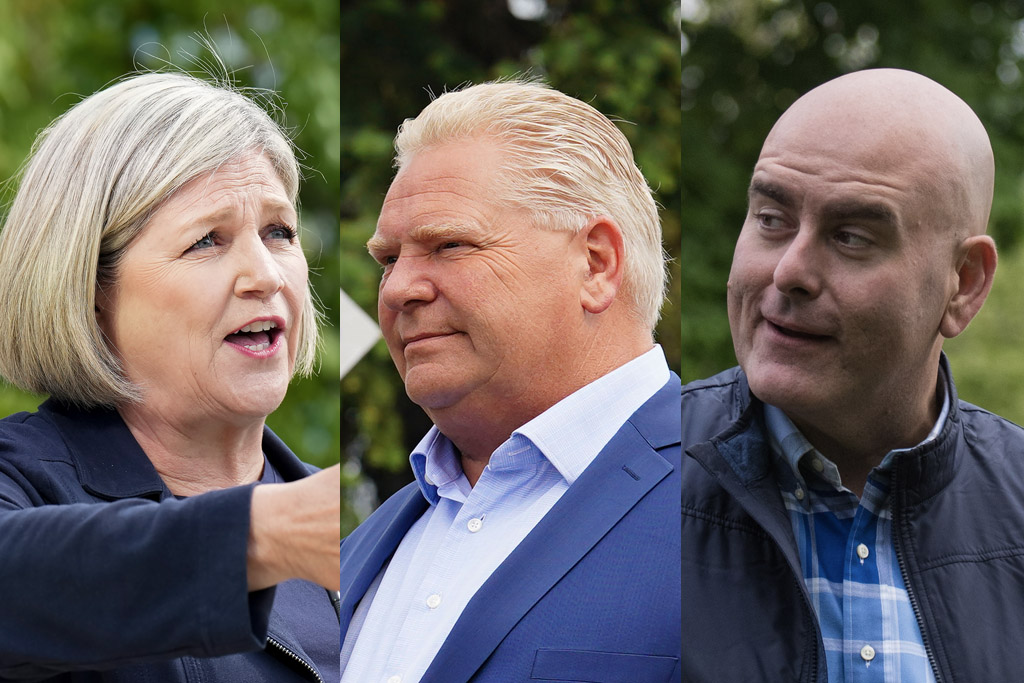
From left to right: Andrea Horwath, NDP leader; Premier Doug Ford, Progressive Conservative leader; and Steven Del Duca, Liberal leader. Photo: The Canadian Press/Nathan Denette; Ford: The Canadian Press/Sean Kilpatrick; Del Duca: The Canadian Press/Tijana Martin
OTTAWA — As Ontario’s election campaign heads for a finish June 2, people representing startups and scale-ups in Canada’s most populous province are glum.
“Generally, this election hasn’t been about the economy and that’s discouraging for people looking to grow companies,” Alanna Sokic, the Council of Canadian Innovators’s manager of government affairs in Ontario, told The Logic in an email. “There are some good policy proposals buried in the parties’ campaign platforms, but innovators would’ve liked to see more talk about an economic vision, a cohesive narrative of how we can seize the post-pandemic economic recovery and put the province on the best possible footing for the 21st-century digital economy.”
Talking Point
None of the Ontario parties has spent the provincial election campaign advancing a big vision for the future of the economy—the campaign has turned more on the cost of living and whether a new highway outside Toronto is good for commuters. But even if the leaders haven’t chosen to campaign on economic issues, their promises and platforms include pledges about how they’d try to boost productivity and the industries of the future.
The Progressive Conservatives lead in opinion polls, but not by such a big margin that they’re quite a lock for another majority. If the opposition New Democrats and Liberals do well on voting day, a minority legislature is possible, and finding common ground among the parties could be important.
The Logic has already reported on the parties’ approaches to housing, the auto sector, labour in the modern economy and Ontario’s role in the cutting-edge field of small modular nuclear reactors.
Here’s what else the major parties have promised for the innovation economy:
The Progressive Conservatives
In 2018, the Ontario Tories published a platform that was bigger on general ideals than specific promises, and it won them a majority, so their lack of any official platform this time might be understandable.
Just before the election call, their government issued a budget that the Tories have said they will reintroduce if the party is re-elected. It promises to build, build, build—highways, transit systems, hospitals, schools—to the tune of more than $158 billion over 10 years. It also promises to “bring tens of thousands of good, well‐paying jobs back to Ontario, seizing our opportunity in critical minerals, clean steel and electric vehicles,” and to “provide Ontario’s talented workers the skills and supports they need to find jobs.”
Greening the economy: The Tories repealed Ontario’s Green Energy Act after coming to power, pulled the province out of a cap-and-trade carbon market with Quebec and California, and aborted a pilot program that put electric-vehicle chargers at transit stations under the province’s control.
But more recently, they’ve shifted gears: their budget touted the hundreds of millions of dollars the Ontario government gave steelmakers to replace coal-based smelting with electric, spending on factories making electric vehicles and batteries for them, and installing electric-vehicle chargers. It promised a new advanced-manufacturing strategy, to be devised with industry.
The Tories have produced a strategy to produce and use low-carbon hydrogen, produced using hydroelectric and nuclear power, and a critical-minerals strategy.
At the same time, though, promises to build new highways—especially a major new route through farmland northwest of Toronto—are central to the Progressive Conservatives’ promise, on the discredited premise that more roads are good for traffic.
Skills training: The Progressive Conservatives have introduced tax credits and training programs, especially for the skilled trades, and their budget promised to keep increasing the range of applied degrees the province’s colleges can grant—such as in managing skilled-trades businesses.
Previous legislation has lowered barriers for workers with professional licences to move to Ontario from other provinces and start work; the budget called on the federal government to make it easier for newcomers to Canada to get credentials recognized here.
Promoting innovation: The Tories’ budget paid a lot of attention to financing growth and entrepreneurship in Ontario. It promised to triple the province’s venture capital fund from $100 million to $300 million, “focusing on building Ontario’s competitive advantages in key sectors, including life sciences, clean technology, information technology and artificial intelligence.” The government has begun consultations on overhauling its regulation of capital markets—which, since Ontario hosts the Toronto Stock Exchange, has national implications, and is revamping privacy and data-protection rules.
And the budget boasted about the Tories’ having created an intellectual-property agency to help boost and protect research and development.
“The PCs made big steps establishing an intellectual property agency, advancing procurement reform and creating a data strategy. If done right, these kinds of policies create the conditions that support a strong domestic tech ecosystem,” Sokic said.
The New Democrats
The Ontario NDP ask voters to “imagine an Ontario that’s prosperous and healthy, where folks don’t struggle to put food on the table or pay the rent, and well-paying, secure jobs are available to all.” They say rebuilding the provincial economy after COVID-19 offers a chance to fix longstanding social inequalities.
Their platform builds on some previous big policy statements, including on the environment and the economy.
Greening the economy: The NDP’s “Green New Democratic Deal” promises to restore a cap-and-trade system for reducing greenhouse-gas emissions, one they project will bring the provincial government $30 billion between 2022 and 2026‚ or an average of $6 billion a year. That’s more than covered by the NDP’s plan to spend $40 billion over a government term on transit, climate retrofits, job training and support for communities harmed by climate change.
The party promises to put some of the money into trade-exposed industries to help them compete and adapt, retrofit five per cent of buildings in the province each year for energy efficiency, create a “cleantech bank,” support green mining initiatives, and create new manufacturing and labour-force strategies, details TBD.
In the provincial power grid, the New Democrats say they want to expand hydroelectricity generation, add more wind and solar power, add connections to Quebec and Manitoba and establish “grid-scale storage” for renewably generated juice, with the goal of “achieving zero emissions by 2030.”
They also say they’d halt new nuclear-power projects until cost and waste concerns are resolved—and what to do with nuclear waste is a national question that could take decades to answer.
Skills training: The NDP platform is light on this. “As technology changes and we move toward a net-zero economy, opportunities for workers to gain new skills and retrain mid-career will become increasingly important,” it says, but its two specific commitments are to create thousands of co-op and internship placements for young people and to help colleges and universities create more work-integrated learning opportunities.
This is the part of the NDP platform that Sokic likes best. “Access to skilled tech talent is the No. 1 priority we hear from our members and that should be the bedrock of a political platform,” she wrote.
The NDP, like practically every party everywhere in Canada, say they’d work on recognizing the skills and credentials of people trained abroad—though in the Ontario NDP’s case, they say they’d focus on health care.
Promoting innovation: Aside from what’s covered in the NDP’s green plan, the party pledges to “build innovation hubs in areas with untapped potential.” They’re to combine small and medium-sized businesses, startups, universities, colleges, research centres, investors and workers—all under public leadership, but with “private-sector investment, capacity, knowledge and innovation.”
The Liberals
In 2018, the Ontario Liberals collapsed from a majority government to third place in the legislature, but their platform promises that they’ve “become a new Ontario Liberal Party by listening to you. One that shares your experiences and reflects your priorities. One that understands elections are just one part of a dialogue, not the end.”
It pledges to lower the cost of living (with moves like $1-a-ride transit), improve health care and schools, and devotes a chapter to seniors.
Greening the economy: The Progressive Conservatives scrapped the previous Liberal government’s cap-and-trade system for cutting carbon emissions, though they replaced it with a different cap-or-pay system for large emitters. This campaign, the Liberals say they’d add a new offset option—so emitters could buy offsets instead of paying penalties—and lower the caps to reduce emissions further. Whatever money the system brings in, they say they’d match with public funds and put into grants, tax credits and loan guarantees for a new Green Jobs Fund.
Rising electricity prices were a factor in the Liberals’ 2018 defeat and shenanigans in siting gas-generating plants led to a major scandal and jail time for ex-premier Dalton McGuinty’s chief of staff David Livingston. So this is a touchy subject for the party. This campaign, the Liberals promise to ban new natural-gas power stations and to phase out those already on the grid in favour of “fully clean” energy in a mix that includes nuclear.
The Liberals pledge to eliminate connection fees for new rooftop solar panels and bidirectional vehicle charging, allowing the big batteries in electric cars and trucks to supplement the provincial grid if they’re plugged in and demand is high.
Also, their platform says, “we’ll harness the power of hydrogen to help businesses get to net zero and break into new and competitive markets.”
Skills training: The Liberals promise to approve new programs at universities and colleges more quickly and to boost experimentation with a $1-billion fund to support them. They’d also work with employers and education institutions on new microcredentials programs to help workers upgrade their knowledge rapidly, and “create new targeted support for young people unable to find secure employment.”
(This, especially the support for microcredentials, is Sokic’s favourite part of the Liberals’ promises, which she said she’d like to add to the NDP’s plans.)
Immigration factors into the Liberal plan, too. They want Ontario to follow Quebec’s lead in taking more control of which immigrants are admitted, so they match the workforce needs the provincial government identifies; the platform mentions skilled tradespeople for the building industry in particular. And they want an easier path to permanent residency for international students who graduate from Ontario postsecondary institutions and invest in or buy businesses.
Promoting innovation: “Solving Ontario’s most complex problems and future-proofing our economy relies on people’s great ideas and technologies,” the Liberal platform says. To attract innovative companies, they’d overhaul the province’s privacy, data and intellectual property laws, encourage more people to patent their IP and make “strategic investments” in “companies with proven track records of innovation and commercialization.” They’d also help businesses “go digital,” with a special focus on rural and agricultural businesses, and promote low-cost cybersecurity solutions.
To help small businesses, the Liberals say they’d eliminate incorporation fees for startups, cap credit-card fees and “introduce a permanent commission cap for restaurant food-delivery service.”



Loading...
Thanks for sharing!
You have shared 5 articles this month and reached the maximum amount of shares available.
CloseThis account has reached its share limit.
If you would like to purchase a sharing license please contact The Logic support at [email protected].
CloseGift the full article!
You have gifted 0 article(s) this month and have 5 remaining.
Recipients will be able to read the full text of the article after submitting their email address. They will not have access to other articles or subscriber benefits.
Photo: The Canadian Press/Nathan Denette; Ford: The Canadian Press/Sean Kilpatrick; Del Duca: The Canadian Press/Tijana Martin
Most Popular This Week


In-depth, agenda-setting reporting
Great journalism delivered straight to your inbox.
News
Canada’s landmark ESG case heads to a final decision
Briefing
Matthew Proud-led SPAC threatens to pull out of merger with UniUni
Ottawa awards Mitacs $162M to create AI-focused work placements
Ontario puts $30M into Vector Institute for AI adoption
Best business newsletter in Canada
Get up to speed in minutes with insights and analysis on the most important stories of the day, every weekday.
Exclusive events
See the bigger picture with reporters and industry experts in subscriber-exclusive events.
Membership in The Logic Council
Membership provides access to our popular Slack channel, participation in subscriber surveys and invitations to exclusive events with our journalists and special guests.