OTTAWA — For Ontario’s Progressive Conservatives, local governments are the biggest obstacle to dealing with the province’s housing crisis.
Skip to content

News
Supply, supply, supply key to solving Ontario’s housing crisis, parties agree
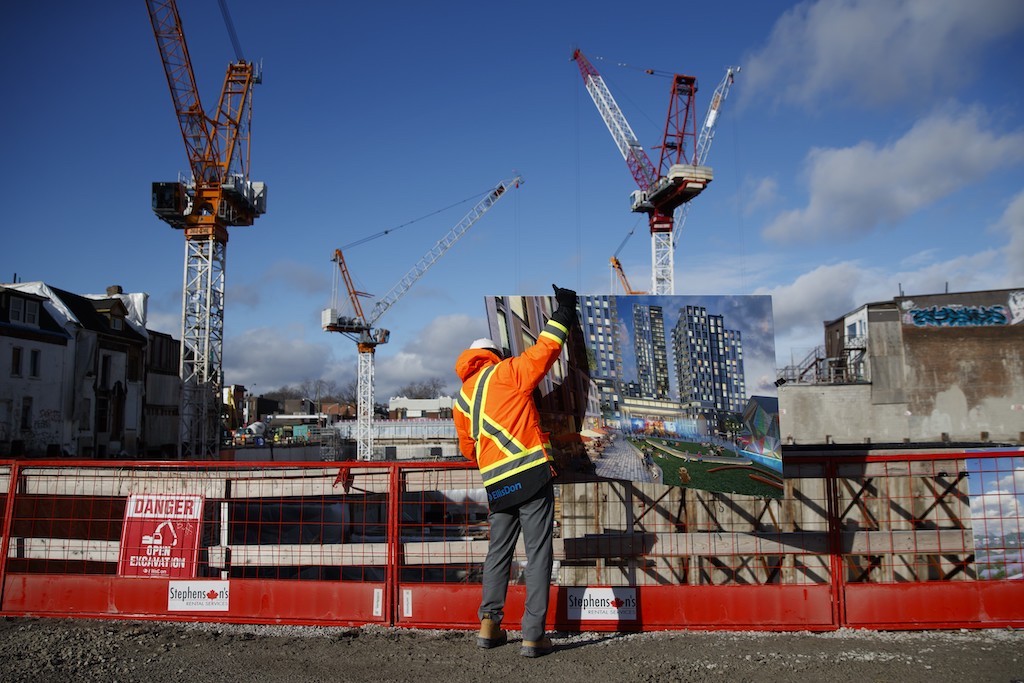
A worker affixing signs for a development at a construction site for new housing in Toronto in 2020. All the provincial party leaders agree that Ontario’s land-use planning system needs to be overhauled to enable more construction, faster. Photo: The Canadian Press/Cole Burston
OTTAWA — For Ontario’s Progressive Conservatives, local governments are the biggest obstacle to dealing with the province’s housing crisis.
“You ask anyone to try to build a home. Sometimes it takes two to three years to get approval from the municipalities. Folks, this is Economics 101. It’s very simple: supply and demand,” Tory Leader Doug Ford told the crowd at a leaders’ debate last week.
Talking Point
Provinces have more power than any other level of government to tackle the shortage of housing. As the cost of living rises, young workers find themselves priced out of their hometowns and would-be entrepreneurs see their money tied up in real estate, the Ontario election has all the major parties campaigning on land-use reform.
In many parts of Canada’s most populous province, home prices have more than doubled since 2016. It’s become a problem for workers and the companies that want to hire them, and as remote work has become viable for some people—especially in many technical and professional jobs—affordability issues have spread from urban centres into small towns.
If local governments get out of the way, the Tories argue, Ontario could be building more than half as many homes as it has been since the COVID-19 pandemic began, and twice as many as was usual in the years before it: an average of 150,000 new homes a year for 10 years.
Both the Liberals and the NDP have the same 1.5-million-home goal the Tories have.
Hold up, said Frank Clayton, a co-founder and senior research fellow at the Centre for Urban Research and Land Development at Toronto Metropolitan University (formerly Ryerson).
“It’s not a target that’s achievable,” he said. “The industry couldn’t produce [it]. They [have a hard] enough time right now. We’ve got shortages of labour and materials and particularly land—because land is the biggest hassle.”
Clayton is an economist who spent a career analyzing land-use policies and the real-estate market. He founded his own consulting firm in 1972 after working at the Canada Mortgage and Housing Corporation. He’s worked mainly in and around Toronto and he’s seen a few things. Including two previous housing crises.
“Once in the early ’70s, which was a national crisis, when house prices and rents all went crazy. And then we had it again in the latter ’80s [when] housing prices just exploded over about three years there and rents were going up,” he said.
One historical solution to spiraling home prices was a massive recession, he said, and nobody wants that. The other is opening land to development—either greenfields on the outskirts of cities for new dwellings or existing land for more density.
Ontario did that following the crunch of the 1980s, Clayton said, opening land for development that lasted until about 2005. Between 1990 and 2005, according to Statistics Canada, the price of a new home—not an existing one—in Ontario increased less than 10 per cent. From 2005 to 2022, it increased more than 78 per cent.
This spring the Tories presented a bill meant to make construction easier and quick-stepped it into law two weeks later. It requires municipal governments to rule on applications quickly or start discounting the fees they charge for things like rezonings and site-plan approvals.
“If you take two to three years to get a permit, what do you think happens within those two or three years? Lumber goes up, steel goes up, labour goes up,” Ford said in the debate.
The City of Toronto, for one, did not love it. Among its planning department’s many complaints: the new law doesn’t engage with how planning approvals actually work in real life, which is that often developers file applications for multiple layers of approvals at the same time, and even though the smaller permissions can’t be dealt with until the bigger ones are, the clock starts ticking toward refunds as soon as the paperwork is in.
It’s the first of what the Progressive Conservatives promise will be several moves to increase the supply of housing in Ontario. Their spring budget said they’d present a new plan every year for the next four years, “with policies and tools that support multigenerational homes and missing middle housing”—that is, buildings of a few storeys, sized between detached houses and towers, that development rules and economics have made impossible in many cities.
These moves at least focus on the right problems, Clayton told The Logic.
“The planning system is a big machine that you just can’t turn around, but the Conservatives are actually trying to do that,” he said.
They should go farther, he said, in keeping with the recommendations from a task force the Tories themselves named, which reported in February. Among those were to set provincewide rules sweeping away zoning for single-family homes and allowing four units in buildings up to four storeys on single lots, secondary suites and laneway houses, rented rooms and conversions of underused commercial properties to residential uses.
What those recommendations have in common is that they’d disrupt existing neighbourhoods, which voters often don’t like. But they’d make more use of land that’s already been built on, rather than seeing cities and towns sprawl out into farmland and creating new transportation headaches.
Few of the task force’s biggest ideas made it into the Progressive Conservatives’ spring bill, though a re-elected Tory government is promising those new plans to boost supply each year.
The other major parties’ platforms indicate they agree with at least part of the diagnosis that overly restrictive zoning is to blame for high prices, though they’re somewhat gentler on the local governments that are responsible for that zoning.
The Liberals say they want to “empower municipalities to accelerate housing projects,” make new housing a higher priority and reward municipalities for building more housing.
They promise $300 million over five years to help municipalities approve housing proposals faster.
But the Liberals also have a lot to say about more direct interventions in the market. They’d create a new provincial agency to finance and even build homes directly, and sell them to first-time buyers. In total, they aim to build 138,000 new “deeply affordable” homes, through social-housing and supportive-housing providers. They imagine they can make 80,000 acres of land available for housing by burying hydro lines.
And they’d target speculators, taking the federal Liberals’ plans for them and amping those measures up. Where the federal government wants to charge a one per cent tax on unused residential property owned by foreigners, Steven Del Duca’s party would put a five per cent tax on them—and a two per cent tax on similar properties owned by Canadians in urban areas. The feds want a two-year ban on property purchases by most non-resident non-Canadians; the provincial Liberals want a four-year one.
(This is a distraction, in Clayton’s view. If you can stop prices from soaring, speculating on real-estate will no longer make sense, he said. Speculation is a symptom, not the problem.)
The Liberals would also put a levy, in an unspecified amount, on people who own land that’s been approved for development and “serviced” with things like water and sewers, but not built on—enough, they say, to fit 250,000 units.
The New Democrats, finally, also see a need for land-use planning reform, by “ending exclusionary zoning and updating growth policies to increase the supply of affordable housing in pedestrian and transit-friendly neighbourhoods.”
Plus, they’d “create a new Residents’ Rights Act so homeowners can easily and inexpensively convert an unused garage, basement or floor into an affordable rental home.” Similar to the Liberals, they’d also create a new provincial housing agency.
“Housing affordability is a crisis all over Ontario,” NDP Leader Andrea Horwath said in the debate. “Already, young people are walking away from their dreams of ever owning a home. That means people leave the communities that they love to find something more affordable—in some cases move great distances away from loved ones, away from family.”
The NDP also promise numerous measures to increase renters’ and buyers’ purchasing power—moves to help people pay the prices sellers can currently command.
Among many other things they’d introduce “shared-equity loans” to help first-time buyers afford down payments, and impose hard rent controls.
“We’ll bring back real rent control for all units and scrap vacancy decontrol,” their housing policy book says. “This means new tenants will pay what the previous tenant would have paid, and landlords will no longer have an incentive to push existing tenants out.”
Clayton scoffs at that, because it would also mean landlords would no longer have an incentive to rent to anyone. “If you want to get more rental housing, we can’t have stringent rent-control schemes,” he said.
Whatever the province does, it won’t work immediately: constructing a home takes months to years. Which is why, Clayton said, there’s no time like the present to get started.
“Our land-use planning system is really the culprit in Ontario,” he said. “[It’s why] the supply of housing is so unresponsive to changes in demand and changes in prices—because it’s all driven by government.”



Loading...
Thanks for sharing!
You have shared 5 articles this month and reached the maximum amount of shares available.
CloseThis account has reached its share limit.
If you would like to purchase a sharing license please contact The Logic support at [email protected].
CloseGift the full article!
You have gifted 0 article(s) this month and have 5 remaining.
Recipients will be able to read the full text of the article after submitting their email address. They will not have access to other articles or subscriber benefits.
Photo: The Canadian Press/Cole Burston
Most Popular This Week




In-depth, agenda-setting reporting
Great journalism delivered straight to your inbox.
The Big Read
Alberta’s referendum is just the start of the turmoil
Briefing
EverWind plans $10B data centre and wind development in Nova Scotia
Canada ready to force Stelco to sell its Canadian operations, Joly says
Feds plan a 60 MW defence-oriented data centre for Ottawa
Best business newsletter in Canada
Get up to speed in minutes with insights and analysis on the most important stories of the day, every weekday.
Exclusive events
See the bigger picture with reporters and industry experts in subscriber-exclusive events.
Membership in The Logic Council
Membership provides access to our popular Slack channel, participation in subscriber surveys and invitations to exclusive events with our journalists and special guests.






