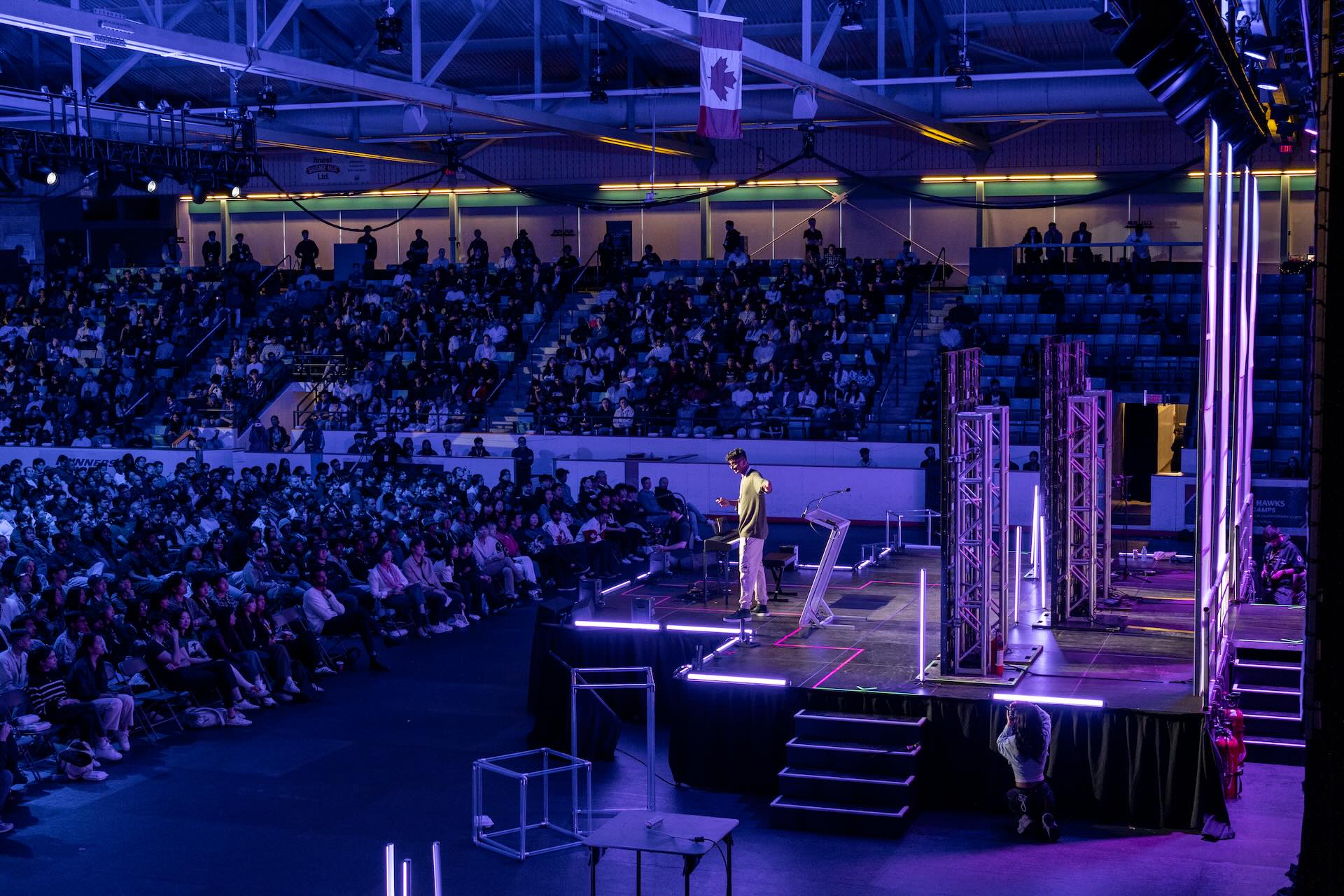
WATERLOO, ONT. — Before the man in the proto-Iron Man suit or the woman with the bass-playing robot took the stage, before the big screens at the front of the arena filled with googly-eyed trains or local landscape photos, before any of that, there was the message.
Skip to content
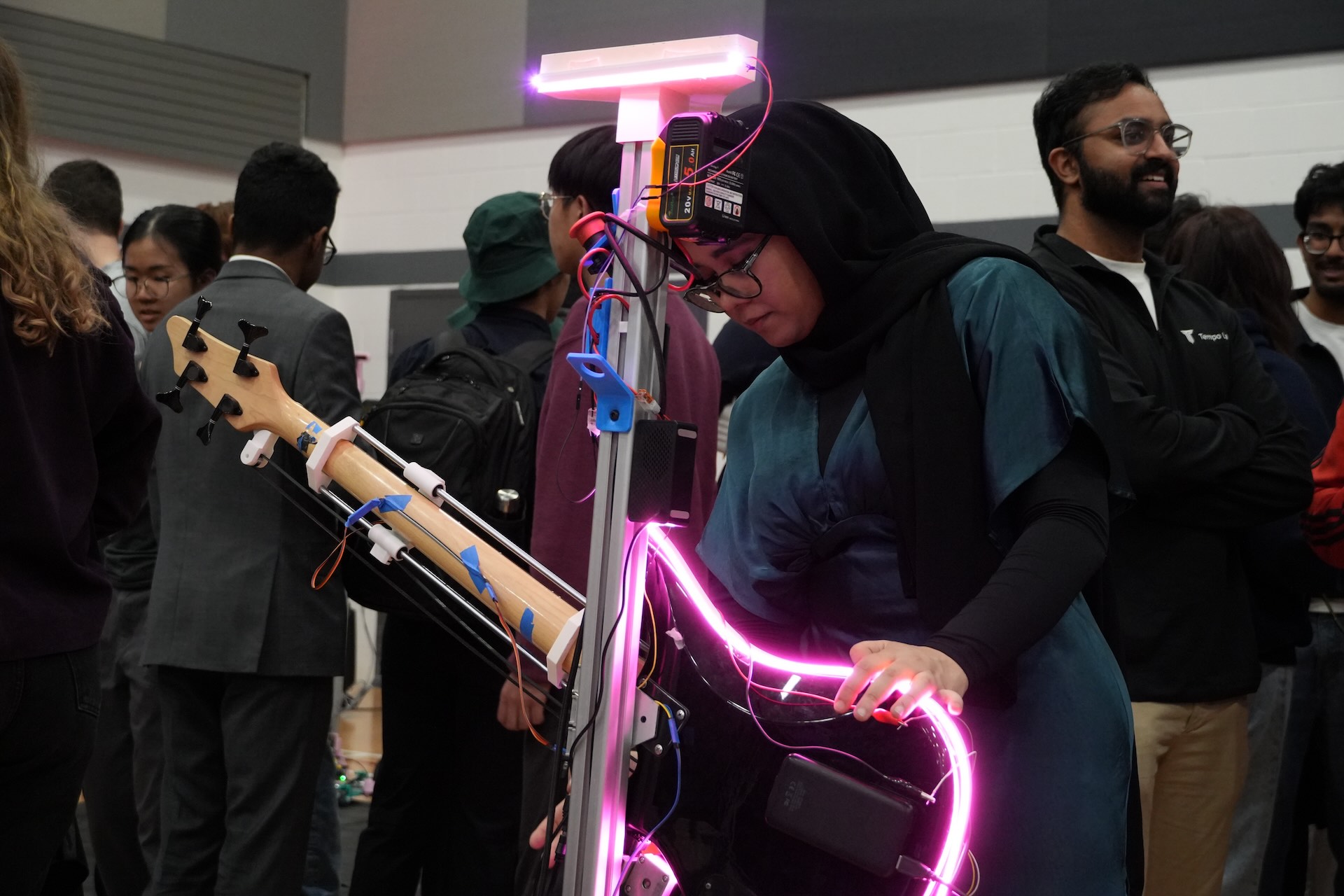 Maisha Thasin demonstrates her robot, which plays “Seven Nation Army” on the bass. Photo: Tony Li via Socratica
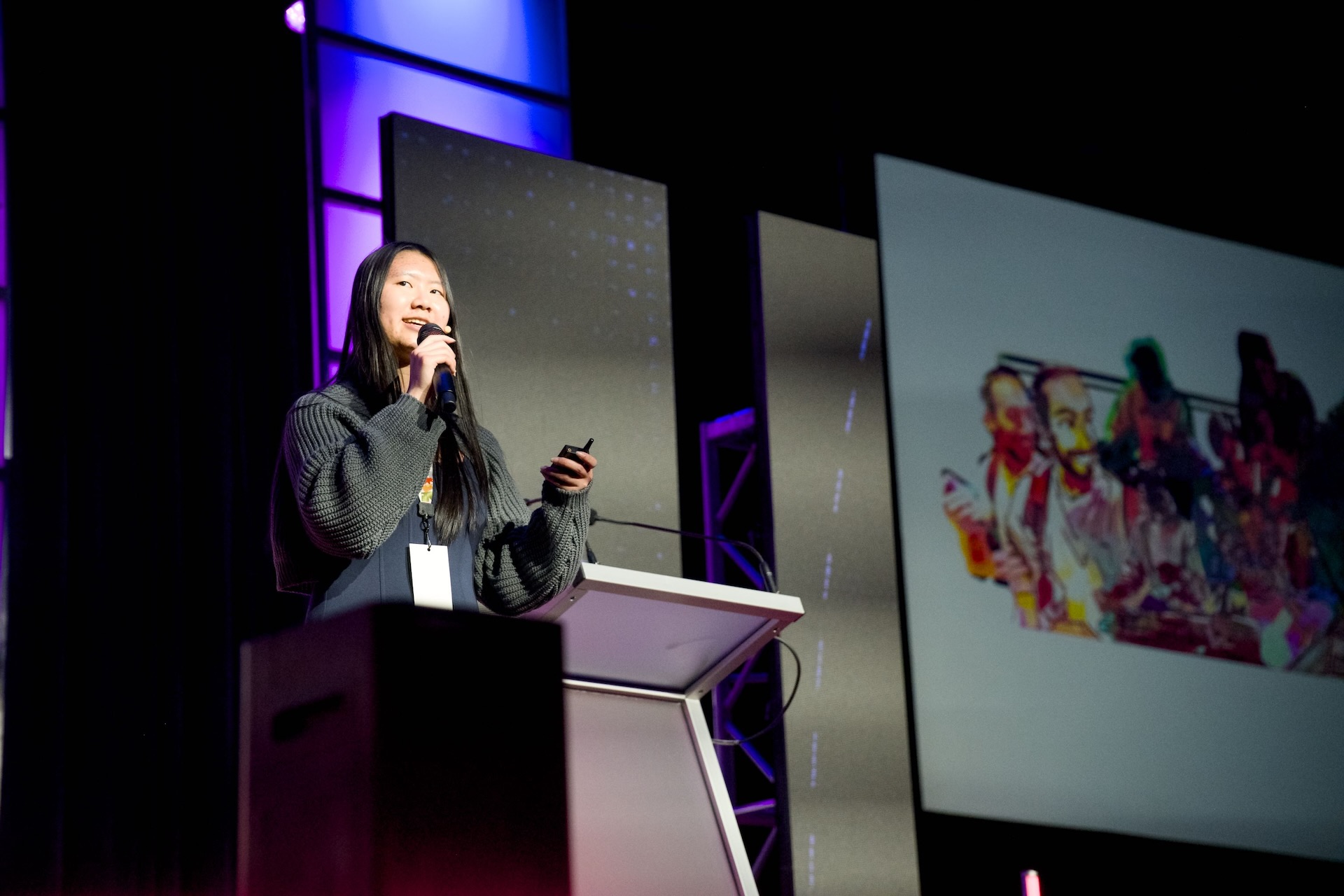 Jasmine Ju talks through her journey making art. Photo: Wilbur Zhang via Socratica

Special Report
Canada’s next generation of builders thinks they’re really onto something
Some 2,500 young people packed a Waterloo hockey arena to talk about what they’re making, and why the future isn’t just another Big Tech job
Rishi Kothari explains Arterial, his software tool for developers, at the Socratica Symposium in Waterloo, Ont. on March 19, 2025. Photo: Freeman Jiang via Socratica
WATERLOO, ONT. — Before the man in the proto-Iron Man suit or the woman with the bass-playing robot took the stage, before the big screens at the front of the arena filled with googly-eyed trains or local landscape photos, before any of that, there was the message.
It appeared twice, silently spelled out on screen, before a voiceover read it aloud. “You clearly want to make something,” it said. “So why not just make it?”
On a Wednesday evening last month, a Waterloo hockey arena filled with dozens of projects inspired by that mantra, and some 2,500 people who’d come to see that work and soak up some of that inspiration. Socratica—a kind of young-people collective started at the University of Waterloo (UW) that has so far spread to 40 chapters in 10 countries—put on the symposium.
Related Articles

Student-led hackathons and demo days are nothing new, especially in Waterloo, a city known for turning out engineers that tech giants clamour to hire and some of Canada’s most promising startups. But it would be too simple to think of Socratica and its symposium as just another tech thing. It’s broader than that, and maybe deeper too.
Socratica started in January 2022 as a drop-in co-working session on Sunday mornings for university students seeking a creative break from the routine of class and work. Waterloo’s engineering school is well-known for being demanding. So is its co-op program, which gives students real-world work experience.
It’s a place filled with “incredible human potential and raw, sheer talent,” says Anson Yu, one of the symposium’s volunteer organizers. But, she says, the school’s achievement-oriented culture can discourage “doing things that are weird or could fail.”
So Socratica tries to give people permission to try new things they’re not very good at yet by showing that most of the people around them are in the same boat. It’s the “risk tolerance and celebration of effort” that makes the gatherings special, according to Yu.
Rishi Kothari’s contribution to the symposium is Arterial, a property technology startup that’s working with developers on projects in the real world. When he set out to address the housing crisis he saw around him growing up in Brampton, Ont., Kothari had “zero domain expertise,” he readily admits. “We just approach things with an air of curiosity.”
Kothari is working the system, not trying to get around it. “If you change the places that you’re looking, you can turn something that is normally a hindrance into a power,” he says.
His approach isn’t a rehashed version of the move-fast-and-break-things philosophy that became shorthand for Silicon Valley’s worst reflexes. In an earlier generation, a founder frustrated by high home prices might have launched some sort of on-demand service that ignored municipal zoning bylaws. Instead, Arterial lets developers figure out what they’d be allowed to build on empty parcels of land in Ontario and how much it would cost, based on local rules and city hall decisions.
But software startups and robots aren’t the only things people make at Socratica. After Kothari’s demo, one presenter talked the audience through her writing practice. Another described how drawing helped with her social anxiety. “Make what you love,” read one of her slides.
Later in the evening, climate engineer Arielle Lok explained how she’d mounted a successful pressure campaign to get the Massachusetts Bay Transportation Authority to put googly eyes on Boston trains and trams. Lok may not be able to fix broken transit, but she can at least make it more friendly.
Many millennials might have found a way to monetize these interests. Launched into the post-Great Recession job market, that generation learned that hobbies were just side-hustles-in-waiting, and cashed in on their extracurriculars. Today’s young people have watched a greater share of their peers than any previous generation find fame and fortune online.
But while the Socratica crowd have learned the art of storytelling from social media influencers, most still seem driven more by the love of the craft than commercial opportunities. Daniel Wang, a third-year business student at Western University, led a team that made hundreds of chocolate chip cookies and Rice Krispies treats to hand out at the symposium. “It’s not a side hustle,” he says. “I just enjoy baking for fun.”
Earlier, Soham Basu had put on a piano recital in two parts, including a particularly fast and florid interpretation of Coldplay’s “Clocks.” A UW computer science and finance student whose last co-op was at Amazon, Basu plays piano as a creative outlet between bouts of studying and working. He’d never performed in front of that many people or on that particular keyboard before. “You just wing it and hope it works out,” he says, which is easier, he adds, in a room full of peers just as eager to “challenge themselves to achieve exciting things.”
These young people insist that the writers, mass bakers and quixotic campaigners among them are not that different from the software founders and robot-builders. It’s a risk to carve out time to do something for yourself at a school where everyone else is focused on landing the best possible co-op placement and preparing to ace it—whether that thing is code or art, Kothari says, “The emotions are the exact same.”
Inevitably, not everyone here will get to keep their dreams. Some will end up at Big Tech firms, making products and working for bosses they don’t necessarily believe in; millennials learned that. At least one will probably end up at Raytheon.
The mood around the Waterloo hockey arena last month may have felt like a religious revival, but commercial realities were still very much on display. At intermission, attendees had a chance to win goodies like mechanical keyboards and Meta’s Ray-Ban AI glasses; the QR code to enter directed them to the career page of event sponsor Shopify. Socratica shows “what happens when you try to solve all the problems around you, just for the love of it,” Farhan Thawar, Shopify’s head of engineering, said in a pre-recorded message, claiming the tech firm has “the same spirit.”
But on the night of the symposium, no one seemed to be thinking much about corporate careers. Nathaniel Angafor, a computer science student at the University of Rochester, had spent seven hours on buses to get to Waterloo. He has an offer to work at Oracle in San Francisco in the fall, he says, but instead plans to join some friends to launch a startup; they’re still figuring out what it’ll make. “I’m trying to take a less traditional path,” Angafor says.
The students at the symposium will soon graduate and go out into the world of work. The Socratica organizers hope they’ve armed attendees with the confidence that they can make a living, and much more, simply by making things—and that they should support each other to maintain that belief. “It feels like we’ve tapped into a part of the zeitgeist that is going to be really loud for the next couple of years,” says Yu.
Update: This story has been edited to reflect updated numbers from Socratica and the symposium.



Loading...
Thanks for sharing!
You have shared 5 articles this month and reached the maximum amount of shares available.
CloseThis account has reached its share limit.
If you would like to purchase a sharing license please contact The Logic support at [email protected].
CloseGift the full article!
You have gifted 0 article(s) this month and have 5 remaining.
Recipients will be able to read the full text of the article after submitting their email address. They will not have access to other articles or subscriber benefits.
Photo: Freeman Jiang via Socratica
Maisha Thasin demonstrates her robot, which plays “Seven Nation Army” on the bass.
Jasmine Ju talks through her journey making art.
Most Popular This Week




In-depth, agenda-setting reporting
Great journalism delivered straight to your inbox.
Commentary
Carmichael: Being boxed in will help Canada focus on what matters
Briefing
Rio Tinto gets nearly $165M in additional federal funds for Quebec aluminum
U.S. to lift tariffs on some Canadian products crucial to Maine: Collins
Carney warns of tech dependence after Starlink disruptions in Ukraine
Best business newsletter in Canada
Get up to speed in minutes with insights and analysis on the most important stories of the day, every weekday.
Exclusive events
See the bigger picture with reporters and industry experts in subscriber-exclusive events.
Membership in The Logic Council
Membership provides access to our popular Slack channel, participation in subscriber surveys and invitations to exclusive events with our journalists and special guests.






