SHARM EL-SHEIKH, EGYPT — Soon after world leaders wrapped their statements Tuesday—a chorus of pleas from vulnerable nations for more climate ambition from their wealthier counterparts, who offered assurances they would do more—a United Nations working group led by Canada’s former environment minister Catherine McKenna dropped a scathing report on greenwashing that called out companies and financial institutions for saying one thing and doing another.
Skip to content



Special Report
Greenwashing report from McKenna-led UN group puts banks on notice
‘Net zero is entirely incompatible with continued investment in fossil fuels’
Catherine McKenna, who led a group of many high-level experts on net-zero emissions, during an interview at the COP27 U.N. Climate Summit in Sharm el-Sheikh, Egypt on Tuesday. Photo: AP Photo/Thomas Hartwell
SHARM EL-SHEIKH, EGYPT — Soon after world leaders wrapped their statements Tuesday—a chorus of pleas from vulnerable nations for more climate ambition from their wealthier counterparts, who offered assurances they would do more—a United Nations working group led by Canada’s former environment minister Catherine McKenna dropped a scathing report on greenwashing that called out companies and financial institutions for saying one thing and doing another.
In her new role as chair of the UN’s High-Level Expert Group on net zero emissions, McKenna said in the report that companies can’t “claim to be net zero” while continuing to build or invest in new fossil fuel assets. “Net zero is entirely incompatible with continued investment in fossil fuels. Similarly, deforestation and other environmentally destructive activities are disqualifying.”
The Logic at COP27
COP27 in Sharm el-Sheikh, Egypt, is being billed as the “implementation COP,” where leaders will be held accountable for their climate commitments. But Russia’s invasion of Ukraine, an energy crisis, rising inflation and a global economic slowdown have transformed the world since nations last met in Glasgow at COP26.
The Logic’s Catherine McIntyre is reporting on the ground in Egypt, speaking to policymakers, climate experts, investors and business leaders to find out how the negotiations will affect Canada’s net-zero ambitions.
The report, which isn’t binding but which lays out requirements that corporate net-zero plans need to satisfy for the UN to consider them credible, landed one day before the official COP27 agenda turns to finance. It underscores a jarring shift in tone from the zeal felt at last year’s COP in Glasgow that the financial sector could help save the planet—that if they could just agree to a few guidelines, banks, asset managers and institutional investors controlling trillions of dollars could divert enough money from fossil fuels to low-carbon assets to eliminate emissions by mid-century.
Carried on that wave of enthusiasm, Canada’s largest banks—RBC, BMO, Scotiabank, CIBC and TD, along with Vancity and National Bank of Canada—signed on to former Bank of Canada and Bank of England governor Mark Carney’s Glasgow Financial Alliance for Net Zero (GFANZ), joining a group of global financial firms representing US$130 trillion in assets.
A year later, several of those firms are having second thoughts. Some U.S. banks have reportedly threatened to leave the alliance and Canadian banks have also raised concerns that some of the criteria to which GFANZ requires them to commit are too restrictive—particularly around phasing out fossil fuels—and could put them at legal risk. Race to Zero, a UN body which set the criteria GFANZ has adopted, clarified in September that members can “independently find their own route.”
Related Articles
Tuesday’s report from the McKenna-led group said this isn’t good enough. “Leadership campaigns like Race to Zero and sector alliances like the [GFANZ] must reinforce high-quality voluntary efforts and consolidate best practices into general norms,” it said.
If Canadian banks are working on improving their climate plans, that work doesn’t appear to be happening at COP27. There are no finance executives here from TD, RBC, BMO or Scotiabank in Sharm el-Sheikh, according to spokespeople for the banks. While TD has no formal delegation, it sent a small number of observers, a spokesperson told The Logic, but declined to provide their names or titles. CIBC spokesperson Tom Wallis said the bank has “representation” at COP, but after several back and forths over email, he would not say who from the bank was here or what positions they held.
RBC did send John Stackhouse, senior vice-president in the office of the bank’s CEO. A former national newspaper editor, he leads the bank’s research and “thought leadership” practice with a focus on economic and technological disruption. In a chat at the Canadian pavilion in the conference centre Tuesday afternoon—sponsored by the federal government, the space resembles a theatrical set design of a bustling corporate office, complete with a coffee station and conference room—Stackhouse said that while industries like banks aren’t part of the formal negotiations at COP, they can influence the decisions delegates make via conversations on the ground at the world’s cornerstone climate event.
“Many of the sustainability and climate leads from European and American banks are here,” Stackhouse told The Logic. “It’s not the only place where we can get together but it’s an important place because a lot of the policies that affect our financing commitments are also determined here.”
Canadian banking’s modest presence at COP coincides with a growing backlash from corporations and the investors and lenders that fund them against the prominence recently given to environmental, social and governance issues. Corporations in the U.S. are now preparing for investigations into their ESG policies amid a Republican reprisal for “woke capital.” Texas and Florida have moved to ban state pension funds from having sustainable investing rules. HSBC’s Stuart Kirk, now ex-head of responsible investing, claimed that climate change concerns were “unsubstantiated” and “shrill” and Elon Musk, the richest person on the planet, has dubbed ESG “an outrageous scam.”
While Carney has dismissed the GFANZ members’ reported apprehensions and threats to leave the group, the organization published a report last week showing it remains far from its goals. The world requires a sevenfold increase in investment in renewables in emerging markets and developing economies—an additional US$1 trillion a year by 2030—to reach net-zero by 2050.
Stackhouse said he doesn’t anticipate the same volume of announcements and pledges Wednesday as rolled out at COP’s Finance Day last year. It may have been easier to back sustainability as a concept before anyone was tracking what it actually meant. “Some may never have intended to achieve their stated goals, aiming only to benefit from the positive press abounding at the time,” reads the report the McKenna group released Tuesday. “But net zero is now at an inflection point.”
Elsewhere at COP27:
• Developing countries need an additional US$1 trillion a year by 2030 to deal with loss and damages caused by climate change, according to a new report by Egypt and the U.K.
• China’s climate envoy said Beijing is committed to carbon neutrality and said multilateralism and cooperation is key to achieving that, after pausing climate talks with the U.S. in August.
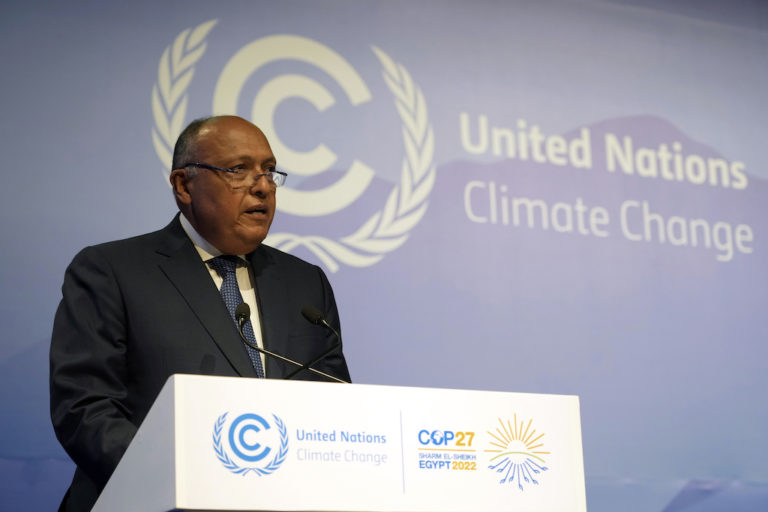
• COP27 president Sameh Shoukry unveiled the Sharm el-Sheikh Adaptation Agenda Tuesday, a 30-goal plan to improve the lives of four billion people vulnerable to climate change.
• “There can be no effective climate policy without the peace,” said Ukrainian President Volodymyr Zelenskyy in a video message played at COP27.
• Back in Ottawa, the parliamentary budget officer found Canada’s GDP was 0.8 per cent lower—that’s roughly $20 billion to $25 billion less—than it could have been without climate change. If countries around the world meet all of their climate commitments, global warming will still reduce Canada’s GDP by 5.8 per cent by 2100, the report said.



Loading...
Thanks for sharing!
You have shared 5 articles this month and reached the maximum amount of shares available.
CloseThis account has reached its share limit.
If you would like to purchase a sharing license please contact The Logic support at [email protected].
CloseGift the full article!
You have gifted 0 article(s) this month and have 5 remaining.
Recipients will be able to read the full text of the article after submitting their email address. They will not have access to other articles or subscriber benefits.
Photo: AP Photo/Thomas Hartwell
Most Popular This Week




In-depth, agenda-setting reporting
Great journalism delivered straight to your inbox.
Commentary
Carmichael: Canadian ignorance about India is a strategic weakness
Briefing
Aritzia shares pop after earnings rise 204%
First Nation in Alberta goes to court over fast-tracked oil pipeline
Chinese EV maker Geely Auto Group to launch in Canadian market in 2027
Best business newsletter in Canada
Get up to speed in minutes with insights and analysis on the most important stories of the day, every weekday.
Exclusive events
See the bigger picture with reporters and industry experts in subscriber-exclusive events.
Membership in The Logic Council
Membership provides access to our popular Slack channel, participation in subscriber surveys and invitations to exclusive events with our journalists and special guests.





