Crypto Quarterly is The Logic’s recurring series assessing the overall state of the crypto market, with a focus on digital assets with strong ties to Canada.
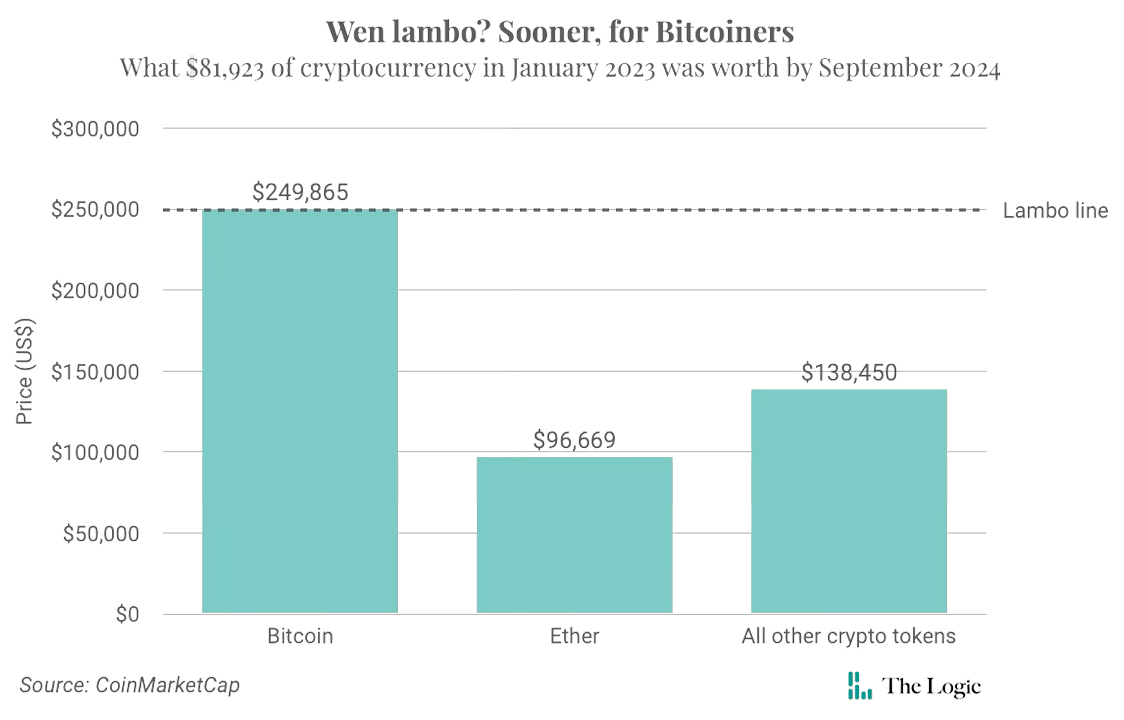
There’s a half-joking phrase crypto holders use to ask how long they’ll have to wait before their holdings make them rich: “Wen lambo?” For people who bought at the market bottom in early 2023 following the collapse of crypto giant FTX, the answer to when they can afford a Lamborghini depends on what digital assets they own.
The total value of all cryptocurrencies has grown significantly since then, from US$661 billion on Jan. 1, 2023, to about US$2.1 trillion at the end of September. But that growth has been uneven. Bitcoin’s value roughly tripled over that time period, while the market capitalizations of Ether and all other crypto tokens have increased less—rising about 118 per cent and 169 per cent, respectively.
Talking Points
- What digital asset will allow you to afford a Lamborghini the fastest—or in crypto parlance, “Wen lambo?”
- Spoiler: In the third quarter, the answer was Bitcoin, which is starting to look more like a blue-chip asset in the crypto world. (This is not investment advice.)
That means the “wen lambo” number for Bitcoin at the market bottom was about US$81,923: if you bought bitcoin worth that much on Jan. 1, 2023, you could have walked into a dealership at the end of September and bought a 2024 Lamborghini Huracán in cash at a price of US$249,865. Someone who bought the same U.S. dollar amount of ether on the same day would be US$153,196 away from being able to drive off in that lambo. A person who purchased a portfolio of all other crypto tokens would be closer, but still US$111,415 short.
Bitcoiners are gloating as they speed past the competition. Probably not in a shiny new lambo, though—they’d rather spend any extra cash they have to buy more bitcoin.
Adam O’Brien, CEO of Edmonton-based Bitcoin Well, which provides a platform for buying, selling and using bitcoin, said “you’re better off going to the casino” than buying crypto tokens other than bitcoin. “The [casino] games are tax-free in Canada.”
Crypto markets tend to follow four-year cycles that coincide with Bitcoin’s halving events, the last of which occurred in April. These events cut the rewards for successfully mining a new block of transactions in half, increasing the scarcity of the digital assets.
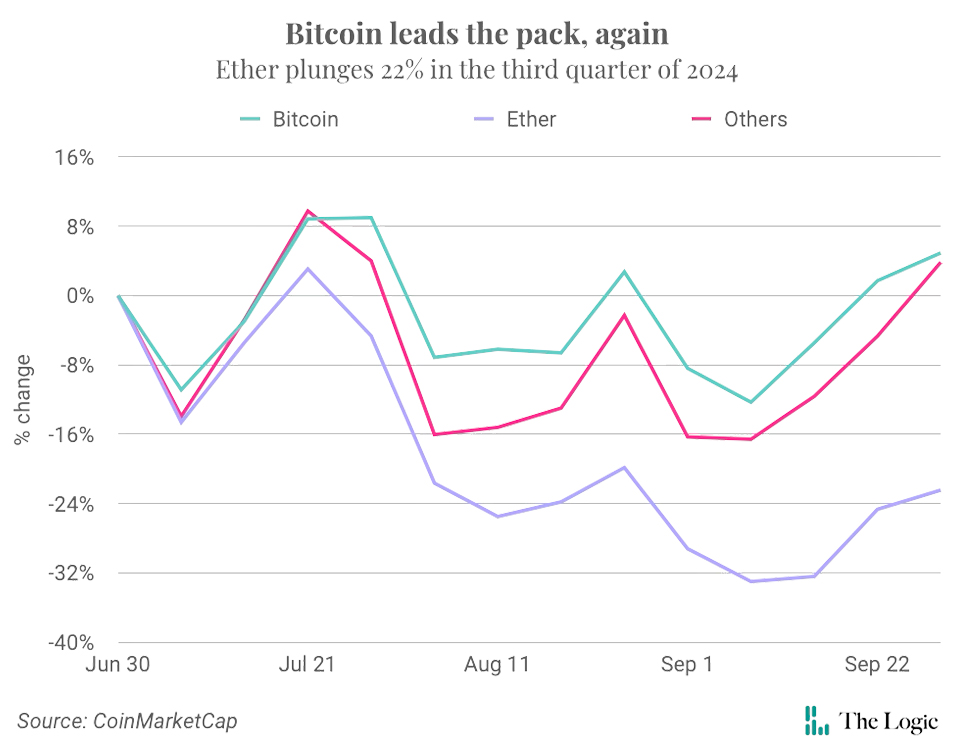
In past cycles, bull runs for Ether—the second most-valuable digital asset after Bitcoin—and other crypto tokens have followed price run-ups for Bitcoin. This time around, however, Bitcoin has continuously outperformed its peers. The price of Satoshi Nakamoto’s original digital asset was up about five per cent at the end of September compared to the beginning of the third quarter, while Ether plunged 22 per cent over the same period.
Greg Benhaim, head of product at Toronto-based digital asset fund manager 3iQ, cautioned that past performance does not guarantee future results. “The classic ‘Bitcoin leads and everything follows,’ I think, is misinterpreted,” he said.
Other blockchains like Ethereum and Solana may be faster and better for coding applications, but they lack Bitcoin’s community and track record of reliability, Benhaim said. Additionally, he said Ether is designed to be used to participate in NFT marketplaces, decentralized finance and other applications on the Ethereum blockchain. The tokens are not supposed to be simply held in cold storage to appreciate in value—which helps explain why Ether exchange-traded funds, which launched in the U.S. in July, haven’t seen the same wild success as Bitcoin ETFs.
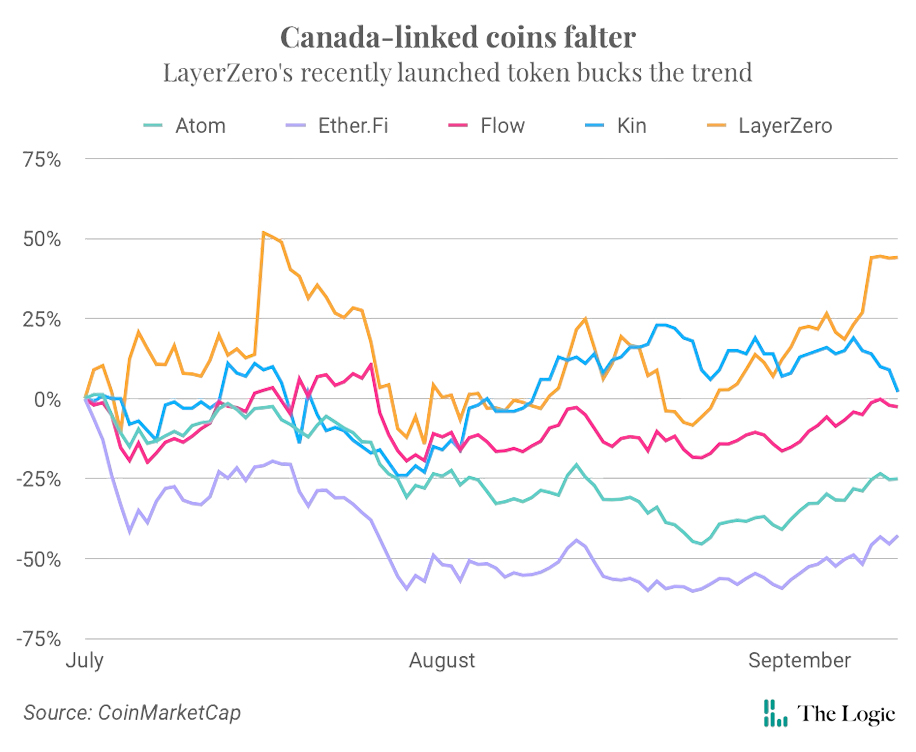
Many smaller crypto tokens linked to Canada have also floundered. Flow, the blockchain built by Vancouver’s Dapper Labs of NBA Top Shot fame, hit an all-time high of US$39.24 in March 2021. Three years later in March of 2024, it reached US$1.64—its highest price since November 2022.
An outlier is LayerZero’s ZRO token, which debuted in June and gained 44 per cent over the third quarter. Vancouver-based LayerZero designed the protocol to make it easier for blockchains to communicate and share data with each other. The company raised US$120 million at a US$3-billion valuation in April 2023, in the depths of the crypto winter.
Tokens like Flow and ZRO were designed with a function in mind, but the non-Bitcoin digital assets that have received the most attention in recent months are so-called meme coins—crypto coins that explicitly serve no purpose other than speculation.
Moo Deng, a baby pygmy hippo who recently became a viral internet sensation, at the Khao Kheow Open Zoo in Thailand in September 2024. Photo: AFP via Getty Images/Lillian Suwanrumpha
In May, a Florida man suffered third-degree burns after drenching himself in isopropyl alcohol and letting two people shoot fireworks at him in a stunt designed to promote his meme coin Truth or Dare. Earlier this month, a meme coin called MOODENG—designed to capitalize on the viral popularity of the eponymous Thai baby pygmy hippo—surged almost 500 per cent in 24 hours after Russian-Canadian inventor Vitalik Buterin sold US$762,000 worth of the token he had received as a gift and donated the proceeds to charity.
Meme coins make it hard for people to take crypto seriously, Benhaim said. “Imagine a team that’s built a company up to half a billion dollars and it’s taken 15 years of their lives to do it. And then they see a meme coin that launched and three months later is valued at $2 billion,” he said.
When the answer to “Wen lambo?” is sooner for tokens based on viral interest in an adorable hippo than serious projects, “it’s very tough to convince people to get interested in digital assets at all,” Benhaim said. It’s funny to think of Bitcoin as a stodgy, blue-chip asset for fundamentals-focused investors—but in the crypto world, at least, it’s starting to look that way.