OTTAWA — Four years into an experiment running its own health clinics staffed by physicians, Shoppers Drug Mart has given up on the idea, in favour of ones run by pharmacists.
Skip to content


News
Why Shoppers Drug Mart gave up on physician-led health clinics
Growing scope of treatment by pharmacists one factor, but clinics led by MDs were money-losers
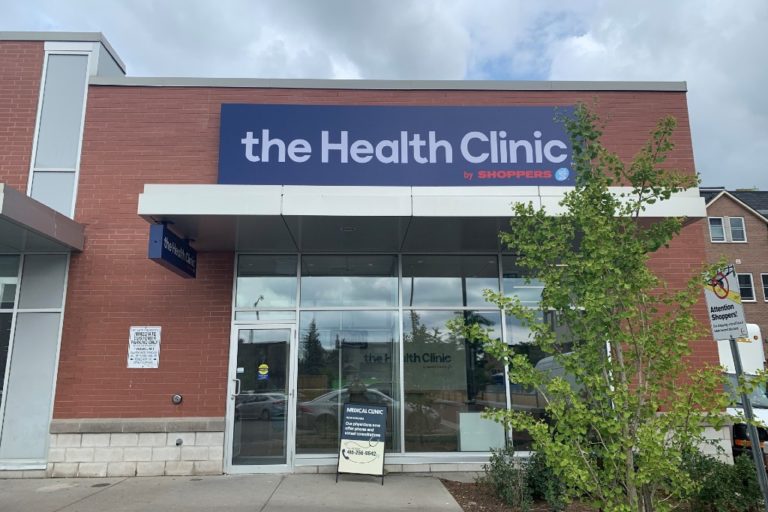
A Shoppers Drug Mart health clinic in northwest Toronto, before the chain abandoned its brief experiment with doctor-run clinics. Photo: Handout/Shoppers Drug Mart
OTTAWA — Four years into an experiment running its own health clinics staffed by physicians, Shoppers Drug Mart has given up on the idea, in favour of ones run by pharmacists.
It’s a rare change of direction for the health division of the Loblaw retail empire, one driven by provinces’ moves to expand the health services pharmacists are allowed to offer, Loblaw spokesperson Aly Vitunski told The Logic.
Talking Points
- Shoppers Drug Mart opened 10 family-medicine clinics in Ontario and B.C. as part of its quest to be an “omni-channel” health provider, but sold them to Well Health and pivoted to clinics led by pharmacists
- Well said the clinics were losing money but it’s turned them into (slightly) profitable operations since taking them over
“The original concept co-located the clinics adjacent to our pharmacies as we explored different approaches to collaborative care,” she wrote in an email. “Since then, the landscape for pharmacists has changed and our focus has shifted to developing our pharmacy care clinics.”
Another likely factor: the 10 doctor-led clinics Shoppers had opened by last spring were losing money, according to Well Health, which bought them as Shoppers exited the business.
Well, a Vancouver-based operator of its own clinics and supplier of technology to others, announced the purchase in April. It took the clinics over in June and said it had brought them into the black by September.
At around the same time, Well also acquired practices from former competitor MCI OneHealth (as part of a process of taking control of its rival) and Manitoba Clinic (which was in creditor protection).
The former Shoppers clinics are still not doing quite as well as the others, Well reported last month: “This cohort of clinics are now operating profitably, with mid–single-digit operating margins for the legacy MCI OneHealth and MB Clinic, and slightly lower margins for the newly acquired Shoppers Drug Mart clinics.”
Related Articles

Shoppers president Jeff Leger spoke to The Logic in 2021, when the clinic strategy was gearing up. It had started with one—in February 2020, when a great deal was about to change in health care. The Shoppers clinics would be tech-enabled, ready for virtual care, with an electronic records system and touchscreen check-ins from the start.
The COVID-19 pandemic validated the model, Leger said at the time. Shoppers had opened three clinics in Ontario by May 2021 and had four more in the works.
The company was convinced that “health care is going to be an omni-channel experience,” Leger said, and Shoppers could be in many of those channels: a pharmacy, a primary-care provider, a seller of home-care equipment, an operator of an app with health and wellness features, a player in diagnostics and virtual care.
In early 2024, the division by then called The Health Clinic by Shoppers had 35 doctors on staff in 10 locations—six in Ontario and four in British Columbia. Then it sold them.
Vitunski did not answer detailed questions about what went wrong with the physician-led clinics, from Shoppers Drug Mart’s perspective.
Well Health vice-president Jeremy Mickolwin, in charge of its clinical operations, has overseen the turnaround effort. He was circumspect about exactly what Well found at the former Shoppers clinics, but he said two types of clinics make for classic Well takeovers: smaller practices run by doctors tired of the hassle of being small-business owners; and larger operations, under corporate management structures, that aren’t making money.
The choke point for many is MDs. There’s no shortage of demand for their services, but finding the physicians who will see patients, write prescriptions and make referrals is difficult, he said. They can drive hard bargains when they come aboard, seeking big shares of the fees their services bring in.
“You end up paying splits to docs that are too high,” Mickolwin said. “And then you end up having unsustainable clinics.”
“If you’re paying a doc $90 out of $100, you have to move on from the doctor, because you can’t run a clinic that way.”
Renegotiating how those fees are divvied up—paying the doctors less—is usually Well’s top priority. “If you’re paying a doc $90 out of $100, you have to move on from the doctor, because you can’t run a clinic that way,” Mickolwin said.
Before joining Well in 2019, he administered a large standalone clinic in Burnaby, B.C., Mickolwin has overseen the expansion of Well Health’s clinic network from 19 to about 150, and said its pipeline of mergers and acquisitions is “hundreds of clinics deep.”
Some of those potential acquisitions were the products of ambitious plans backed by real money.
“A lot of people like the idea of ‘growing into’ their expenses,” he said. They’ll open a 30,000-sq.-foot centre with a wide range of health providers and adjacent services like aesthetic treatments, putting in a lot of money up front.
“You’re looking at a two-to-three–year ramp-up, even if you can execute on that,” Mickolwin said. “If you don’t execute on that, you’re stuck with this huge lease and a huge space you have to fill.”
In many parts of Canada, provincial governments have expanded pharmacists’ “scopes of practice,” allowing them to administer a growing range of vaccines and both prescribe and dispense medicines for common afflictions like acid reflux and urinary tract infections.
Shoppers has opened “pharmacy care clinics” across much of the country, planning to have 146 of those by the end of this year. Expansion in Alberta has been fastest, but Shoppers has pharmacy clinics in Saskatchewan, Ontario, Nova Scotia and New Brunswick as well. In September, it declared a trial run in Quebec a success, with plans to go from five clinics to 25 there.
Those clinics’ services are much more limited than an MD’s, but they can look much like doctors’ offices, including exam rooms and waiting areas. Shoppers advertises that a human “care concierge,” not a touch screen, will greet you.
Despite Shoppers’ enthusiasm for the model, Well Health’s Mickolwin said he doesn’t see it as “a viable option” because relatively few patients have simple problems with no potential complications.
The corporate leviathan clearly disagrees—but it’s been wrong before.



Loading...
Thanks for sharing!
You have shared 5 articles this month and reached the maximum amount of shares available.
CloseThis account has reached its share limit.
If you would like to purchase a sharing license please contact The Logic support at [email protected].
CloseGift the full article!
You have gifted 0 article(s) this month and have 5 remaining.
Recipients will be able to read the full text of the article after submitting their email address. They will not have access to other articles or subscriber benefits.
Photo: Handout/Shoppers Drug Mart
Most Popular This Week




In-depth, agenda-setting reporting
Great journalism delivered straight to your inbox.
News
India wants to buy less Canadian uranium. Canada’s nuclear lab is helping
Briefing
Aritzia shares pop after earnings rise 204%
First Nation in Alberta goes to court over fast-tracked oil pipeline
Chinese EV maker Geely Auto Group to launch in Canadian market in 2027
Best business newsletter in Canada
Get up to speed in minutes with insights and analysis on the most important stories of the day, every weekday.
Exclusive events
See the bigger picture with reporters and industry experts in subscriber-exclusive events.
Membership in The Logic Council
Membership provides access to our popular Slack channel, participation in subscriber surveys and invitations to exclusive events with our journalists and special guests.