
Listen Now
0:00
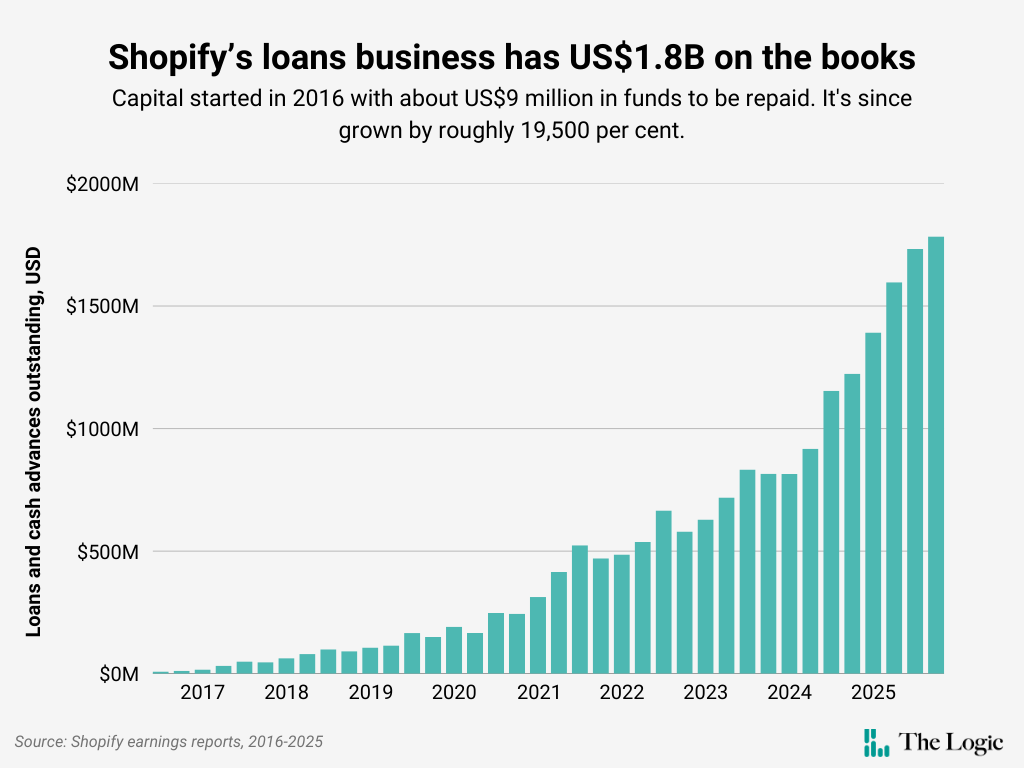
Shopify’s money-lending business continues to grow fast with the firm recording nearly US$1.8 billion in outstanding funds in its most recent quarter.
The service, known as Shopify Capital, launched in 2016. Back then, in its first full quarter, Shopify reported just over US$9 million in merchant cash advances owing, the only type of funding available at the time. In its most recent quarter, that figure, which now also includes loans, stood at US$1.784 billion—a roughly 19,500 per cent increase.
Talking Points
- Shopify reported US$1.784 billion in funds to be repaid, up from US$9 million when its loans business launched a decade ago
- Shopify Capital has grown fast in recent years and is now available in eight countries, including Canada
Shopify Capital has grown at a rapid clip over the years, roughly by half each year for the past three years, with the firm using AI to suss out which of its merchants could use—and repay—funds, with algorithms, not humans, making pre-emptive offers.
The amount that Shopify makes from Capital is small but growing. In its last financial year it earned US$258 million from lending interest and fees, up from US$205 million the previous year. Shopify also likely benefits from the loans which help merchants grow and sell more inventory using its e-commerce platform.
Shopify declined to answer The Logic’s questions about the loans business. “Shopify Capital is built around a single premise: merchants shouldn’t need a credit score or business plan to access the funding they’ve earned,” said spokesperson Rachael Hensley, hinting at how Capital likely gives funding to business owners who may struggle to get loans elsewhere.
Shopify Capital lends merchants money through loans and cash advances, depending on where a business is based. Store owners don’t apply for funding. Rather, pre-approvals are one of the jobs Shopify has off-loaded to AI. The AI offers funds to stores based on performance. Once a store owner sees an offer, they can request the funding, which is reviewed by a human before being doled out. Merchants repay Shopify through a cut of their daily sales.
“It’s a nice sweetener to the rest of the business,” said Martin Toner, managing director of institutional equity research at ATB Capital Markets. “They are able to, based on their relationship with the customer, pretty safely lend at pretty high rates.”
Despite loaning billions of dollars since Capital launched, Toner said the risk to Shopify’s business is low because of how well it knows the companies to which it is lending money. The customer base—typically small businesses—is “extremely volatile,” Toner said, but Shopify can dole out large sums because it knows “pretty much everything” it needs to know about the clients.
Related Articles


As a result, the company has never reported any major losses on the loans, Toner said. In its last financial year, Shopify wrote off US$103 million in loans and US$28 million in merchant cash advances, according to its financial reports—a drop in the bucket of what merchants owe these days.
The upward curve of how much money Shopify is lending comes as it expands Capital to more countries. Since launching in the U.S., the loans service has been rolled out to seven more countries, starting with Australia, the U.K., France and Canada. Then, between May and December of last year, Germany, the Netherlands, Ireland and Spain were added.
The growth of Shopify Capital has happened quicker than most industry watchers expected, said Ken Wong, managing director of software research at Oppenheimer & Co., a brokerage and investment firm.
Shopify is also experimenting with new ways to offer loans. In November 2025, it launched Capital flex in the U.S., which offers some merchants continuous access to funds with an ever-changing limit based on their business metrics. Merchants can borrow however much they want, up to a limit, whenever they need it and no longer have to wait until they’ve repaid more than half to borrow additional funds, according to the company.
There’s more room for Shopify to grow Capital, too. It requires regulatory compliance, similar to its Payments business, which is now available in nearly 40 countries. As more countries get added, Wong said he expects Capital’s rate of growth to continue to outpace that of its core e-commerce subscription business. Shopify’s Hensley said Capital would expand to more countries in the future, but declined to give further details.













