It’s hard to shake the feeling that the auto-parts industry has been dealt a poor hand.
Amid the 2,230 slot machines at Caesars Windsor, the Automotive Parts Manufacturers’ Association was making its own big bet last week, as small businesses chased EV business in an uncertain economy. Minutes from the tunnel off Riverside Drive, with a clear view of Detroit, it’s a region and industry that can’t be untangled from the U.S.—which is a trade partner frequently seduced by protectionism, warned Deputy Prime Minister Chrystia Freeland.
She called attendees from the parts-industry “fellow veterans, fellow survivors” of the North American free trade negotiations of 2017 and 2018—which was then followed by a pandemic, a semiconductor shortage, an embattled U.S. incentive bill that threatened Canadian manufacturing, and regulations mandating that automakers change their business models to make EVs.
“I know that the pandemic was particularly challenging for you as an industry. It was challenging when it first hit, and we locked down,” she said. “You were dealing with supply-chain strains … in the middle of all of that, we did have some problems on the Ambassador Bridge.”
The household-name automakers have struggled to keep assembly lines moving while juggling shut downs, shortages and sweeping legal changes. 2020 ended a decade of growth in global auto production, and the recovery remains sluggish. The auto-parts conference shows how these issues have also trickled down to small businesses.
Nearly 81 per cent of businesses in the transportation-equipment manufacturing sector have less than 100 employees, with more than 70 per cent of auto-parts makers falling into the same category, Statistics Canada data says. The parts industry has about 69,000 workers, compared with just over 24,000 that work at automakers.
“None of us should assume that our success is pre-ordained,” Freeland cautioned parts makers in her talk. She also made national headlines nodding to the government’s tightening fiscal policy for “difficult days ahead,” adding that “anyone who claims they could prevent the challenges ahead is just wrong.”
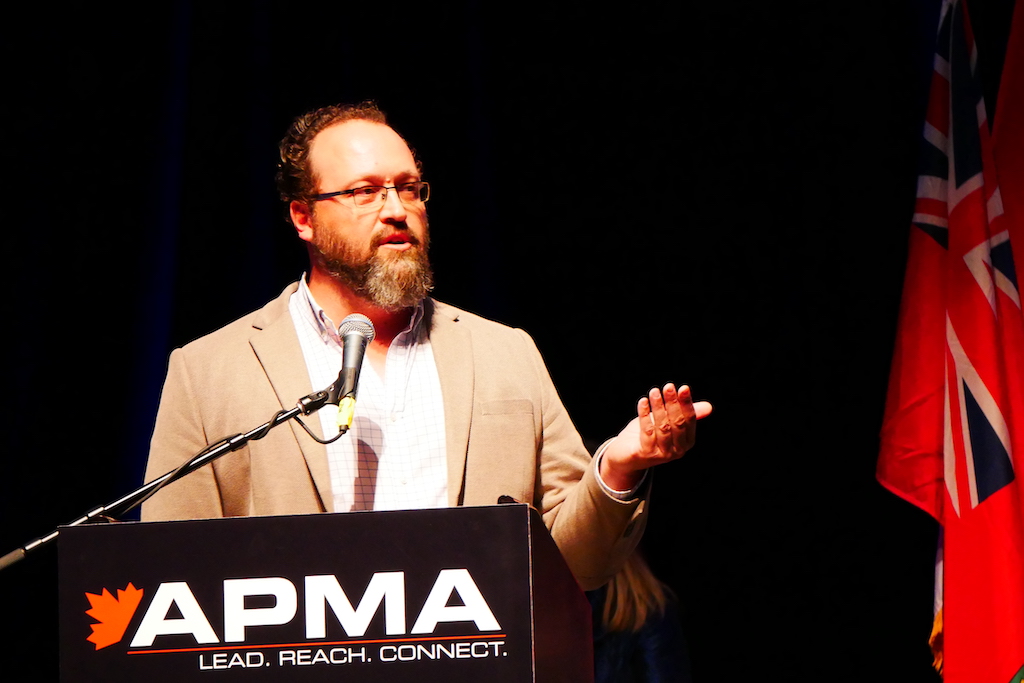
Flavio Volpe, president of the Automotive Parts Manufacturers' Association, speaks at the 2022 APMA annual conference. Photo: Anita Balakrishnan/The Logic
Joseph McCabe, president and CEO at the consulting firm AutoForecast Solutions, also spoke at the event. He told The Logic that Canada’s auto sector is well positioned, despite Freeland’s comments on its vulnerability.
“What I liked about this meeting was that if you look at the bare bones of it, Canada’s in a really unique position to act like a nimble supplier,” he said in an interview with The Logic. “Because everything is centralized in one area like Ontario, not 50 states in the U.S., Canada can be more like a speedboat and turn, rather than the U.S., which is like a big barge.”
If the big automakers were worried, they didn’t let on to their suppliers. Toyota downplayed any worries about layoffs, while the Stellantis-LG battery plant said it’ll start hiring in November.
Ontario Economic Development Minister Vic Fedeli said he’s talking up the province’s “end-to-end” ecosystem in discussions with a half-dozen household-name battery makers for another plant, and the province is readying its chequebook for lithium hydroxide plants to support the transition to an EV supply chain.
“We have met with well over a dozen companies while we were in Germany. We feel there’s a a real transformation happening, where they look at the turmoil that’s happening worldwide, and they look at Ontario as this sea of calm,” he told The Logic. “That’s why we’ll get in the door of these companies at such high levels.”
Read Shift—The Logic’s authoritative weekly newsletter on automotive technology industry news—for more; and if you know someone who should be reading it, they can sign up here.