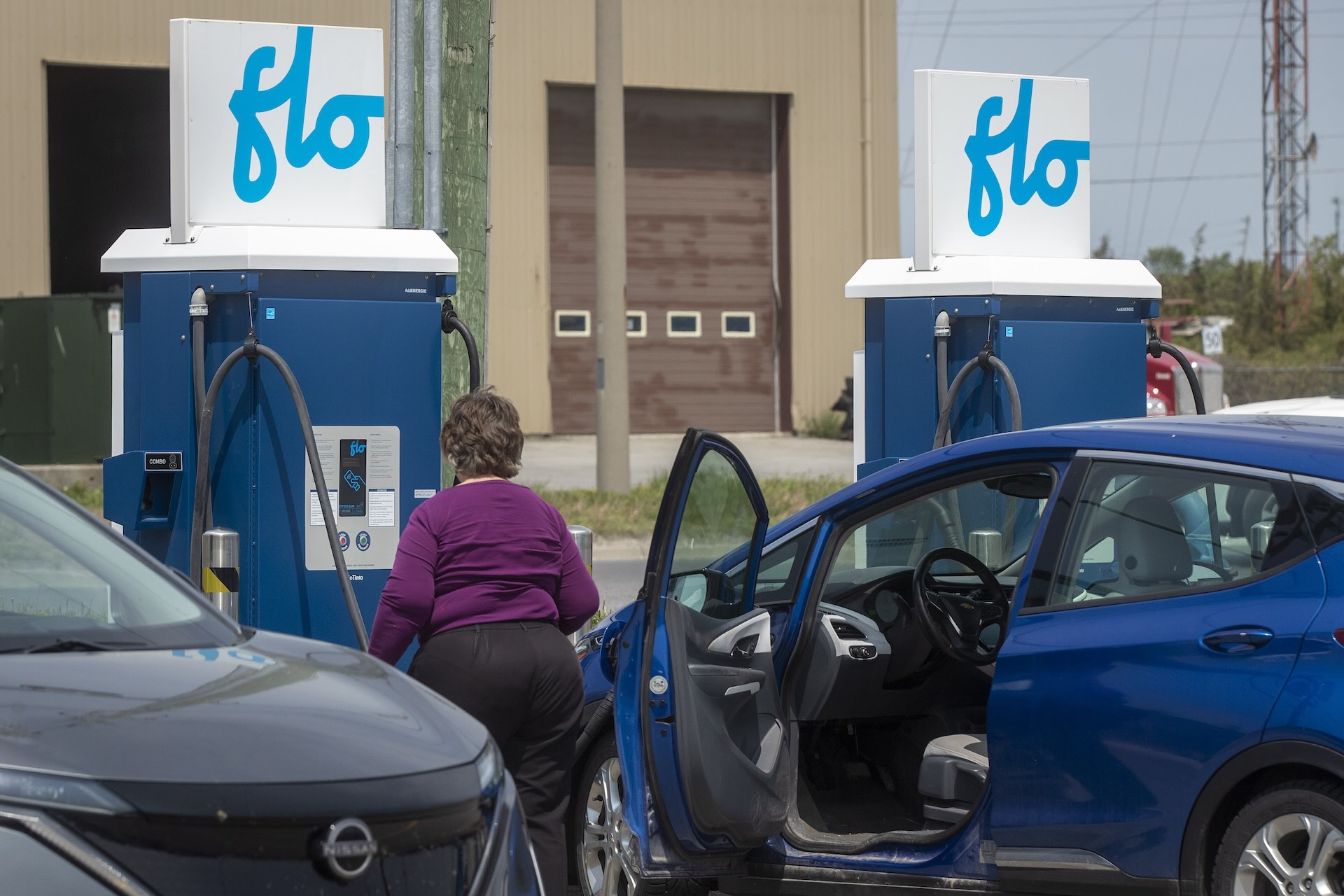
A group representing General Motors, Ford and Stellantis is alarmed by Canada’s lack of EV chargers.
In a little over a year, the federal government will begin enforcing its mandate that 20 per cent of new autos sold in 2026 be zero-emission vehicles (ZEVs)—a minimum that will reach 60 per cent by 2030 and 100 per cent by 2035. The country’s charging availability isn’t on track, says a new report by the Canadian Vehicle Manufacturers’ Association this morning.
“There is no obvious pathway to having the needed charging infrastructure to achieve 100 per cent ZEV sales by 2035,” the report said.
The automakers anticipate the transition will require 100 public chargers coming online every day for the next 11 years, or nearly 40,000 per year.
Seem high? In fact, the number mirrors the federal government’s forecasts. Analysis commissioned by Ottawa in February estimated that the nation’s nearly 30,000 public charging ports would need to rise to over 100,000 in 2025. Adding 70,000 public EV charging ports over the next year would be quite a feat, given that only about 13,000 public chargers were built between August 2022 and the publication last February of the analysis.
There is little data on chargers in private homes, but CVMA head Brian Kingston isn’t hopeful. The report notes that the federal government has made scant progress with standards-setting groups in its quest to make installing EV chargers in new homes easier.
The document calls on Ottawa to add provisions to the Canadian Electrical Code requiring more new builds to be EV-ready, and for regulations ensuring chargers are reliable.
“This is a great example of an item where it’s blatantly obvious everybody agrees it needs to happen, yet the federal government hasn’t been able to make this change.” said Kingston, adding, “We don’t really have time to waste.”
Automakers plan their models years in advance, and Kingston said manufacturing and sales plans for 2026 are well underway. To meet the 80/20 ratio, some automakers may have to buy credits from rivals, or raise prices and reduce their sales of gas-powered vehicles.
Buyers, at least, seem to be doing their part: Zero-emission vehicles are on track this year to hit 16 per cent of new-car sales, according to S&P Mobility, bringing the feds’ goal into sight. The government said its funding has backed 41,000 chargers to date, another 1,600 of which it announced this week.
Yet the CVMA notes that EVs still represent less than three per cent of vehicles on the road, which provides little incentive for private sector investment in EV chargers.
Canadians who do buy EVs, meanwhile, will be driving yawning distances between the country’s largest cities. To keep them in ZEVs, and encourage others to buy them, charger coverage on that highway network will have to expand fast.
“If this isn’t addressed urgently,” said Kingston, “there is simply no way that the targets can be achieved.”
Read Shift—The Logic’s authoritative weekly newsletter on automotive technology industry news—for more; and if you know someone who should be reading it, they can sign up here.