
Listen Now
0:00
EDMONTON — Despite the federal Liberals’ talk about “buying Canadian” and building up the defence sector, government buyers are still treating Canadian products as second-best, says Alberta tech entrepreneur James Neufeld.
“It’s a really big systemic challenge that there is a slight prejudice in the Canadian buying system because [government buyers] are worried they will buy subpar products,” Neufeld told The Logic.
Talking Points
- Edmonton’s Samdesk has sold its digital intelligence-gathering tool to numerous large companies and Canada’s military allies
- The department is looking for a provider to supply the capabilities Samdesk has, and CEO James Neufeld is exasperated that Canadian companies are getting no advantage in the bidding
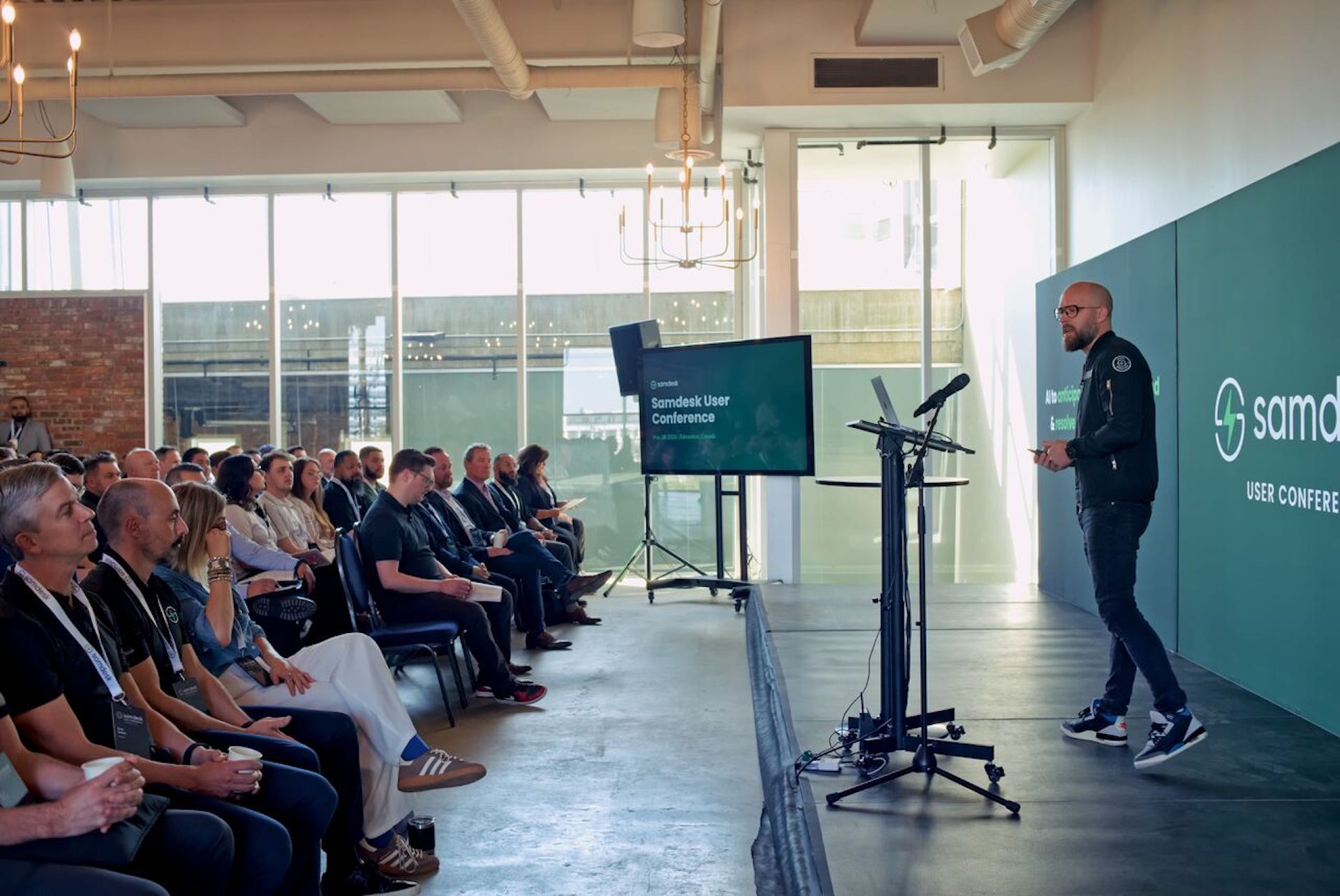
Neufeld is an energetic, physically restless guy. Shaven-headed, bearded, with statement eyeglasses, he talks a mile a minute and one thought starts coming out before the last one’s done. He has had the government’s ear on other things: he sat on the advisory group that helped craft the AI strategy that Prime Minister Mark Carney released in early June.
“On the task force, I had the great privilege of talking to about 100-plus founders across the country, and unfortunately they all have very similar stories,” Neufeld said.
The company he founded and leads, Samdesk, shares a downtown Edmonton office building with Jobber; the Alberta Machine Intelligence Institute, where AI godfather Rich Sutton is chief scientific advisor, is visible out the windows a couple of blocks southeast. “I get his students that all work for us now,” Neufeld grins.
Samdesk makes a platform with the same name that combines social media posts and traditional data sources to provide calibrated alerts about potential hazards and business risks.
Related Articles


DoorDash uses it to warn delivery drivers away from dangers, Neufeld said; when Iran responded to U.S. and Israeli attacks by targeting other Persian Gulf states, Samdesk pinged clients with staff travelling in places like Qatar to tell them their people might be in danger.
Many startups begin by doing business with small customers and set their sights higher as they grow; an oddity of Samdesk’s product is that its best market is big organizations with global operations. “We now have airline clients,” Neufeld said. “When war breaks out, that’s an emergency-level situation. They need to redirect flights mid-air.”
The company has sold its services to NATO, to the U.K. Ministry of Defence and to the Pentagon, Neufeld said. But selling to Canada’s own defence department is shaping up to be a challenge—despite the millions of dollars in grants and loans Ottawa has given Samdesk over the years to support its growth.
Emergency Management Minister Eleanor Olszewski (who oversees Prairies Economic Development Canada as an Edmonton MP) stood with Neufeld a year ago as she announced another $1.8-million contribution to the company. The Department of National Defence has even tried Samdesk out, Neufeld said.
“When DND said, ‘Hey, we would love a Samdesk demo,’ we’re, like, ‘Amazing!’ High-fives in the office, national pride at an all-time high,” he said. The company has usage logs indicating that people there put it through its paces and had plenty of contact with the department along the way, Neufeld said.
Now, National Defence is seeking a tool for its Intelligence Command that does what Samdesk does: one that will monitor and synthesize data from open sources to “alert users to developing situations, based on predefined criteria, for the purposes of conducting exploitation and analysis.”
Neufeld thinks that the government’s Buy Canadian policy, its AI strategy and its defence industrial strategy should all weigh in Samdesk’s favour.
“It has all the markings, we think, of what [Artificial Intelligence Minister Evan] Solomon has been trying to achieve,” Neufeld said. (The two have known each other, a little, for a long time, Neufeld said. In a previous job, he worked on interactive TV elements—like audience-polling technology—for shows including the CBC’s Power & Politics, which Solomon once hosted.)
But the bidding documents for the National Defence work say explicitly that there’s no advantage for Canadian companies in the process.
Over the past few years, the same department has given sole-sourced deals for similar services to Data Centre Intelligence (DCI), an Ottawa-based firm that markets itself as a helper for vendors trying to get federal contracts.
Public records indicate that DCI has been delivering to DND a platform called Dataminr First Alert. That comes from a New York-headquartered company of the same name; Dataminr promotes its “joint offerings” with companies including DCI in serving Canadian customers.
The documentation says the department sole-sourced the work to DCI because it had exclusive rights to supply what the department wanted to buy.
Neufeld said he thinks the new procurement is nominally competitive but set up in a way that favours the current supplier. According to the bidding materials, the winning bidder has to be ready for at least 183 military members and civilian DND staff to use its product on the department’s secure network on the very day the contract is awarded.
DCI did not respond to emailed questions from The Logic. Public Services and Procurement Canada, which is running the current procurement on National Defence’s behalf, referred questions to National Defence, which did not respond by deadline.
“The question is, ‘Is there a stigma?’” Neufeld said. “If there is, let’s have a real, honest conversation about it. I think there is—unintentionally, but I think there is.”
Clarification: This story was updated to more accurately describe the financial support Samdesk has received from the federal government.