Listen Now
0:00
Connie Stacey has spent the better part of a decade trying to get the federal government to pay attention to her defence tech startup, often to no avail.
Her company, Grengine, builds battery systems designed to replace diesel generators in remote and harsh environments, such as on military bases and in the Arctic. Despite having a collection of awards and participating in half a dozen accelerators, federal support remained scarce.
Talking Points
- The federal government has committed billions of dollars to bolster Canada’s defence industry. Startups say the system to turn that money into contracts and revenue is still moving too slowly.
- As other countries accelerate defence spending and procurement, founders warn Canada risks losing domestic companies
Then, around January 2025, her inbox began filling up with emails from interested buyers and funders, including Canadian government officials. The inquiries haven’t stopped. “People started talking about defence,” Stacey said, “and talking about it a lot.”
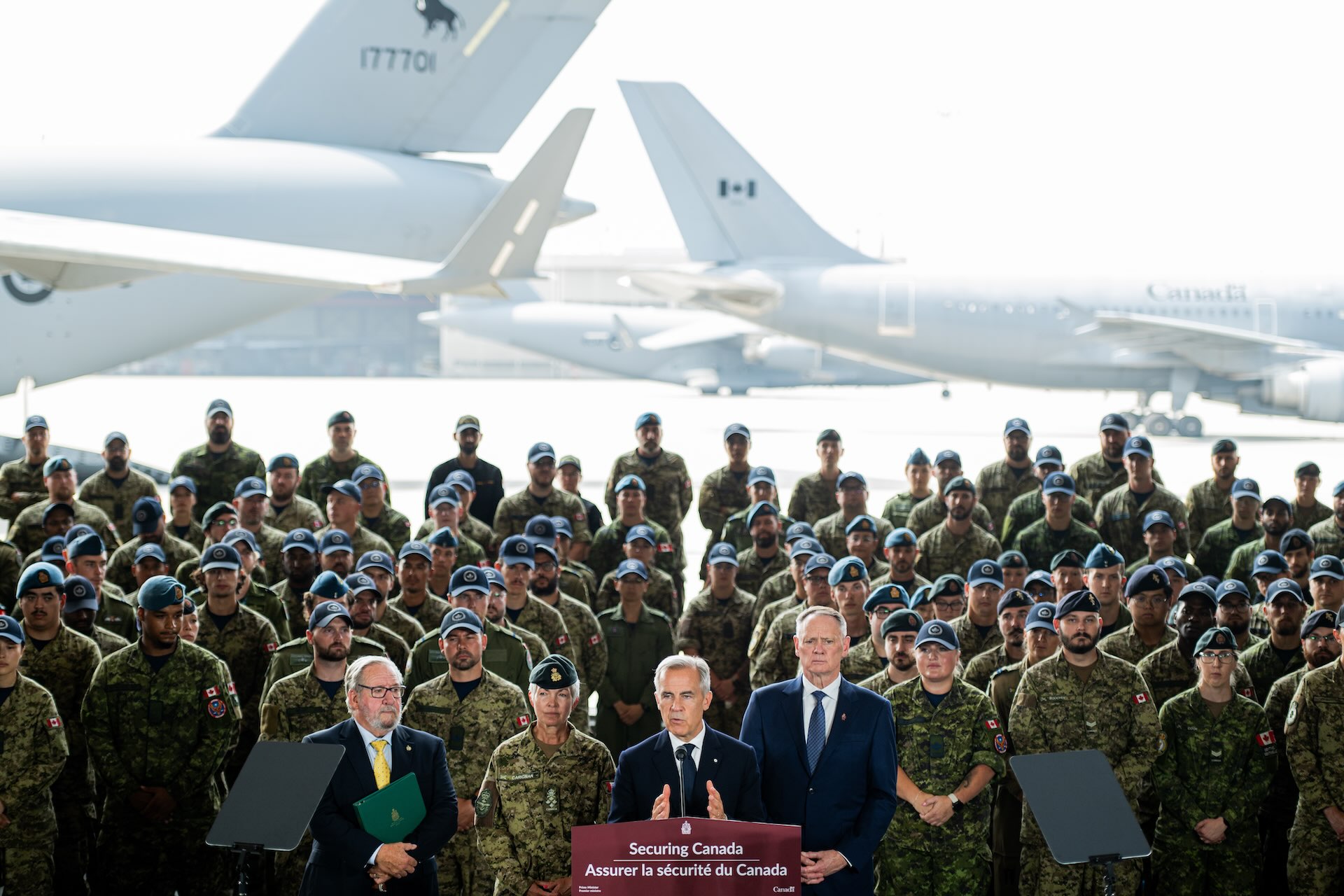
After years of underspending on the military, Prime Minister Mark Carney campaigned last spring on the promise of “unprecedented acceleration of investment” in Canada’s armed forces. Since forming government, he’s earmarked more than $63 billion for defence spending, with 70 per cent of Ottawa’s contract spending going to Canadian companies.
Stacey says that push is generating more interest from potential customers and investors than ever before. In December, Grengine landed a spot in the prestigious NATO DIANA program, an international accelerator for dual-use technology companies, adding to the halo effect around her business.
Despite some progress, Stacey and other prominent defence entrepreneurs told The Logic that all the noise about defence hasn’t translated into major investments, contracts or revenue at home.
As startups wait for policy ambition to become commercial reality, some founders are concerned they will run out of money and time. “My worry is about how fast we get there,” Stacey said. “My worry is that it will take longer than a company like mine can afford to wait.”
Under its new Defence Industrial Strategy (DIS), Ottawa has introduced a string of programs and funding tools meant to help Canadian companies develop and sell defence technology. A pillar of the plan is a Build-Partner-Buy procurement framework that prioritizes domestic suppliers. Another is a $6-billion defence strategy administered by Crown corporation the Business Development Bank of Canada. The program will provide loans, advisory services and equity investments through two new venture capital funds for defence tech and dual-use startups—those building technology with both military and civilian applications.
The government has introduced measures to help companies shorten the time between developing their tools and selling them to the military. These include a new Defence Industry Assist stream within the National Research Council, offering companies grants and technical support to build their products. And it’s giving regional development agencies $357 million to help businesses expand in new markets. In February, Ottawa joined the European Union’s Security Action for Europe program, a €150-billion loan program to help countries fast-track defence purchases through a common procurement process across member states.
Taken together, the measures represent one of the most significant recent attempts to create a coherent defence innovation system in Canada.
All that promise has drawn throngs of investors and entrepreneurs to the sector, says Glenn Cowan, managing partner at early-stage defence investment firm One9, and former squadron commander in the Canadian military. Banks, pension funds and other institutional backers that once avoided the sector are now taking a closer look, Cowan said. “It’s made it mainstream,” he said. “Investors would not touch defence because we treated it almost like a vice investment… That has entirely changed.”
The number of companies exploring defence markets for the first time has also ballooned, said Cowan. Some firms that previously focused on commercial or industrial customers are now repositioning their products for military use, betting that demand from governments and allies will remain strong for years. “The inbound deal flow we’re seeing is relentless. It’s pretty crazy, actually,” said Cowan, adding he expects a “significant increase” in the number of deals out of One9 later this year.
While billions of dollars may be circling the sector, entrepreneurs who spoke to The Logic said it’s slow to find them.
Kostyantyn Khomutov, CEO of Ottawa-based battery company GBatteries, said interest in his business has picked up recently. His company, which develops technology that allows drones to operate in cold environments, is one of the 22 Canadian startups admitted to NATO DIANA this year. He’s also an alumnus of the Creative Destruction Lab and the Silicon Valley accelerator Y Combinator. He expects his business to clinch some of the government money promised for defence tech—he’s started applying for loans and exploring raising venture capital—but it hasn’t happened yet.
Khomutov’s fellow NATO DIANA founder Daniel Sax has had a bit more luck. The CEO of the Canadian Strategic Missions Corporation recently won $400,000 through a government-funded challenge to develop a technology to purify water on the moon. The company is also leading a $3-million project to advance manufacturing for nuclear microreactors—its primary business—to which the government is contributing $1.2 million.
Sax said the money is helpful, but across the board, he said funding and procurement for promising Canadian defence startups isn’t happening fast enough. He blames what he calls the “molasses layer” of bureaucracy in Ottawa. “The mechanisms of government are just slowing down the entire process… They’re trying,” he said, “but government is struggling to get capital out in the same way that it has traditionally.”
Officials leading BDC’s defence strategy said they’re trying to help bridge the gap between what the military needs and what companies are building. The bank is designing the $6-billion initiative around the government’s new DIS, said Peter Dawe, vice president of the division. Dawe, who served 35 years in the military and whom the bank seconded from the Department of National Defence, said the goal is to ensure public money flows to technologies that the Canadian army and its allies will buy, rather than investing in a smattering of projects for which demand is uncertain.
The DIS is broad, though, with 10 priority categories that dual-use companies may fall into. Companies vying for BDC funding could be building quantum sensing or sovereign space launch technology, for example, or nuclear reactors, autonomous drones or harbour monitoring tools. “We’re seeing lots of inbound as people align themselves to try and help solve the problems articulated in the DIS,” said Peter Suma, managing partner of BDC’s StrongNorth Fund, a $300-million equity investment component of the bank’s defence strategy. “It’s a lot of inflow to deal with,” he added.
While it’s a lot to wade through, Suma said that BDC has started writing cheques. Last week, it announced an investment in Medicine Hat-based drone company Landing Zones Canada, its first deal from the StrongNorth Fund. Before that, the bank said it had provided nearly $92 million in financing to 16 businesses through the program since it launched last December.
Dawe said the BDC program’s success hinges on getting more money out the door and helping companies scale quickly. “If we can achieve that and show tangible results, that is the win in the first year,” he said.
Harjit Sajjan has seen first-hand how poor coordination between government and industry can leave promising technologies on the sidelines. After a career in the military, then in government as Minister of Defence, Sajjan has shifted to entrepreneurship, where, as co-founder of Juno Industries, he’s building a startup that he hopes can respond to the military’s changing needs. Rather than having one product to sell, Juno is positioning itself as an innovation hub that can build tools when the need arises. Last month, for example, the company unveiled an autonomous communications and surveillance system for Arctic environments.
“There are certain challenges that need to be dealt with very quickly,” Sajjan said. That requires knowing what technologies the Armed Forces need and how it would use them. Sajjan said Juno, which launched in January, is deliberately recruiting people who understand how the military and procurement works so it can focus on solving the right problem from the start.
Sajjan said Ottawa could do a better job of identifying how to make use of what entrepreneurs are already building. There may be existing technologies that can solve challenges for the defence sector, he said, “but the dots aren’t connected.”
Ottawa’s IDEAS program, which stands for Innovation for Defence Excellence and Security, attempts to do that by funding projects that could solve problems the military has already identified. Founders say the program, which launched in 2018, is a step in the right direction, but could be improved. A January report from Space Canada, for example, argued that the program needs to increase funding—which starts at $250,000—for earlier stage companies in the space sector “to incentivize bolder and broader” innovation. It also urged the government to add a stream for unsolicited technologies from industry, where companies can pitch ideas that the military may not yet know it needs.
Sax said if Ottawa is serious about boosting domestic defence tech, that process needs to move much faster. Other countries are also doubling down on military spending, he said, and he worries Canada risks being left behind. Poland, Finland and the U.K., for example, are all increasing their defence budgets, and Germany recently passed legislation to speed up defence procurement by letting the government bypass certain regulations. “What we’re seeing internationally is the timeline’s really compressed,” said Sax. In Canada, he added, that’s not happening quickly enough.
Stacey said she’s now looking beyond Canada for funding, while global attention on her business is high. “I’m very aware that most likely the investment will come from outside Canada, and that will be, very shortly, followed by pressure to move… I have fought 10 years to avoid that,” she said. “But you can only do that so long before eventually you have to just accept that you can’t grow here.”