Skip to content

Canada's Business and Tech Newsroom

  • Professional Subscription
  • Partnerships & Advertising
  • Licensing & Syndication
Log In Subscribe
Welcome,
  • My Account
  • Log Out
  • Business
  • Tech
  • National
  • The Big Read
  • Briefings
  • Commentary
Search
Log In Subscribe
Welcome,
  • My Account
  • Log Out
News

Canada’s radio-jammer ban is forcing military drone makers to test in Texas

Listen Now
0:00
News

Canada’s radio-jammer ban is forcing military drone makers to test in Texas

Federal laws all but prohibit the gear needed to find out how drones would perform against well-equipped enemies

By David Reevely
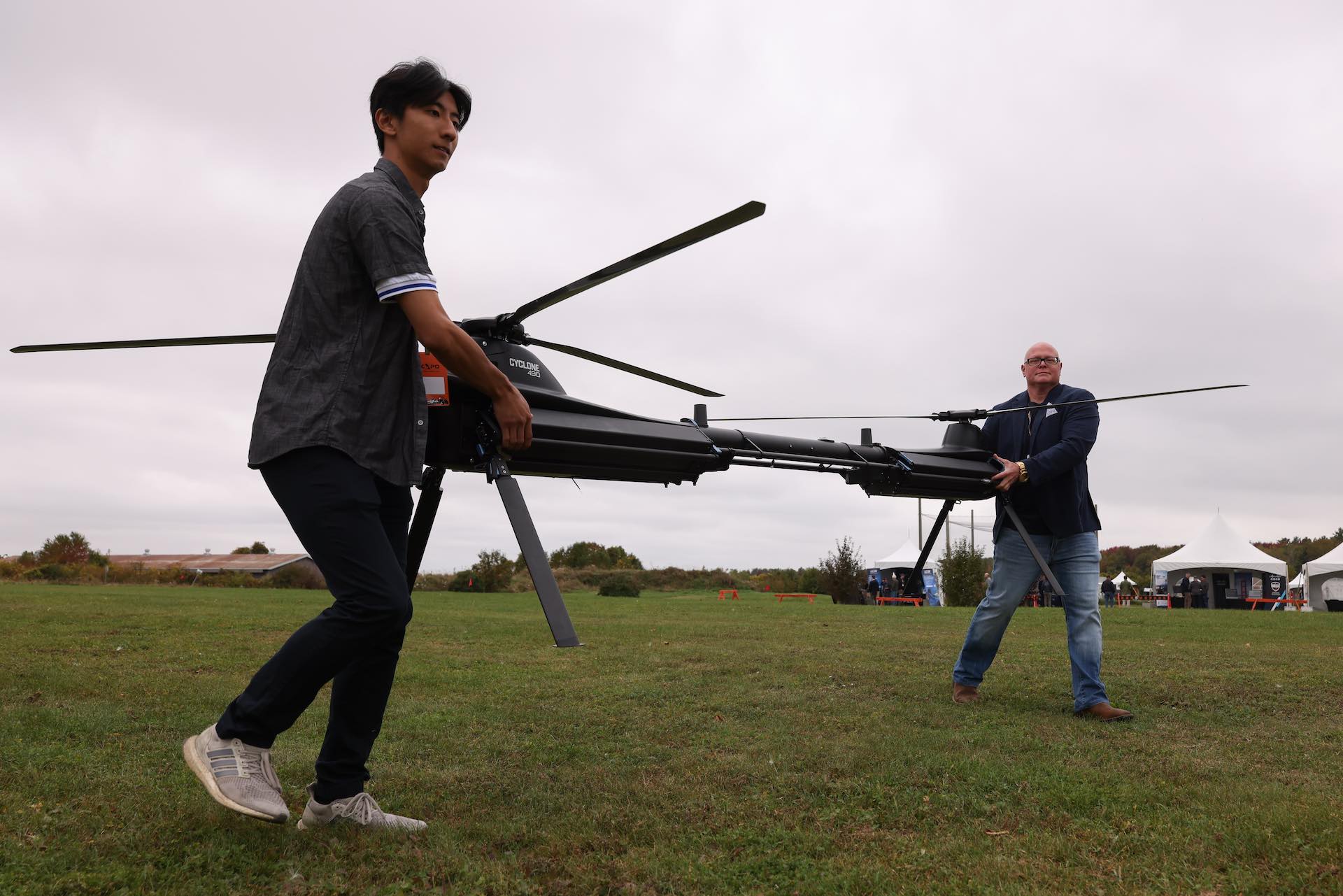
A wide frame of two men on field carrying a drone. The UAV looks to be about three metres long and is shaped like a bar with helicopter rotors on each end.
Albert Pegg, right, senior manager engineering and manufacturing at Avidrone Aerospace, and software developer Josh Cai, demonstrated the company’s dual-rotor UAV at Area X.O in Ottawa. Photo: David Kawai for The Logic
Oct 5, 2026 | 5:45 AM ET
A A
A Small A Medium A Large
Share

Gift

Share

Listen Now
0:00

OTTAWA — Developing military drones in Canada is difficult because of federal laws against interfering with flying objects—even your own.

Finding out how drones perform when they face countermeasures like radio-signal jamming—as practically every drone on every battlefield will—means taking them elsewhere for those trials.

Talking Points

  • A federal law against jamming radio signals make it almost impossible for Canadian startups to test drones intended for military uses (or devices that could stop them)
  • The Canadian Forces are considering using an exemption covering the military itself to create test sites

“We’ve looked to the U.S. and Ukraine to be our partners in those types of tests,” said Kath Intson, CEO of Sentinel R&D, a drone maker based in Hamilton, Ont. 

Sentinel makes fixed-wing drones—like little airplanes—for reconnaissance and kamikaze attacks. A year ago, it was a startup hoping to supply drones to Ukraine and be ready when Canada eventually wanted them. Now, Sentinel has a deal with Ukraine’s Airlogix to produce Airlogix drones here and is selling drones of its own design to Ukrainian forces.

“We did tests in Texas just a few weeks ago,” Intson told The Logic at an exhibition at Ottawa autonomous-vehicle testing facility Area X.O.

Related Articles

Sentinel R&D is selling its own drones directly to Ukraine

By Murad Hemmadi
A photo illustration showing a variety of map and military elements, including images of a quadcopter and missile. Images of Pete Hegseth and Dario Amodei are also in the illustration.

For Canada, the march of the killer robots is getting hard to avoid

By David Reevely

The obstacle is in the Radiocommunication Act, which has a provision simply saying this: “No person shall install, use, possess, manufacture, import, distribute, lease, offer for sale or sell a jammer.”

There are limited exceptions for the military and its existing suppliers, the RCMP and prisons, set in regulations written under the law.

“Canada will not be able to produce anything that is effective in combat until we can test against jamming systems—conventional jamming systems, as well as staying at the bleeding edge of electronic warfare,” Intson said.

A shot of Kath Inston holding a mic and speaking on stage with two other people. The backdrop is an orange screen.
Kath Inston, CEO of Sentinel R&D, points to a drone testing range in Latvia as a potential example for Canada to follow. Photo: David Kawai for The Logic

The Canadian Forces are very aware of the problem, said Lt.-Col. Nicolas Verreault, answering a question from Intson while he was on a panel at the Ottawa expo. Verreault is the head of the Canadian military’s Joint Uncrewed Systems Office, which is the central drone authority for the army, navy and air force.

“Being able to design systems that are resilient to enemy electronic warfare and having the ability to test systems domestically in Canada before we send them overseas is of vital importance,” he said.

Besides supporting exemptions to the no-jammers law for duly vetted suppliers, Verreault said, the Canadian Forces are considering opening test sites that the private sector could use, under cover of the military’s exemption.

The government could add more exceptions: Justin Simard, a spokesperson for the Department of Innovation, Science and Economic Development, said in an email that it’s planning to hold consultations on “a proposed new class-based exemption for stakeholders in the legitimate supply chain for jammers, including developing defensive anti-drone applications.”

The plan is to have a new regulation in place before the end of 2028. “Until that process is complete, the current prohibitions and authorization requirements remain in place,” Simard said.

Speaking on a different panel at the exposition, Kevin Toderel, CEO of Toronto’s Remote Robotic Systems, said electronic warfare—interfering with drone controls, including by jamming signals—has rendered useless many drones that seem capable in tests.

He pointed to a U.S. program under then-president Joe Biden to build up private sector drone companies. The first four drone models it identified were sent to Ukraine to help defend it against Russia, Toderel said.

“You want to guess how many of those platforms actually worked in Ukraine? These are $30,000, $40,000 platforms,” he said. “Zero. Zero platforms worked.”

Surviving electronic countermeasures is “table stakes” in drone fights, Toderel said. “That has to be mandatory in the testing, and not just what we can get our hands on in Canada. We need to do our best to be able to get out into the field and test what our adversaries are using.”

The restriction on jammers in Canada also limits Canadians’ ability to develop anti-drone measures, Intson pointed out: “There is no practical pathway right now for a Canadian electronic warfare company.”

A photo of John Hryniw showing Lt.-Gen. Darcy Molstad a quadcopter drone. Hryniw is wearing a dark suit and Molstad is clad in in camouflage fatigues. There is a white tent in the background.
John Hryniw, a vice-president with Volatus Aerospace, shows a drone to Lt.-Gen. Darcy Molstad of Joint Forces Command during the expo at Area X.O in Ottawa. Photo: David Kawai for The Logic

It is also illegal, incidentally, for a civilian to try to knock down a drone with a physical attack, like a projectile, a laser or a net. That’s in the Aeronautics Act, covering aircraft in general.

The Liberal government’s last budget bill amended that law so the federal transport minister can permit exemptions for drones, like the exceptions for police and military allowed in the Radiocommunication Act, though regulations for issuing those permits haven’t yet been written.

Electronic warfare tools that could repel drones—essentially creating bubble zones around potential targets—are better than ones that take them down physically, though, said Glen Lynch, CEO of drone company Volatus.

“You shoot down a drone, where does it go? You’re raining down bits and pieces on a schoolyard or a highway intersection,” he said. “The ideal scenario is not that we blow it up. The ideal scenario is that we put it in a lake.”

He said his company uses simulators to work on anti-drone gear and on hardening its drones against those measures.

Gift the full article

“We can actually design and test systems,” he said. “The problem is we can’t test them in a real environment.”

Intson said Latvia has an electronic warfare testing range, despite being smaller and much more densely populated. “Canada, for sure, should be able to figure this out,” she said.


#defence #defence tech #Drones #economy #Tech

Sponsored Content

How to shift your workforce from AI experimentation to adoption

By Jessica Aftimus Rosa

The real-world economic offshoots of sovereign AI

By Deborah Aarts
Illustration of a plane flying above a mailbox

Increasing healthcare access across Canada

By Deborah Aarts
Paid promotional content

Loading...

Thanks for sharing!

You have shared 5 articles this month and reached the maximum amount of shares available.

Close
This account has reached its share limit.

If you would like to purchase a sharing license please contact The Logic support at [email protected].

Close
Want to share this article?

Upgrade to all-access now

Close
Gift the full article!

You have gifted 0 article(s) this month and have 5 remaining.

Copy link and gift
Copy Link
Email to a friend
Send Email
Gift on Social Media

Recipients will be able to read the full text of the article after submitting their email address. They will not have access to other articles or subscriber benefits.

A wide frame of two men on field carrying a drone. The UAV looks to be about three metres long and is shaped like a bar with helicopter rotors on each end.

Photo: David Kawai for The Logic

A shot of Kath Inston holding a mic and speaking on stage with two other people. The backdrop is an orange screen.

Kath Inston, CEO of Sentinel R&D, points to a drone testing range in Latvia as a potential example for Canada to follow.

A photo of John Hryniw showing Lt.-Gen. Darcy Molstad a quadcopter drone. Hryniw is wearing a dark suit and Molstad is clad in in camouflage fatigues. There is a white tent in the background.

John Hryniw, a vice-president with Volatus Aerospace, shows a drone to Lt.-Gen. Darcy Molstad of Joint Forces Command during the expo at Area X.O in Ottawa.

Most Popular This Week

An image of Mark Carney standing in front of a red podium with the words "AI for All / L'IA pour tous." He is wearing a suit and tie. In the background, people wearing scrubs and white coats are visible.
News

Carney picks big-name researchers and investors for new AI advisory council

By Murad Hemmadi
A shot of Dominic Barton taken from behind, with his face in profile as he looks to his right. He is in a hearing room with two large video-projection screens on the wall before him.
News

Dominic Barton’s next big job for Canada? Bringing home the money

By Joanna Smith
Two individuals stand facing each other inside a lit-up installation inside a bust room. Both people are holding smartphones.
News

The Maple 8’s Canadian pledges may do little for startups and scaleups

By Catherine McIntyre
Close up of Mark Carney in a black suit against a black backdrop, looking over his shoulder with an eyebrow raised.
News

Ottawa tries to deliver on Carney’s promise to build faster

By David Reevely

In-depth, agenda-setting reporting

Great journalism delivered straight to your inbox.

A yellow CAT excavator vehicle sits between two rock faces of a graphite mine.
News

Critical minerals face a funding ‘valley of death.’ Miners hope tax breaks will change that

By Anita Balakrishnan

Briefing

Potash from Belarus en route to United States

By Joanna Smith   |   Oct 5, 2026 | 12:29 PM ET

Financing instability is slowing down Ottawa’s housing agency, CEO says

By Catherine McIntyre   |   Oct 2, 2026

Cleveland-Cliffs CEO says federal lawsuit would be a bad business decision for Canada

By Anita Balakrishnan   |   Oct 2, 2026

Best business newsletter in Canada

Get up to speed in minutes with insights and analysis on the most important stories of the day, every weekday.

Exclusive events

See the bigger picture with reporters and industry experts in subscriber-exclusive events.

Membership in The Logic Council

Membership provides access to our popular Slack channel, participation in subscriber surveys and invitations to exclusive events with our journalists and special guests.

Recent Popular Stories

News

Carney picks big-name researchers and investors for new AI advisory council

By Murad Hemmadi   |   Oct 2, 2026
An image of Mark Carney standing in front of a red podium with the words "AI for All / L'IA pour tous." He is wearing a suit and tie. In the background, people wearing scrubs and white coats are visible.
News

Ottawa tries to deliver on Carney’s promise to build faster

By David Reevely   |   Sep 28, 2026
Close up of Mark Carney in a black suit against a black backdrop, looking over his shoulder with an eyebrow raised.
The Big Read

Cameco’s high-stakes bid to be Canada’s next nuclear champion

By Joanna Smith   |   Sep 23, 2026
A shot looking down the length of a tunnel with conduits along its sides and railroad-style tracks on its floor. There are two workers in the distance wearing hardhats and headlights and walking toward the camera.
The Big Read

The professor trying to make Canada a supercomputer superpower

By Murad Hemmadi   |   Sep 30, 2026
A man stands at a chalkboard while looking at the camera. He has apparently written "It's not rocket science; it's quantum chromodynamics."
News

The Maple 8’s Canadian pledges may do little for startups and scaleups

By Catherine McIntyre   |   Sep 29, 2026
Two individuals stand facing each other inside a lit-up installation inside a bust room. Both people are holding smartphones.
News

Canada dodged the money-laundering ‘grey list’—but banks remain a weak spot

By Claire Brownell   |   Sep 29, 2026
A silhouetted person walks amid a row of buildings.

Canada's most influential executives and policymakers are reading The Logic

  • CPP Investments
  • Sun Life Financial
  • C100
  • Amazon
  • Telus
  • Mastercard
  • bdc
  • Shopify
  • Rogers
  • RBC
  • General Motors
  • MaRS
  • Government of Canada
  • Uber
  • Loblaw Companies Limited
logic-logo

Canada's Business and Tech Newsroom

100% human-crafted journalism

Newsroom

  • News Tips
  • AI Policy
  • Editorial Disclosures
  • Story Pitches

Company

  • About Us
  • Terms of Service
  • Privacy Statement
  • Corporate Information

Contact

  • Contact Us
  • Advertise
  • FAQs
  • Work at The Logic

© 2026 The Logic Inc. All Rights Reserved.

Trusted by leaders

Error

Account creation failed.

Please email us at [email protected].

Create Account

[wppb-register form_name=”cozmo-registration-form-for-modal”]

I do have an account
Login

The username or email you provided does not exist. Please try again.

or

[wppb-login]

I don’t have an account