OTTAWA — Betting that drones are crucial to the future of war, Canadian companies are seeking to supply, and learn from, some of the best in the field: the Ukrainian military.
Skip to content

 Katheron Intson, CEO of Sentinel R&D, with a ReKam 3.2 drone at the Area X.O testing ground in Ottawa. Photo: David Kawai for The Logic
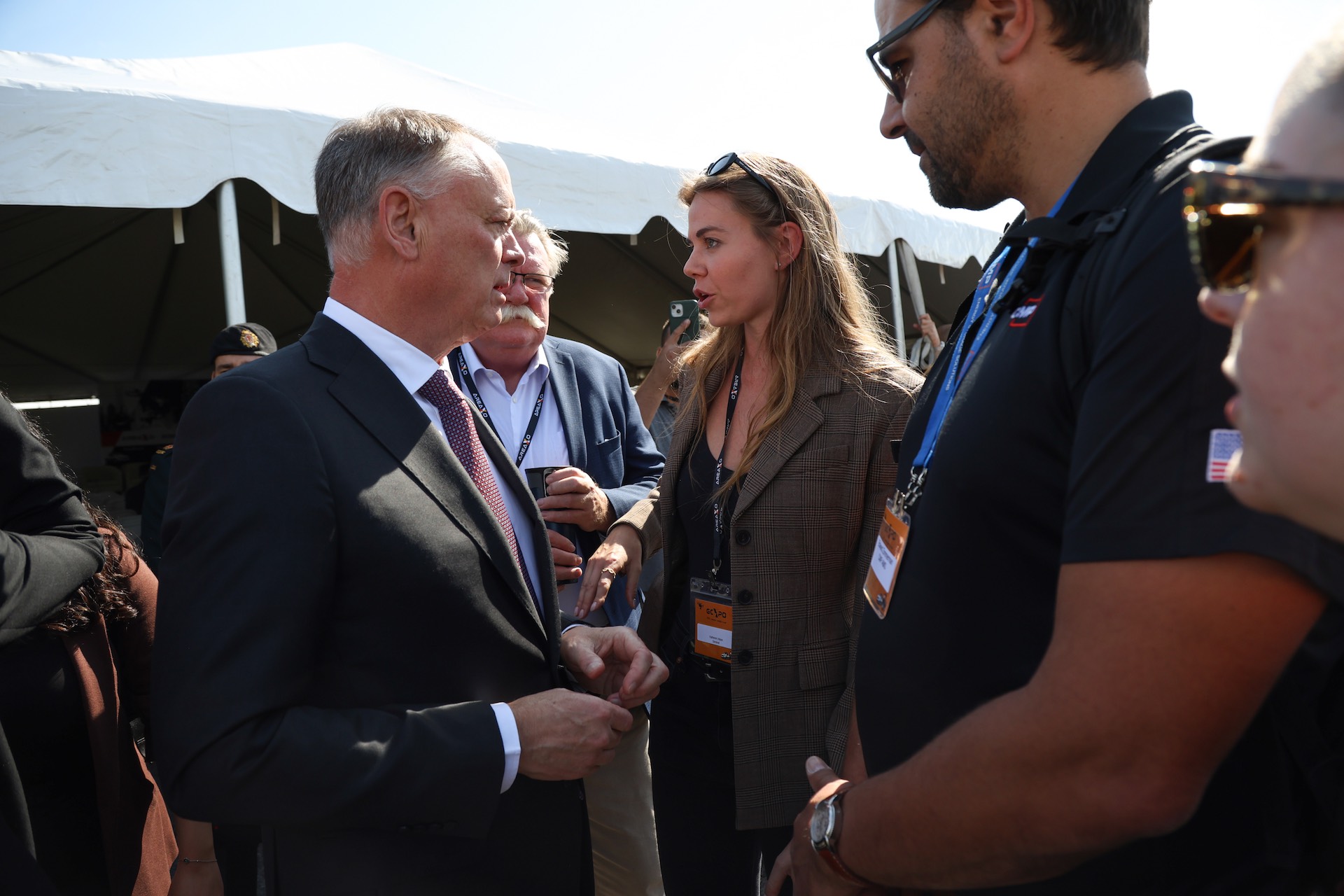 Defence Minister David McGuinty, left, with Intson at the expo in Ottawa; McGuinty encouraged defence-tech companies to help refit the Canadian military. Photo: Invest Ottawa

The Big Read
War in Ukraine opens a new front for Canadian drone firms
Uncrewed aircraft have become essential tools of modern warfare, creating a crowded new market in Ukraine and beyond
A Sentinel R&D drone in mid-flight; the Hamilton, Ont., company is looking to provide drones to Ukraine for its war effort against Russia. Photo: Handout/Sentinel
A Sentinel R&D drone in mid-flight; the Hamilton, Ont., company is looking to provide drones to Ukraine for its war effort against Russia. Photo: Handout/Sentinel
OTTAWA — Betting that drones are crucial to the future of war, Canadian companies are seeking to supply, and learn from, some of the best in the field: the Ukrainian military.
The market is not easy to crack, said Katheron Intson, chief executive of Sentinel R&D, a small producer of fixed-wing aerial drones in Hamilton, Ont. Introductions via Sentinel investors, and joining trade-and-technology missions organized by Ukrainians actively sniffing out western technology, have been critical.
“Being humble, being willing to integrate with some of the proven technologies, that’s how you can be useful to Ukraine,” said Intson.
Talking Points
- Canada is beginning to think about how to integrate drones into its military forces
- The fledgling domestic drone industry is taking lessons from Ukrainian battlefields, where uncrewed vehicles dominate the skies
Intson emphasizes that for Sentinel, the point is to help Ukrainians fight off Russian invaders. The company’s chief technical officer is Katheron’s brother Anders, a lifelong military aficionado who launched the firm after the full-scale Russian invasion in 2022.
The Intsons come from Estonia, Katheron said—a country forcibly taken into the Soviet Union amid the Second World War and, like Ukraine, dominated by Moscow for generations. They feel a kinship.
Ukraine has a whole branch of its military dedicated to drone warfare. Its military has used the devices to drop grenades on individual soldiers fighting for Russia and make devastating attacks on the country’s airfields. They must hide, though, from short-range Russian quadcopters near the front lines and contend with long-distance drone strikes by cheap Iranian-designed Shaheds and Russian-made clones.
Related Articles

Like much of the West, Canada is now thinking about how best to add drones to its forces. When this country and its treaty allies are ready to buy, Intson said, Sentinel expects to be prepared with what they need: “While the goal was to be helpful to Ukraine, the lessons that we are learning there—and by ‘we,’ I mean NATO—can be applied to future conflicts.”
The firm has moved quickly over the past year, from prototyping in a garage to developing its products in a 5,000-square foot facility in Hamilton. It’s now preparing to send three ReKams for testing by the U.S. military’s special operations command. Another Toronto-area company, WaveStorm, is likewise building experience in the “hot zone” of eastern Europe (among other places), and expects that to be useful elsewhere.
Something of a gold rush is underway as numerous governments crank up their military spending, and Ukraine is as hot as a market can be. The technological barriers to entry are low. It’s easy to claim that a product is military-grade, but you can’t know for sure until a real enemy is trying to destroy it, said Gal Hana, WaveStorm’s CEO.
“Many of those technologies claim and can show very nice reports in the lab, but in real life scenarios, they are not performing,” he said.
Canadian military connections helped link WaveStorm up with Ukrainian counterparts, he said. Exposure to operational demands is invaluable for an innovator, and so is the “frontier” mindset forced upon combatants.
“They can’t wait for the ideal product,” Hana said. They need the best they can get fast.
On a hot day in early autumn, Intson showed off Sentinel’s product at an expo at Ottawa’s Area X.O, a government-sponsored testing ground for all kinds of autonomous vehicle technologies. Perspiring attendees waved away wasps and scrutinized an example of Sentinel’s flagship drone. Resting on a crate, it looked a lot like a hobbyist’s glider had been carefully wrapped in black duct tape.
The ReKam 3.2 is not meant to be flashy. Sentinel hopes to fill a Ukrainian need for drones that are intended to be reused but not so expensive that Ukraine can’t afford to sacrifice some (“attritable but recoverable,” as Intson puts it) and that can carry significant weight (“not teeny-tiny”).
The key feature is that it’s payload-agnostic, Intson said. Users can swap in surveillance sensors, radio-signal jammers or equipment to target other drones. Sentinel’s drone can carry a little fuel and a lot of explosives for kamikaze attacks on short-range targets, or the reverse for hits on long-range ones. It’s working on larger models that can carry more.
“You have to be really integratable, particularly in Ukraine, with some of the component companies that have been battle-tested,” she said.
Estonian connections have been vital for Sentinel. One investor (Erik Rannala of Mucker Capital) and Intson’s own network helped connect the company to Ragnar Sass, an Estonian co-founder of Darkstar, a coalition of investors and others trying to build up Europe’s defence-tech ecosystem. Darkstar organizes “bootcamp” sessions in Ukraine to link tech companies with the Ukrainian military; Sentinel took part in one in Kyiv in March.
Ukraine itself is actively seeking to connect potential suppliers through programs like Brave1, which seeks to promote co-ordination between defence suppliers; Inston had recently returned from a defence-tech show it organized in Lviv, in western Ukraine.
At the Ottawa event, Intson spoke on a panel that took the stage in the expo’s defence-tech section right after Defence Minister David McGuinty exhorted attendees to help the government to refit the Canadian military.
“We need your smarts,” McGuinty said. ”We need your creativity, your drive, your passion. We need your money.”
Canada intends to supply Ukraine, and to learn from it. In Kyiv in August, Carney announced that a $2-billion military aid package to the country would include $220 million for drones, counter-drone measures and electronic warfare, “including investments in joint ventures between Ukrainian and Canadian industry.”
Just what those joint ventures might be, neither Carney’s nor McGuinty’s offices could say by The Logic’s deadline.
Canada is especially interested in dual-use technologies, those that have both civilian and military applications. Being able to sell to both markets will help Canadian companies diversify and scale, McGuinty said at the Ottawa expo.
Turning civilian technology to military purposes is much of what WaveStorm does. Hana compares it to turning a regular person into RoboCop. “We are the ones that bring the ruggedness into the picture.”
Hana, an Israeli business executive turned diplomat turned Canadian entrepreneur, observed that Canadians can be staid and risk-averse, while Israelis typically are not. It’s not a coincidence that Roman Shimonov, the founder of armoured-vehicle company Roshel (arguably Canada’s most successful defence startup in recent memory), is Soviet-born but came of age in Israel and is working in Ukraine, too, he said.
Hana’s company has scored two small contracts with the Canadian military, totalling less than $100,000. But he said WaveStorm has multiple projects in Ukraine, including one to outfit a range of drones with guidance systems that can make do when GPS signals are jammed and cellular data connections—a common means of guiding drones at long distances—are poor. WaveStorm advertises its expertise with mesh networks, which could allow a fleet of drones to communicate with each other and relay signals back to base on their own protected frequency; another option is using onboard cameras to compare images of the ground to pre-loaded maps.
Such technology has potential uses in Canada, Hana pointed out, given the vast expanses of the country with spotty or no cellular coverage.
“The lessons that we are learning there can be applied to future conflicts.”
He argued Canada should invest in similarly hardening civilian technologies—redesigning components and systems to work in harsh weather, under cyberattack, while being physically battered. At home, such products could have uses in tough conditions—fire zones, the North, at sea, in storms—and be more saleable abroad.
“All of a sudden, a Canadian company that sold [drones] to British Columbia for a fire application can sell that to the French army and for ships on patrol, because they have everything ready,” Hana said. Indeed, drones that could help fight forest fires were McGuinty’s prime example of a dual-use product.
Sea drones are a neglected technology with potential, Hana added, pointing to a NATO sea-drone exercise in September—where Ukrainians brought their experience and wiles to playing the NATO countries’ enemy.
Canadians took part, too: Newfoundland’s Kraken Robotics supplied sonar equipment to multiple participants. Rheinmetall Canada tried out an amphibious crawler.
Rheinmetall Canada’s parent company was founded to arm the German Empire when Otto von Bismarck was chancellor. In comparison, Sentinel and WaveStorm are baby companies. But then, their products aren’t as hard to start making as fighter jets or submarines. Speed and agility are key for both the technology and the technologists.
A live, menacing enemy motivates you to move fast and be creative, and to try things rather than spend too much time at the drawing board, Hana said.
“When you are in a battle, it’s a very fertile cultivator of innovation.”



Loading...
Thanks for sharing!
You have shared 5 articles this month and reached the maximum amount of shares available.
CloseThis account has reached its share limit.
If you would like to purchase a sharing license please contact The Logic support at [email protected].
CloseGift the full article!
You have gifted 0 article(s) this month and have 5 remaining.
Recipients will be able to read the full text of the article after submitting their email address. They will not have access to other articles or subscriber benefits.
Photo: Handout/Sentinel
Katheron Intson, CEO of Sentinel R&D, with a ReKam 3.2 drone at the Area X.O testing ground in Ottawa.
Defence Minister David McGuinty, left, with Intson at the expo in Ottawa; McGuinty encouraged defence-tech companies to help refit the Canadian military.
Most Popular This Week




In-depth, agenda-setting reporting
Great journalism delivered straight to your inbox.
The Big Read
Alberta’s referendum is just the start of the turmoil
Briefing
EverWind plans $10B data centre and wind development in Nova Scotia
Canada ready to force Stelco to sell its Canadian operations, Joly says
Feds plan a 60 MW defence-oriented data centre for Ottawa
Best business newsletter in Canada
Get up to speed in minutes with insights and analysis on the most important stories of the day, every weekday.
Exclusive events
See the bigger picture with reporters and industry experts in subscriber-exclusive events.
Membership in The Logic Council
Membership provides access to our popular Slack channel, participation in subscriber surveys and invitations to exclusive events with our journalists and special guests.






