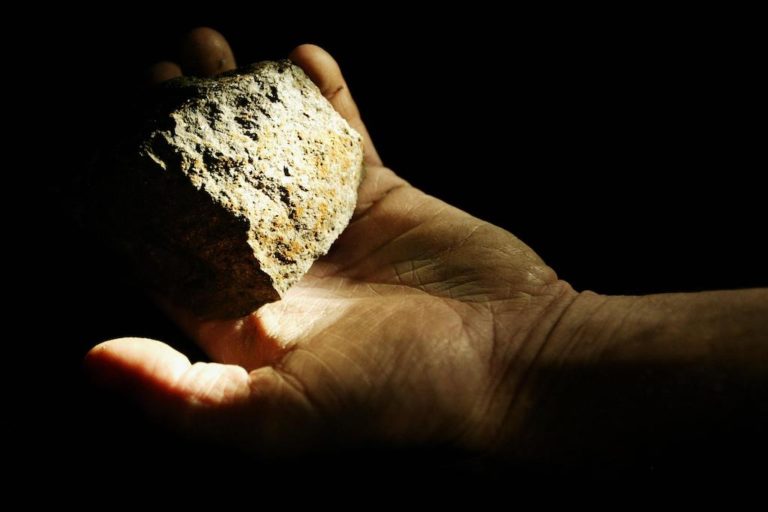
MONTREAL—You probably don’t know what Elysis means, but you might well be holding its result in your hand. And within it is the very essence of the green-revolution conundrum.
Skip to content


Commentary: Quebec Ink
Why Apple’s climate-friendly aluminum poses a dilemma for Quebec
The Elysis smelting process is an environmental quantum leap that could cost high-paying jobs—at least in the short term
Molten aluminum at the Alouette aluminum smelter in Sept-Îles, Que., in May 2019. Photo: The Canadian Press/Jacques Boissinot
MONTREAL—You probably don’t know what Elysis means, but you might well be holding its result in your hand. And within it is the very essence of the green-revolution conundrum.
The fruit of technology developed in tandem by competing aluminum multinationals Alcoa and Rio Tinto, Elysis is a carbon-free method of smelting the metal. This is a big deal. Light, strong and infinitely recyclable, aluminum is an ideal material for these aspirationally green times, save for this: producing it is a filthy business that consumes six per cent of the world’s coal-fired electricity. As such, conventional aluminum smelting is a significant obstacle to the global effort to limit planetary warming to 1.5 C above pre-industrial levels.
By contrast, the only byproduct of Elysis aluminum is oxygen. Apple, which stickhandled the partnership between Alcoa and Rio Tinto, uses Elysis-made aluminum in the frames of its iPhone SE and in the production of a Macbook Pro model. The material’s green bona fides are dizzying. According to Elysis, the eponymous company that produces it, GHG emissions in Canada alone would be reduced by roughly seven million tonnes—the equivalent carbon output of 1.8 million cars—were all 10 of Canada’s aluminum smelters to adopt the technology.
Related Articles

Yet it would also lead to a catastrophic loss in Quebec, home to nine of those 10 smelters. According to a report from Saguenay-based strategic development firm Groupe Performance Stratégique, recently obtained by Radio-Canada, the implementation of the Elysis process could render as many as 5,600 jobs directly and indirectly related to the province’s aluminum industry obsolete. And Elysis sounds like a fait accompli in Quebec, at least if you’re listening to the provincial government. “The important thing is to decarbonize the aluminum smelters. If they don’t, they’re going to close,” said Innovation Minister Pierre Fitzgibbon recently.
It’s a scenario playing out around the world as economies perform the often-halting march towards decarbonization: doing so will necessarily mean the elimination of many well-paying jobs. “There are going to be some sectors where adopting low-carbon technologies leads to probably lower employment levels than the status quo,” as John McNally, program director for clean and resilient growth at the Ottawa-based Smart Prosperity Institute, told me.
This is particularly true in carbon-intensive industries like mining, McNally points out. Which means Canada, as a digger of nickel and plunderer of oil-soaked sands, is particularly vulnerable. So, too, is the country’s auto sector, a $16-billion industry supporting some 500,000 jobs. It’s a reminder that revolutions, green or otherwise, tend to be bloody.
Consider Germany, where auto manufacturing also represents an outsized chunk of the economy. The country is in the midst of an accelerated decarbonization effort, with goals of reducing emissions by 88 per cent from 1990 levels by 2040, and achieving full carbon neutrality by 2045. This has put enormous pressure on the country’s car industry. Result: potential job losses of 100,000 in three key auto-producing regions—nearly 13 per cent of the entire sector. Europe got a taste of things to come last week when Ford cut 3,800 jobs, citing a shift to EV production. Germany and the United Kingdom bore the brunt of the layoffs.
The drive for efficiency is behind these cuts. BMW’s M3 engine, which propels the 3-series from 0 to 100 km/h in as little as 3.4 seconds, has about 1,200 parts. The M version of the company’s all-electric i4 goes even faster and is exponentially less intricate.
Decarbonized aluminum is similarly less complex than its GHG-heavy cousin. Explaining the intricacies of aluminum smelting is eye-glazing, but it boils down to this: traditional smelting requires carbon bits that last 20 to 30 days before needing to be replaced, work that is done by humans. Elysis’s bits, made of ceramic, last two and a half years. Thus, it takes fewer warm bodies to make Elysis aluminum.
The political implications of the ensuing job losses are considerable. Quebec’s energy-hoovering aluminum industry is largely an outgrowth of the province’s abundant hydroelectricity. Two world wars goosed demand for the metal that only increased as manufacturers transitioned from weaponry to planes, trains and automobiles. Apple’s Elysis play represents the first significant disruption in a sector that hasn’t changed much over its 120-year history, relying as it does on cheap power and oodles of well-entrenched, well-paid workers.
Elysis’s global footprint is small, with only a single demonstration-phase smelter, located in Saguenay-Lac-Saint-Jean, Que., currently in production. But that’s the plant supplying Apple, and Apple’s interest in the technology is surely a sign of things to come. The company compelled Rio Tinto and Alcan to play nice in the interest of hastening the development of the technology—“a marriage forced by Apple,” as Fitzgibbon put it to me last summer—because the aluminum it’s been using, sourced largely from coal-burning China, is both a drag on its carbon neutrality goals and a looming PR nightmare.
Imagine the precedent of the world’s largest smartphone manufacturer insisting that all its baubles be made from clean aluminum.
So, the green revolution will be difficult. How bloody it must be, in terms of lost jobs, is not so clear. Last week, I called around to stakeholders in carbon-heavy industries, thinking I’d hear the sound of the sky falling. It was quite the opposite. Jeffrey Lewis of Vale, the Brazil-based mining company, told me that increased demand for its mineral bounty, driven mostly by EV production, will likely offset whatever jobs are lost to green efficiencies.
General Motors, meanwhile, says developing the software and processing the minerals required in EV production will more than make up for redundant gasoline-era jobs—including a $500-million battery-materials plant in Bécancour. “We expect that we’ll have all the same people employed and we’ll actually end up hiring people,” GM Canada vice-president David Paterson told me. One door closes, another opens: though thousands of Ford workers lost their jobs last week, thousands more were saved when Volkswagen announced its plan to electrify its popular Tiguan SUV.
“Overall, the economic job story associated with the transition is actually a really strong one, because you’re going to see huge growth in sectors like advanced manufacturing,” McNally told me. The post-carbon prognosis is “rosy” even in Alberta and Saskatchewan, he added, as the oil and gas sector moves from, say, digging up carbon to sequestering it underground.
As its aluminum industry amply demonstrates, Canada is an energy hog, ranking last among comparable countries when it comes to productivity per gigajoule, according to a recent HEC Montréal report. Changing that will mean short-term job losses, but governments and industry must see beyond them if they wish to secure the country’s place in the global economy. Because the revolution is happening either way.
Martin Patriquin is The Logic’s Quebec correspondent. He joined in 2019 after 10 years as Quebec bureau chief for Maclean’s. A National Magazine Award and SABEW winner, he has written for The New York Times, The Guardian, The Walrus, Vice, BuzzFeed and The Globe and Mail, among others. He is also a panelist on CBC’s “Power & Politics.” @MartinPatriquin



Loading...
Thanks for sharing!
You have shared 5 articles this month and reached the maximum amount of shares available.
CloseThis account has reached its share limit.
If you would like to purchase a sharing license please contact The Logic support at [email protected].
CloseGift the full article!
You have gifted 0 article(s) this month and have 5 remaining.
Recipients will be able to read the full text of the article after submitting their email address. They will not have access to other articles or subscriber benefits.
Photo: The Canadian Press/Jacques Boissinot
Most Popular This Week




In-depth, agenda-setting reporting
Great journalism delivered straight to your inbox.
The Big Read
Alberta’s referendum is just the start of the turmoil
Briefing
EverWind plans $10B data centre and wind development in Nova Scotia
Canada ready to force Stelco to sell its Canadian operations, Joly says
Feds plan a 60 MW defence-oriented data centre for Ottawa
Best business newsletter in Canada
Get up to speed in minutes with insights and analysis on the most important stories of the day, every weekday.
Exclusive events
See the bigger picture with reporters and industry experts in subscriber-exclusive events.
Membership in The Logic Council
Membership provides access to our popular Slack channel, participation in subscriber surveys and invitations to exclusive events with our journalists and special guests.






