Skip to content

Canada's Business and Tech Newsroom

  • Professional Subscription
  • Partnerships & Advertising
  • Licensing & Syndication
Log In Subscribe
Welcome,
  • My Account
  • Log Out
  • Business
  • Tech
  • National
  • The Big Read
  • Briefings
  • Commentary
Search
Log In Subscribe
Welcome,
  • My Account
  • Log Out
News

The luxury parka company that wants to wire soldiers’ clothing

Listen Now
0:00
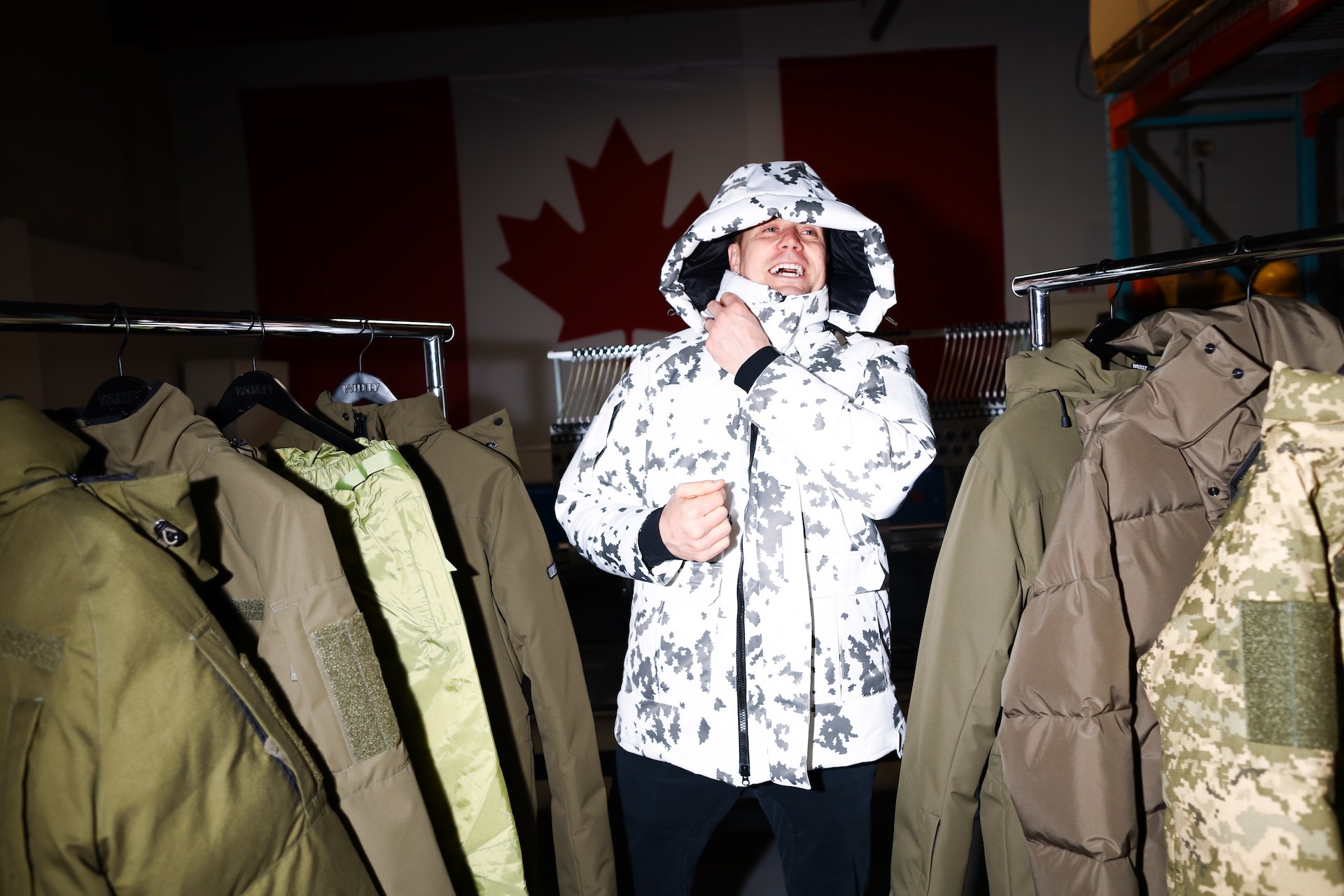
A shot of a laughing James Yurichuk bundling himself up in a white-and-grey camouflage parka, surrounded by other khaki and camouflage parkas on racks. There is a Canadian flag visible on the wall in the darkened background.
News

The luxury parka company that wants to wire soldiers’ clothing

Clothing that tracks the well-being of troops on the battlefield is a promising new front in military tech. High-end winterwear firm Wuxly is charging into it.

By David Reevely
Wuxly founder James Yurichuk wants to make smart military wear that commanders can use to monitor soldiers’ well-being in real time. Photo: Cole Burston for The Logic
Apr 24, 2026
A A
A Small A Medium A Large
Share

Gift

Share

Listen Now
0:00

As Canada pours billions of public dollars into its defence sector, companies in all sorts of fields are hurrying to find military uses for their goods—drones, communications equipment, AI systems, navigation tools. And… undergarments? 

Yes, if they’re T-shirts from Ontario clothing company Wuxly.

Talking Points

  • Toronto-area Wuxly will sell you a fancy coat descended from one its CEO once commissioned for his girlfriend, but it’s also been outfitting Ukrainian troops and NATO allies for years
  • Smart textiles that can track soldiers’ vitals in real time are its next big project

“These are… electronically infused textiles,” says co-founder and CEO James Yurichuk. “It’s a bio-monitoring system for soldiers.”

Some serious money is behind things like communication and sensor systems meant to send masses of data to headquarters for AIs to crunch into real-time analysis for commanders. Yurichuk’s goal is to make clothing that adds to that mix vital information about the humans whose lives are on the line.

“If someone’s deployed, say, in the Arctic, you can see if their core temperature is getting too low. You can see if someone may have been in an accident,” he says. “It can triage, in live time, some of these conditions.”

Such readings could also, of course, alert a commander if a combatant has been wounded or killed.

Related Articles

Bank towers are shown from Bay Street in Toronto's financial district, on Wednesday, June 16, 2010.

Canada’s biggest banks get into defence after years of avoiding military financing

By Chaimae Chouiekh

Canadian defence startups are teaming up to build military tech

By Murad Hemmadi and David Reevely

Wearables like watches and rings can gather similar data, but “what we’re using goes around the chest,” says Yurichuk. “It is next to skin, so you can get the best reading possible.” Wuxly’s intent, furthermore, is to gather live information even if troops are under fire, not just data about soldiers’ health and general fitness that gets dumped into a dashboard from time to time.
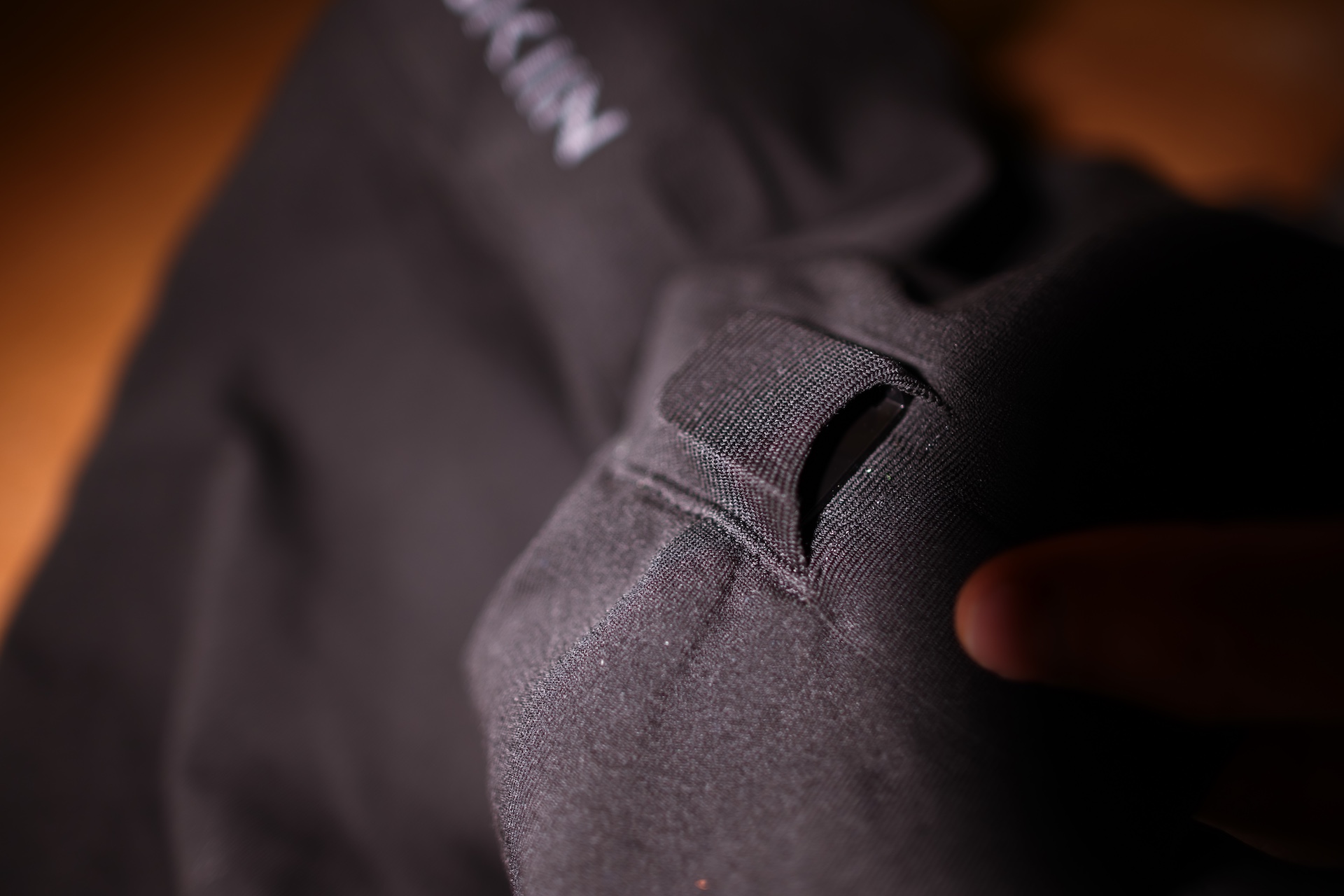
A close-up of a tiny sensor pouch sewn into a black garment. The device in the pouch is close to the size of a human finger that is partially visible in the photo.
The charging insert pouch in a Wuxly women’s undershirt. Photo: Cole Burston for The Logic

Wuxly is developing the smart clothing with another Toronto-area company, Myant, which makes similar tech for civilian health care, like bands that fit around people’s chests to monitor for heart problems.

The company set out to make something that just feels like an undershirt. It’ll have an insert the size of a key fob for charging, Yurichuk says. “You’ve just got to pull that out and you can throw it into the wash to be laundered, and just air dry.”

Yurichuk spent about a week in March at a “sprint” organized by Vimy Forge, a federally funded defence tech accelerator in Fredericton—down the road from Canadian Forces Base Gagetown. He was there with executives from companies developing things like marine and amphibious robots and AI-driven lie detectors.

“What stood out most was the emphasis on genuinely mission-first thinking—mapping innovation to real operational gaps rather than building in isolation,” he says.

The move into smart clothing is new but Wuxly has had a defence-oriented business for a while. The company’s history dates to 2013, when Yurichuk was a linebacker in the Canadian Football League. He was going from the B.C. Lions, in Vancouver’s mild climate, to the Toronto Argonauts. His girlfriend at the time was from South America and was not equipped for a Toronto winter.

“If we didn’t keep her warm, she was going to fly right back to Brazil,” Yurichuk says. He commissioned a custom jacket for her from a tailor friend.

The jacket worked: James and Daniela Yurichuk are married, with four children.

Wuxly was born as a company, under the name Woolly Mammoth, in 2015. Its winterwear competes with Canada Goose and Moose Knuckles at the luxury end of northern-practical, with parkas retailing for as much as $1,495.

The company has about 25 corporate employees, Yurichuk says. It uses as much Canadian content as it can and does all its cutting and sewing domestically, with a variable workforce of about 200.

That’s been pivotal in putting Wuxly in the position it’s in now.
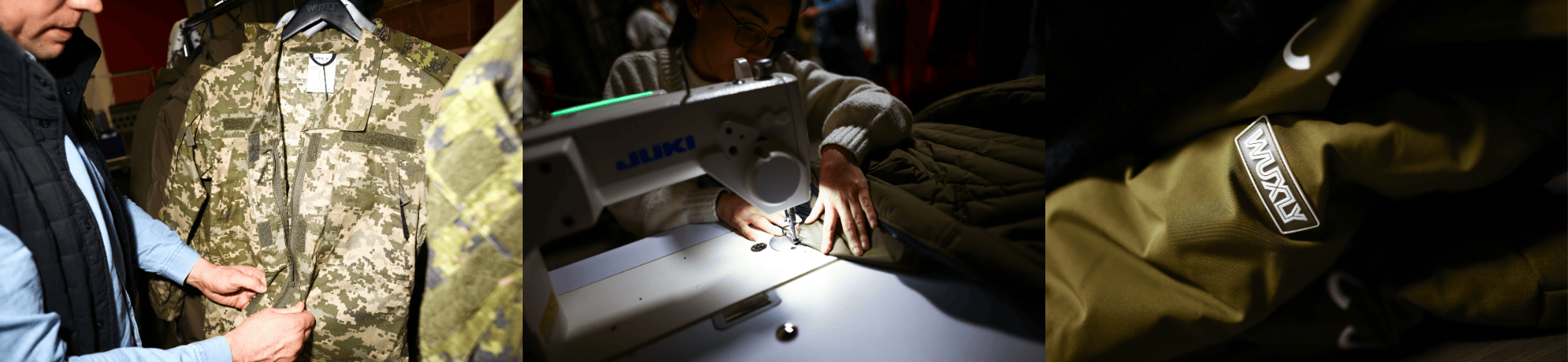
Launched as a maker of high-end winterwear, Wuxly has had a defence-oriented business for a while. Photo: Cole Burston for The Logic

Early in the COVID-19 pandemic, the federal government gave Wuxly contracts—around $100 million worth, Yurichuk says—that had it mobilize multiple other manufacturers to make reusable protective gowns. “There weren’t many Canadian textile producers,” he says.

The company plowed pandemic profits into production capacity and certifications from the International Organization for Standardization, which add credibility when it’s trying to make big sales.

Demand for personal protective equipment waned, however, along with the pandemic emergency. Then, in 2022, Russia invaded Ukraine. Yurichuk, who has Ukrainian ancestry, sent Wuxly-made jackets. That, he says, led to calls for sleeping bags, tents and even tank covers.

“The product was really well-received, and the government started trusting us in some very important, high-profile projects,” he says. When Canada donated uniforms for female Ukrainian soldiers, it enlisted Wuxly.

“They were making their uniforms in the basements of homes in Ukraine,” Yurichuk says. “We ended up making 40,000 female combat uniforms for them.”

More recently, Wuxly has supplied Nordic countries’ militaries with things like helmet covers, which have to fit particular helmet models and provide warmth, protection and camouflage.

“We’re a classic Canadian company that probably sells more outside Canada than it does inside Canada,” Yurichuk says.

Nearly 40 years after the Canadian military began integrating women into combat roles, the Canadian Forces still issue women combat uniforms designed for male bodies, though they’re working on it. Wuxly aims to land some of that business, Yurichuk says.

Gift the full article

He hopes being able to show that Wuxly gear has already been used in combat, and by other NATO countries, will make a difference.

“We’re not just bolting it on the wall that, ‘Hey, we’re in defence! We’re doing military!’” Yurichuk says. “It’s not a sewing machine and a dream that we’re selling here.”


#defence #defence tech #defence technology #economy #procurement #Tech

Loading...

Thanks for sharing!

You have shared 5 articles this month and reached the maximum amount of shares available.

Close
This account has reached its share limit.

If you would like to purchase a sharing license please contact The Logic support at [email protected].

Close
Want to share this article?

Upgrade to all-access now

Close
Gift the full article!

You have gifted 0 article(s) this month and have 5 remaining.

Copy link and gift
Copy Link
Email to a friend
Send Email
Gift on Social Media

Recipients will be able to read the full text of the article after submitting their email address. They will not have access to other articles or subscriber benefits.

A shot of a laughing James Yurichuk bundling himself up in a white-and-grey camouflage parka, surrounded by other khaki and camouflage parkas on racks. There is a Canadian flag visible on the wall in the darkened background.

Photo: Cole Burston for The Logic

A close-up of a tiny sensor pouch sewn into a black garment. The device in the pouch is close to the size of a human finger that is partially visible in the photo.

The charging insert pouch in a Wuxly women’s undershirt.

Launched as a maker of high-end winterwear, Wuxly has had a defence-oriented business for a while.

Most Popular This Week

An image of Mark Carney standing in front of a red podium with the words "AI for All / L'IA pour tous." He is wearing a suit and tie. In the background, people wearing scrubs and white coats are visible.
Special Report

Canada’s new AI strategy sets lofty goals for adoption and growth

By Murad Hemmadi and Laura Osman
Exclusive

Canada’s new AI strategy includes $500M fund to back key firms

By Murad Hemmadi and Catherine McIntyre
The Big Read

Canada’s AI boom is about to collide with a major labour shortage

By Catherine McIntyre
A low-angle shot of a truck carrying vehicles across the bridge at the Canada-U.S. border in Sarnia, Ont. The U.S. and Canadian flags are flying in the foreground.
Analysis

Why Canada’s wait-and-see approach to U.S. trade talks just might work

By Joanna Smith

In-depth, agenda-setting reporting

Great journalism delivered straight to your inbox.

The image shows the inside of Toronto Stadium on a sunny day. The rows of seats are empty; an empty green field is visible.
News

Toronto and Vancouver aren’t getting a World Cup bookings boom

By Chaimae Chouiekh

Briefing

Amazon to raise $14B worth of loonie bonds as it spends big on AI: Report

By Murad Hemmadi   |   Jun 8, 2026 | 3:26 PM ET

Self-driving truck firm Gatik expands Pepsi delivery deal

By Anita Balakrishnan   |   Jun 8, 2026 | 3:12 PM ET

AI drives software buyout deals to their lowest level since the COVID-19 pandemic

By Catherine McIntyre   |   Jun 8, 2026 | 2:48 PM ET

Best business newsletter in Canada

Get up to speed in minutes with insights and analysis on the most important stories of the day, every weekday.

Exclusive events

See the bigger picture with reporters and industry experts in subscriber-exclusive events.

Membership in The Logic Council

Membership provides access to our popular Slack channel, participation in subscriber surveys and invitations to exclusive events with our journalists and special guests.

Recent Popular Stories

News

Canada’s surprise plan to buy Saab command jets leaves competitors seeking answers

By David Reevely   |   May 29, 2026
A closeup of a scale model of a jet covered in pixellated camouflage, with sensor equipment attached to the top of its fuselage. There are civilians and uniformed military personnel milling in the background.
News

Lion Electric is back—and smaller than ever

By Martin Patriquin   |   Jun 1, 2026
Exclusive

Canada’s new AI strategy includes $500M fund to back key firms

By Murad Hemmadi and Catherine McIntyre   |   Jun 3, 2026
Analysis

Why Canada’s wait-and-see approach to U.S. trade talks just might work

By Joanna Smith   |   Jun 2, 2026
A low-angle shot of a truck carrying vehicles across the bridge at the Canada-U.S. border in Sarnia, Ont. The U.S. and Canadian flags are flying in the foreground.
The Big Read

ApplyBoard faces a reckoning as Canada’s immigration boom turns into a bust

By Claire Brownell and David Reevely   |   May 27, 2026
The Big Read

We found every data centre in Canada

By Murad Hemmadi, David Reevely, Aleksandra Sagan, Chaimae Chouiekh, Martin Patriquin and Catherine McIntyre   |   Apr 8, 2026
Four vertical slices of aerial view photos. From left, a building in downtown Toronto housing several data centres, a picture of the Albertan wilderness where the proposed Wonder Valley data centre would go, a lit-up QScale data centre in Quebec, and a data centre at a Hydro-Quebec dam.

Canada's most influential executives and policymakers are reading The Logic

  • CPP Investments
  • Sun Life Financial
  • C100
  • Amazon
  • Telus
  • Mastercard
  • bdc
  • Shopify
  • Rogers
  • RBC
  • General Motors
  • MaRS
  • Government of Canada
  • Uber
  • Loblaw Companies Limited
logic-logo

Canada's Business and Tech Newsroom

100% human-crafted journalism

Newsroom

  • News Tips
  • AI Policy
  • Editorial Disclosures
  • Story Pitches

Company

  • About Us
  • Terms of Service
  • Privacy Statement
  • Corporate Information

Contact

  • Contact Us
  • Advertise
  • FAQs
  • Work at The Logic

© 2026 The Logic Inc. All Rights Reserved.

Trusted by leaders

Error

Account creation failed.

Please email us at [email protected].

Create Account

[wppb-register form_name=”cozmo-registration-form-for-modal”]

I do have an account
Login
or

[wppb-login]

I don’t have an account