Justice Minister Arif Virani has tabled a long-awaited bill that would compel technology platforms to remove harmful content and increase the maximum penalty for advocating genocide online to life in prison.
Skip to content


News
Ottawa unveils Online Harms Act, proposing new penalties for hate crimes
Highly anticipated Bill C-63 would add a definition of hatred to Criminal Code
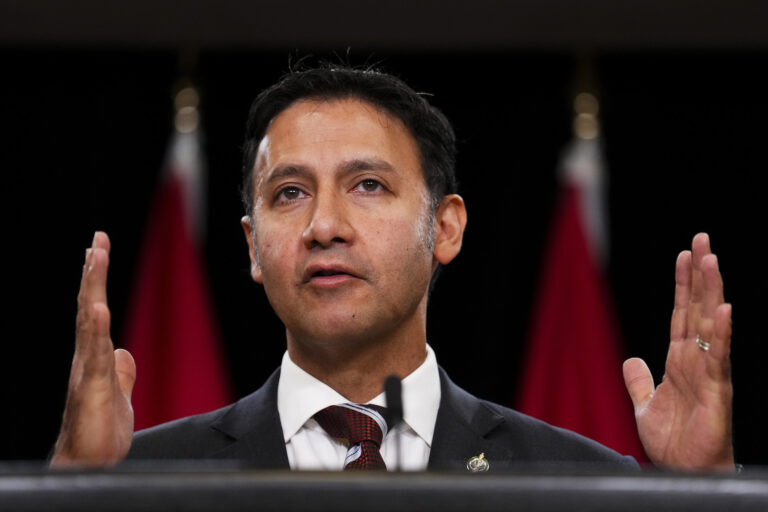
Justice Minister Arif Virani has unveiled Bill C-63, which would compel technology platforms to remove harmful online content. Photo: The Canadian Press/Adrian Wyld
Justice Minister Arif Virani has tabled a long-awaited bill that would compel technology platforms to remove harmful content and increase the maximum penalty for advocating genocide online to life in prison.
First promised in 2019, the legislation unveiled Monday would target social media and live-streaming services, as well as user-uploaded adult content services, in an attempt to “reduce exposure to harmful content and empower and support users,” according to briefing materials provided to journalists. The Online Harms Act, or Bill C-63, would also add a definition of “hatred” to the Criminal Code, consistent with Supreme Court decisions.
The proposed law, which the government says is necessary to curb a dramatic increase in online harassment, child exploitation and hate speech, is arguably the most contentious part of its legislative efforts to regulate “Canada’s digital public square.”
“I want to be crystal clear about what the Online Harms Act does not do. It does not undermine freedom of speech,” Virani told reporters. “It enhances free expression by empowering all people to seek and participate in online debate.”
Related Articles

Here are the key points from Bill C-63:
- The legislation proposes to create a five-member digital safety commission to enforce the new law, with the power to order the removal of non-consensual intimate content, as well as a digital safety ombudsperson to field complaints and make recommendations to social media services.
- Only services with a certain threshold of users would be covered by the legislation, though the governor-in-council can include additional social media services below it should they pose a significant risk of harm. (The documents did not specify the exact thresholds)
- The legislation focuses on seven types of harmful online content: content that victimizes a child or revictimizes a survivor; content used to bully a child; content that induces a child to harm themselves; content that incites violent extremism or terrorism; content that incites violence; content that foments hatred; and intimate content communicated without consent, including deepfakes.
- The bill would compel services to remove sexually victimizing or revictimizing content, as well as non-consensual intimate content, within 24 hours following a flag or a complaint regarding the content.
- Online services targeted by the legislation would have the duty to act responsibly, make certain content inaccessible and protect children. The law would exclude private and encrypted message services like Signal and Telegram.
- The bill would allow the Canadian Human Rights Tribunal to mediate disputes, order the removal of hate speech and levy fines of up to $20,000. As for the platforms, the government said fines for non-compliance would be as high as six per cent of global revenue.
In remarks to reporters, Virani stressed the lengths the government had gone to in gathering views and concerns on the issue, saying, “this legislation does not come out of a vacuum.” Rather, he said, “it is a result of literally years of hard work, research and consultation with stakeholders, with experts, with international partners and average Canadians who are concerned about the well-being of their families, their neighbours and their communities.
“The message that all those people have sent to us is loud and it is unequivocal. Doing nothing is not an option.”
The minister noted that Canada is joining allies like the United Kingdom, France, Germany and Australia in legislating in the area. “We have learned from their experiences,” Virani said. “We cannot tolerate anarchy on the internet. The cost is too great.”



Loading...
Thanks for sharing!
You have shared 5 articles this month and reached the maximum amount of shares available.
CloseThis account has reached its share limit.
If you would like to purchase a sharing license please contact The Logic support at [email protected].
CloseGift the full article!
You have gifted 0 article(s) this month and have 5 remaining.
Recipients will be able to read the full text of the article after submitting their email address. They will not have access to other articles or subscriber benefits.
Photo: The Canadian Press/Adrian Wyld
Most Popular This Week




In-depth, agenda-setting reporting
Great journalism delivered straight to your inbox.
The Big Read
Beacon is building an AI empire by fixing Main Street’s software
Briefing
Inovia raises US$200M for new VC fund as it eyes AI’s impact
43% of eligible Albertans voted ahead of Monday’s referendum
AI chip company Tenstorrent raises US$1.5B, valuing it at US$6.2B
Best business newsletter in Canada
Get up to speed in minutes with insights and analysis on the most important stories of the day, every weekday.
Exclusive events
See the bigger picture with reporters and industry experts in subscriber-exclusive events.
Membership in The Logic Council
Membership provides access to our popular Slack channel, participation in subscriber surveys and invitations to exclusive events with our journalists and special guests.







