After mass shootings at two New Zealand mosques in 2019, Prime Minister Justin Trudeau was one of 18 world leaders, along with Meta and Google and other Big Tech companies, to sign onto the Christchurch Call to Action. The non-binding pledge sought to eliminate terrorist and violent extremist content from the internet, calling for “regulatory or policy measures” to curb the spread of online hate and violence.
Skip to content

 Vigils in Ottawa on Oct. 28 and in Vancouver on Oct. 19. Proponents of legislation to curb online harms say the spread of hate online has worsened since the start of the Israel-Hamas war. Photo: Patrick Doyle & Darryl Dyck/The Canadian Press
News
Justice Department to lead Ottawa’s renewed push for online harms law
Heritage hands off file after drawn-out struggles over streaming, online news acts
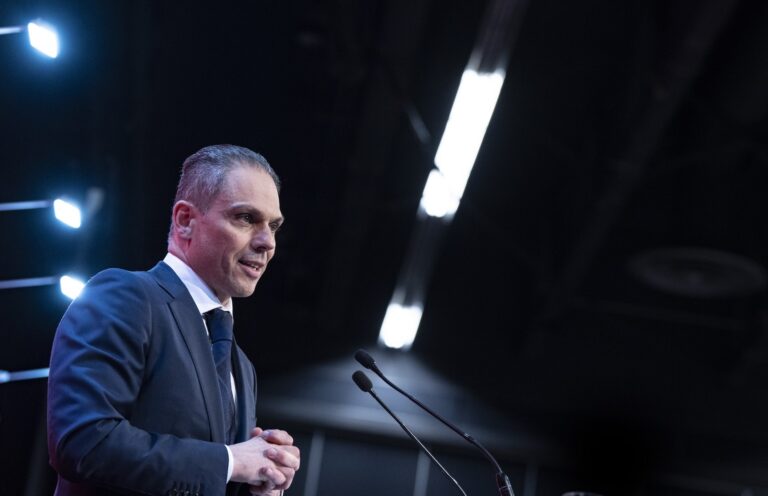
Justice Minister and attorney general of Canada Arif Virani holds a press conference in Ottawa in October 2023. Photo: The Canadian Press/Sean Kilpatrick
After mass shootings at two New Zealand mosques in 2019, Prime Minister Justin Trudeau was one of 18 world leaders, along with Meta and Google and other Big Tech companies, to sign onto the Christchurch Call to Action. The non-binding pledge sought to eliminate terrorist and violent extremist content from the internet, calling for “regulatory or policy measures” to curb the spread of online hate and violence.
It became a campaign promise four months later, when Trudeau’s Liberals, in an election that would reduce their government from majority to minority, said they would compel social media platforms to remove illegal material within 24 hours under threat of “significant financial penalties.”
Talking Points
- The federal Justice Department and new minister Arif Virani will take the lead on the Liberals’ long-delayed effort to curb online harms, sources say
- Justice will take over the lead on the file from Heritage, which continues to manage the fallout from the Online Streaming Act and the Online News Act
Four years later, that promise remains mired in false starts and delays. Despite a comprehensive consultation process and (another) campaign promise to introduce legislation within 100 days of the 2021 election, a law regulating hateful and violent content is nowhere near the books. In the European Union and the United Kingdom, these regulations are now the law of the land. In Canada, the government still can’t say when equivalent legislation will be forthcoming.
According to two government sources, the online harms file is being transferred from the Department of Canadian Heritage—which oversaw the controversial bills C-11, the Liberal effort to extend the Broadcasting Act and its Canadian content rules to govern digital platforms, and C-18, the Online News Act—to the Department of Justice.
“[The file] has been out of our hands for quite a while. We handed over all the documents [to Justice],” said a Heritage source, whom The Logic agreed not to name so they could speak freely about information that isn’t yet public. “It’s just a question of when [the Prime Minister’s Office] wants to make that shift and how they want to message it.”
Related Articles


A source within the PMO, who also spoke on the condition of anonymity, confirmed that Justice will be taking the lead on the file, with Heritage playing a role the source described as a “supporting character.” However, it’s not clear when Justice will take up the file. Asked if the department had yet received the file from Heritage, David Taylor, director of communications for Justice Minister Arif Virani, responded with a simple “No.”
The delay has frustrated those who want the government to take action on the assortment of issues that fall under the online harms label. Many of those advocates believe such a law is more necessary now than in 2019. “Every day that the bill is delayed is another day that harm is happening online, and the problem isn’t going away. The lack of a law is having a palpable daily impact,” said Emily Laidlaw, a University of Calgary associate law professor who co-chaired the government’s advisory panel on online harms.
But according to the PMO source, the Justice Department’s first task will be figuring out how to define “online harms” for the purposes of the legislation—a hurdle at which the Liberals’ efforts have previously faltered.
Seven months after he signed the Christchurch Call, Trudeau tasked then-heritage minister Steven Guilbeault with devising and implementing online safety regulations. The government shelved Guilbeault’s first legislative effort, which would have compelled platforms to report information on their users to law enforcement and national-security agencies, after critics said it was likely unconstitutional and “could result in the creation of a surveillance state.”
Pablo Rodriguez, who replaced Guilbeault as heritage minister in 2021, struck a committee to advise the ministry on how best to craft an online harms bill. The 12-person group struggled not only with how to curb online harms, but to define the very term, underscoring how crafting a law regulating certain forms of speech is a fraught, complex affair.
Nevertheless, the group agreed that the government should adopt a less punitive approach, instead compelling platforms to adopt “rigorous, significant and sophisticated transparency requirements” to mitigate risk on their sites. The government sounded hopeful. “We’re committed to getting this right and to engaging Canadians in a thorough, open, and transparent manner every step of the way,” Rodriguez said in a statement to The Logic at the time. (Trudeau has since appointed Pascale St-Onge as heritage minister.) Legislatively, little has happened since.
Virani, appointed justice minister in the same July cabinet shuffle that put St-Onge at Heritage, promised online harms legislation in the wake of the Oct. 7 Hamas attacks in Israel, though he offered no timeline. His sortie was the first public hint that his ministry would have a hand in the bill’s crafting.
Virani is well versed on the file, having held cross-country consultations on the proposed law in 2021, when he was parliamentary secretary to former justice minister David Lametti. The Online Streaming Act and Online News Act, Heritage’s two previous bills regulating internet platforms, continue to be divisive, drawn-out affairs, suggesting there is limited bandwidth within the ministry to take on another potential fight with Big Tech. (Neither Meta nor Google, which have found themselves at odds with the government over the Online News Act in particular, responded to a request for comment about its plans for online harms legislation.)
Though polling suggests a majority of Canadians support the government regulation of certain aspects of the internet, it will be difficult political territory for the Liberals. Polls also put them far behind the opposition Conservative Party, which has called the Liberal government’s legislation regulating streaming platforms a “desperate” attempt “to police and control speech.”
Conservative MP Rob Moore, who serves as the party’s shadow minister for justice and the attorney general, didn’t respond to an interview request.
Whatever the political calculus, proponents of a bill are likely to keep up the pressure. Bernie Farber, the founding chair of the Canadian Anti-Hate Network and another member of the online harms advisory committee, said the Israel-Hamas war has only inflamed hatred online. “There’s nothing whatsoever to protect people from being targeted. And it’s getting worse with the war, and the fallout with the war. … The Jewish community, but the Muslim and Palestinian communities, as well, will come under the same targeting. And why not? It’s easy for frustrated, racist bigots to get their frustrations out, and there’s no consequences.”
“There aren’t consequences for the massive amount of child sexual abuse material that is readily available on the internet,” said Canadian Centre for Child Protection executive director Lianna MacDonald, who also served on the advisory committee. “Every day that goes by that this material is allowed to be shared is not only incredibly harmful to children. It is very bad for society at large.”
Correction: Emily Laidlaw is an associate law professor at the University of Calgary. This story has been updated.



Loading...
Thanks for sharing!
You have shared 5 articles this month and reached the maximum amount of shares available.
CloseThis account has reached its share limit.
If you would like to purchase a sharing license please contact The Logic support at [email protected].
CloseGift the full article!
You have gifted 0 article(s) this month and have 5 remaining.
Recipients will be able to read the full text of the article after submitting their email address. They will not have access to other articles or subscriber benefits.
Photo: The Canadian Press/Sean Kilpatrick
Vigils in Ottawa on Oct. 28 and in Vancouver on Oct. 19. Proponents of legislation to curb online harms say the spread of hate online has worsened since the start of the Israel-Hamas war.
Most Popular This Week




In-depth, agenda-setting reporting
Great journalism delivered straight to your inbox.
News
National Bank CEO warns AI alone won’t give banks a lasting edge
Briefing
Canada and Ontario commit over $5B to support tariff-hit steel sector
Hackers will see cars as major targets in next 3 years, 83% of car-tech workers say
EA shutting down Edmonton studio BioWare
Best business newsletter in Canada
Get up to speed in minutes with insights and analysis on the most important stories of the day, every weekday.
Exclusive events
See the bigger picture with reporters and industry experts in subscriber-exclusive events.
Membership in The Logic Council
Membership provides access to our popular Slack channel, participation in subscriber surveys and invitations to exclusive events with our journalists and special guests.





