Turmoil, confusion and animosity are roiling open banking in the U.S.—and some are concerned the same thing could happen in Canada if the country’s rollout of the idea faces more holdups.
Skip to content

News
Canada moves forward on open banking while U.S. backtracks
Turmoil in the U.S. is a cautionary tale for Canada, industry association warns
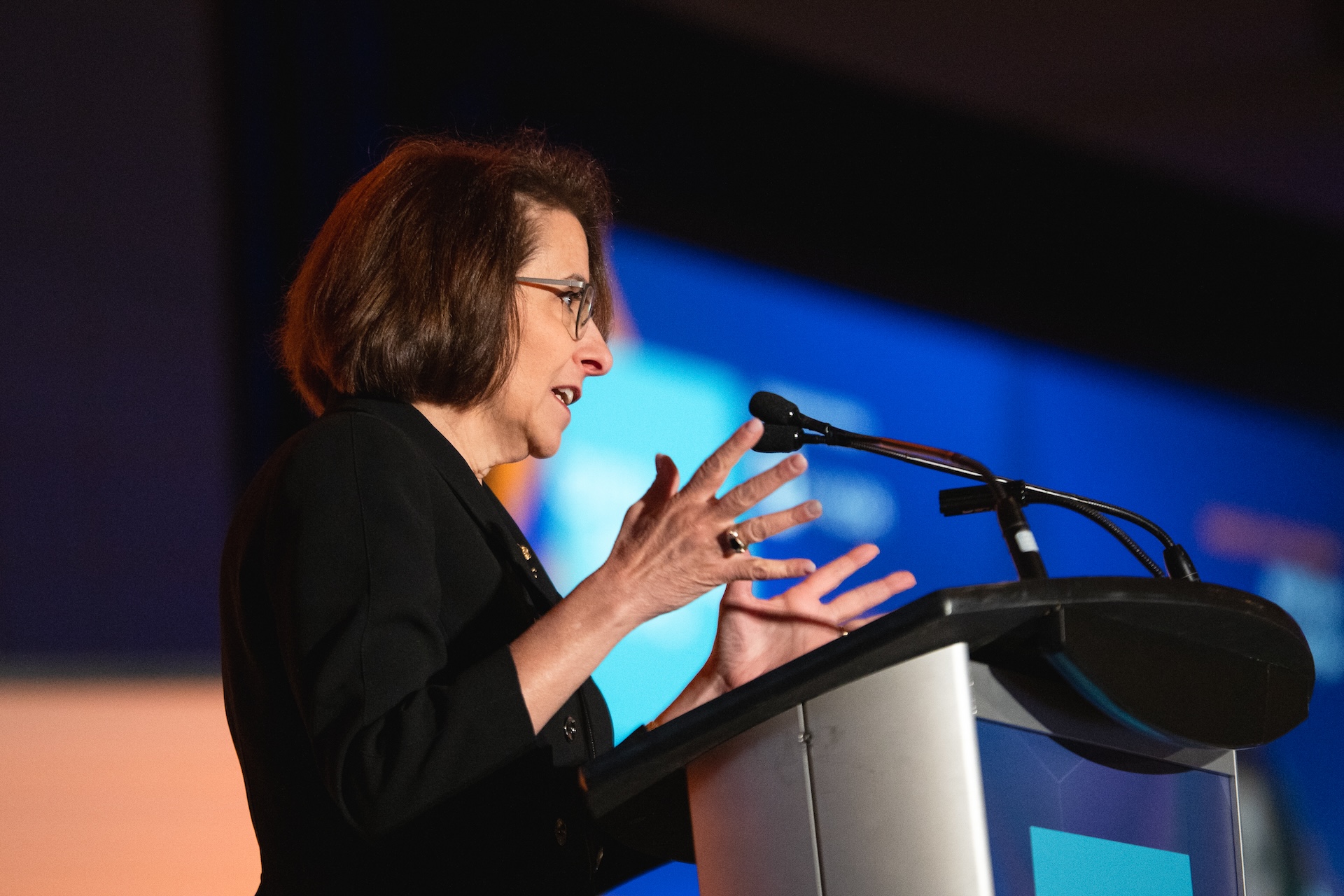
Shereen Benzvy Miller, commissioner of the FCAC, is pictured at Open Banking Expo in Toronto on June 17, 2025. Photo: Laura Proctor for The Logic
Turmoil, confusion and animosity are roiling open banking in the U.S.—and some are concerned the same thing could happen in Canada if the country’s rollout of the idea faces more holdups.
“Further delay risks importing the same kind of dysfunction that we’re seeing in the U.S.,” said Laine Williams, a spokesperson for the Financial Data and Technology Association of North America, an industry association that lobbies for open banking in both the U.S. and Canada. “Canada should learn from this cautionary tale.”
In October 2024, the U.S. Consumer Financial Protection Bureau (CFPB) released its open banking framework, which would require banks to give away data, with a consumer’s consent, to any fintech that agrees to meet certain requirements. Fintechs use bank account data to power accounting software, budgeting apps and other services. Bank industry associations immediately challenged CFPB’s open banking framework in court, arguing it’s unfair to force banks to grant competitors free access to their data.
The CFPB released its open banking framework under former president Joe Biden’s administration. After Biden was succeeded by Donald Trump, Elon Musk’s Department of Government Efficiency gutted the agency in February as part of its effort to slash federal spending.
Talking Points
- The U.S. has reversed course twice on open banking, and on Friday issued a formal notice to revise the framework rather than scrap it
- Canada’s open banking journey has been much less adversarial, but has also been mired in disagreements and multiple delays, which advocates say put the framework at risk if it isn’t implemented soon
In May, a hollowed out CFPB backtracked on open banking, asking the court to strike it down, saying it “exceeds the Bureau’s statutory authority and is arbitrary and capricious.”
Amid uncertainty over open banking’s future, JPMorgan Chase told fintechs it would start charging them to access customer data, according to a Bloomberg report—a move the CFPB’s open banking framework would have prohibited. JPMorgan did not respond to a request for comment.
Associations for fintech and crypto companies, which rely on bank data to function, pushed back in July, asking Trump to support open banking. The crypto sector wields enormous political power in Washington, having accounted for nearly half of all corporate spending on federal political campaigns in 2024. Trump’s son Donald Trump Jr., who is involved in many of the Trump family’s crypto ventures, posted his support of open banking on X earlier this summer.
Related Articles


The pressure was effective. In a further twist, the CFPB said in a July 29 court filing that it intends to reconsider open banking. On Friday, the agency issued an official notice to kick off the process, asking for input on issues including charging fees, security and privacy.
With the CFPB headed back to the drawing board, Canada is now further ahead on the path to open banking. In June, Financial Consumer Agency of Canada (FCAC) commissioner Shereen Benzvy Miller said Ottawa is forging ahead with the framework under Prime Minister Mark Carney, after the spring federal election threw its fate into question. Canada has already passed part of the legislation required to launch the framework by a target of early 2026 and Benzvy Miller said the FCAC and the Department of Finance are in the process of crafting the rest.
As it has in the U.S., open banking in Canada has faced repeated delays and pushback from big banks. The Canadian banking sector now officially supports the concept, however. Parna Sabet-Stephenson, who leads the financial services and technology teams at Gowling WLG, said the process has been less adversarial in Canada than it has been south of the border.
Canada plans to require banks to provide data to fintechs for free under open banking, but Sabet-Stephenson said there’s currently nothing stopping a Canadian bank from announcing it will charge fintechs to access its data, as JPMorgan has done. Even once the framework has launched, banks will be free to charge for access to data that falls outside its scope, she said.
“Open banking doesn’t mean that everything will always be free,” she said. “What falls within open banking should be at no cost, but that’s why the scope… is very important.”
One feature that may be unique to Canada’s open banking approach is a ban on screen scraping. Currently, many fintech services rely on this workaround in the absence of open banking, which requires customers to provide their online banking passwords so a bot can impersonate them, access their accounts and download data. The practice has been widely criticized by banks and fintechs alike as error-prone, insecure and less efficient than open banking.
Morva Rohani, executive director of the Canadian Web3 Council (CW3), an industry association for the crypto sector, said many Canadian crypto businesses rely on the practice to connect to users’ bank accounts.
CW3—which has much less political power than its American crypto-lobbying counterparts—is pushing for Ottawa to broaden the scope of open banking to include digital assets and ensure crypto platforms can apply to use the framework, Rohani said. If they can’t, and Ottawa goes through with banning screen scraping once open banking is in place, the crypto sector will be at “a structural disadvantage,” she said.
Williams said that while Canada isn’t moving quickly enough on open banking, it’s undeniable that its policymakers have “done their homework.”
“While the U.S. has been bogged down in litigation and reversals, Canada has engaged in thoughtful conversations and consultations,” Williams said. “But unless this talk on paper moves into action, it risks watching innovation and investment leave for other markets.”



Loading...
Thanks for sharing!
You have shared 5 articles this month and reached the maximum amount of shares available.
CloseThis account has reached its share limit.
If you would like to purchase a sharing license please contact The Logic support at [email protected].
CloseGift the full article!
You have gifted 0 article(s) this month and have 5 remaining.
Recipients will be able to read the full text of the article after submitting their email address. They will not have access to other articles or subscriber benefits.
Photo: Laura Proctor for The Logic
Most Popular This Week




In-depth, agenda-setting reporting
Great journalism delivered straight to your inbox.
The Big Read
Alberta’s referendum is just the start of the turmoil
Briefing
EverWind plans $10B data centre and wind development in Nova Scotia
Canada ready to force Stelco to sell its Canadian operations, Joly says
Feds plan a 60 MW defence-oriented data centre for Ottawa
Best business newsletter in Canada
Get up to speed in minutes with insights and analysis on the most important stories of the day, every weekday.
Exclusive events
See the bigger picture with reporters and industry experts in subscriber-exclusive events.
Membership in The Logic Council
Membership provides access to our popular Slack channel, participation in subscriber surveys and invitations to exclusive events with our journalists and special guests.






