The Ontario government has appointed former federal civil servant Dan Herman to design a new organization meant to bolster intellectual property ownership in the province, The Logic has learned.
Skip to content

News
Ontario taps former federal civil servant Dan Herman to design IP agency
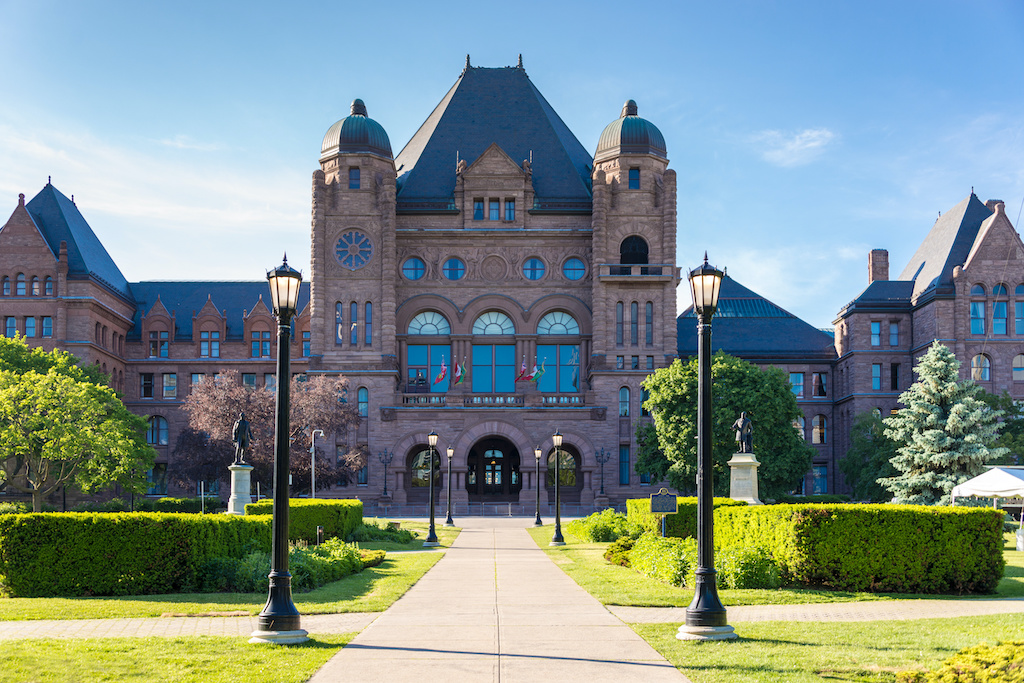
The Ontario Legislative Building at Queen's Park in Toronto in May 2015. Photo: Roberto Machado Noa/LightRocket via Getty Images
The Ontario government has appointed former federal civil servant Dan Herman to design a new organization meant to bolster intellectual property ownership in the province, The Logic has learned.
Herman was one of five members of an expert panel led by former BlackBerry executive Jim Balsillie tasked with consulting with universities and other stakeholders on how to fill the gap between public spending on research and development and commercial outcomes.
Talking Point
The Ontario government has appointed Dan Herman, the former head of strategy for the federal innovation ministry, to design an arm’s-length organization to increase intellectual property ownership in the province. Herman’s appointment follows more than two years of consultations with universities and other stakeholders led by former BlackBerry executive Jim Balsillie. A priority for the new organization will be measuring how public research dollars translate to commercial products at post-secondary institutions.
The panel’s primary recommendation from more than two years of consultations was to launch a new organization that offers entrepreneurs education and other support to help them generate and license their intellectual property.
“We need to create a systematic approach to ensuring everyone in the province—regardless of geography, regardless of language—can access support,” Herman said in an interview with The Logic, noting that the panel found wide variation between post-secondary institutions’ ability to help commercialize innovations. “We’re essentially creating a floor, so no matter where you are, you’re going to be able to get access to expertise.”
“The Special Advisor will help to address challenges related to governance, structure, costing and implementation,” said Colleges and Universities Minister Ross Romano in an email to The Logic. Romano said the organization is expected to be operational by early 2022.
Herman—a former head of strategy for the federal innovation ministry who also co-founded the Centre for Digital Entrepreneurship and Economic Performance, a think tank focused on Canada’s innovation economy—said the mechanics and governance of the organization are still being worked out. However, he anticipates it will be structured as a publicly funded agency working at arm’s length of the government.
Licensing intellectual property—for example through patents, trademarks and copyright—can be a lucrative source of revenue, and helps companies ensure rivals can’t freely replicate their ideas. As of 2020, these “intangible assets” accounted for about 90 per cent of the assets in the S&P 500 Index, up from about 17 per cent in 1975. However, a 2019 report by the Canadian Intellectual Property Office found that just two per cent of small- and mid-sized firms in the country had any patents.
In early 2020, the Ontario expert panel published a report urging the government to develop a mandatory IP curriculum for entrepreneurs and researchers who receive provincial funding.
That report also called for a centralized online resource with patent information for the province’s universities, colleges, research hospitals and business accelerators that benefit from the millions in funding that governments spend on research and development each year. Herman said the new organization could help carry out those recommendations.
The province has so far earmarked just $1.5 million for the initiative, a budget Herman expects will increase substantially when the organization launches.
Ontario’s efforts to boost IP literacy and output is part of a growing understanding that Canada is underperforming its peers in terms of generating income from its research. It ranked 17th on the World Intellectual Property Organization’s most recent Global Innovation Index. While the report pegged Canada ninth on inputs such as R&D funding and policies to support innovation, it ranked just 22nd on outputs, which include commercialization and intangible assets like patents.
Ottawa is also trying to address the patent gap. In 2018, it budgeted $85.3 million for an IP strategy. The biggest component of the plan so far is the $30-million Innovation Asset Collective, a non-profit designed to help cleantech companies generate more patents and protect themselves from intellectual-property litigation.
Herman said one priority for the Ontario agency will be to measure how public research dollars translate to commercial products at post-secondary institutions, where the mismatch between spending and returns is particularly prominent. The Logic reported in January that Canada’s top universities and research institutes spent $4.5 billion on research and development in 2018 but generated only $54.4 million in licensing income from their IP that year.
“We want to ensure that we get good data on this translation,” said Herman. “It’s public dollars that go through; what’s the ultimate outcome?” Herman could not say if the government plans to tie its funding for institutions to their commercial outcomes. “I don’t want to speak for what the minister wants in that case,” he said. Romano did not answer The Logic’s questions on whether funding will depend on institutions’ outcomes.
Jean-Nicolas Delage, an IP lawyer and co-leader of law firm Fasken’s technology, media and telecommunications group, cautioned against making public funding contingent on IP income, warning that it could stifle innovation. “A university teacher or researcher needs to have the capability to teach, research and publish if that’s what he or she wants,” said Delage. “You need to be able to disseminate your knowledge to the world without needing to generate revenue for innovations created in a university setting. That has to be a choice.” Delage said measures of success should instead include things like research sponsorships, PhD graduation numbers and academics starting and joining companies. “If [a university] does generate revenue, that’s great, but I do not believe that this should necessarily be the dominating metric of success.”
Delage suggested governments focus on supporting entrepreneurs with funding and education to help extract value from IP. “We need to help innovative companies grow and stay in Canada, and go public in Canada and create intellectual property that is Canada-owned,” he said. “And we should do that without attaching strings to subsidies, but by creating conditions where our companies are happy to grow in the country and create value for shareholders here.”
In Quebec, where Delage is based, the government has tried addressing gaps in IP commercialization by amalgamating most of the province’s tech-transfer offices, entities that deal with commercializing research for universities and public research institutions.
Herman said the Ontario model will not eliminate existing tech-transfer offices, but will act as a support system for them. “We really want to respect every postsecondary institution and their priorities,” he said. “What we want to do is supplement the capacity that each of those have by giving them something to plug into that doesn’t exist today.”



Loading...
Thanks for sharing!
You have shared 5 articles this month and reached the maximum amount of shares available.
CloseThis account has reached its share limit.
If you would like to purchase a sharing license please contact The Logic support at [email protected].
CloseGift the full article!
You have gifted 0 article(s) this month and have 5 remaining.
Recipients will be able to read the full text of the article after submitting their email address. They will not have access to other articles or subscriber benefits.
Photo: Roberto Machado Noa/LightRocket via Getty Images
Most Popular This Week




In-depth, agenda-setting reporting
Great journalism delivered straight to your inbox.
News
Canada faces a satellite-launch crunch as SpaceX retires its workhorse rocket
Briefing
Rio Tinto gets nearly $165M in additional federal funds for Quebec aluminum
U.S. to lift tariffs on some Canadian products crucial to Maine: Collins
Carney warns of tech dependence after Starlink disruptions in Ukraine
Best business newsletter in Canada
Get up to speed in minutes with insights and analysis on the most important stories of the day, every weekday.
Exclusive events
See the bigger picture with reporters and industry experts in subscriber-exclusive events.
Membership in The Logic Council
Membership provides access to our popular Slack channel, participation in subscriber surveys and invitations to exclusive events with our journalists and special guests.