When Northvolt’s new $7-billion battery factory near Montreal was announced one year ago this week, the company was riding high. Recently valued at US$12 billion, the most highly funded startup in Europe awaited a window for an initial public offering, which some speculated could raise its value to US$20 billion.
Skip to content

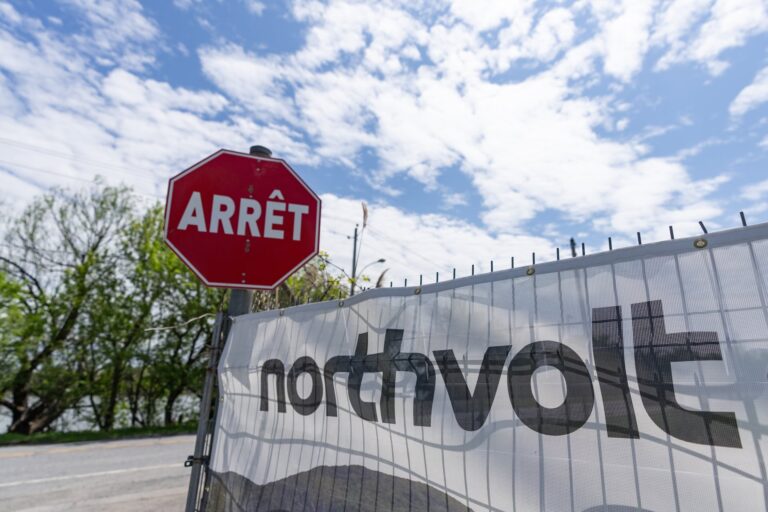
 The site of Northvolt's planned factory east of Montreal, in May 2024. Photo: The Canadian Press/Christinne Muschi

News
With a laundry list of Canadian backers, is Northvolt too big to fail?
Four pension-fund investments, up to $7.3B in subsidies in play as financial woes intensify
Photo: Photo illustration by Paul Kim for The Logic. Photo of Northvolt construction site: The Canadian Press/Christinne Muschi; photo of Christopher Gorelczenko, Senior Director of Commissioning at Northvolt: Getty Images/Jonathan Nackstrand/AFP
When Northvolt’s new $7-billion battery factory near Montreal was announced one year ago this week, the company was riding high. Recently valued at US$12 billion, the most highly funded startup in Europe awaited a window for an initial public offering, which some speculated could raise its value to US$20 billion.
The Montreal-area project—the biggest private investment in Quebec history—put Northvolt alongside giants like Stellantis, Volkswagen and Honda as one of the four pillars of Canada’s burgeoning electric-vehicle sector, helping make central Canada one of the leading battery districts in the world.
Talking Points
- Northvolt, one of the pillars of Canada’s EV strategy, was heavily backed by governments and other institutional investors, but has not fared well as automakers cut their EV production goals.
- Pension funds, taxpayers and suppliers are awaiting news on Northvolt’s Montreal-area project as creditors circle the company.
- Still, many industry watchers say the company’s issues are not a referendum on the state of Canada’s EV investments.
Twelve months on, growth in EV demand has fallen short of expectations, and Northvolt finds itself in a cash crunch that casts doubt on its future. On Monday, it slashed 20 per cent of its global workforce, on top of cost-cutting previously announced in a review of its global operations. The government of Sweden, where Northvolt is based, made it clear last week it won’t bail out the company, leaving the startup’s creditors to consider their options. Reports say Northvolt has hired the New York-based consulting firm Teneo to provide restructuring advice.
At a minimum, many expect Northvolt’s Quebec plans to be pushed back, though the company has not confirmed any delays. This week, it repeated assurances that work continues on the construction site, and on the design of the three facilities: cell production, cathode production and recycling.
The fate of Northvolt and its plant carries high stakes for Canada, which has offered billions in subsidies and will be with the company for the long haul. As part of the $7.3 billion in government funding granted to Northvolt for the facility, a portion of the repayable debt will be converted into shares. There’s also the question of what will happen to the up to 3,000 jobs expected to be created by the factory.
Political leaders had hoped corporate subsidies to the EV industry could add 250,000 clean-energy jobs to the economy. But if even well-capitalized companies like Northvolt are struggling to scale up, how much will the industry’s slower growth weigh on Canada’s economic plans?
Related Articles

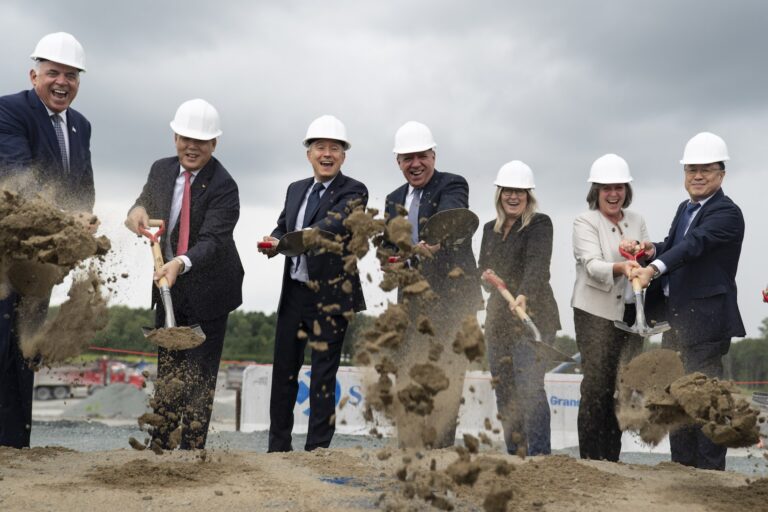
“It’s clear that some of these companies will die,” said Normand Mousseau, scientific director of the Trottier Energy Institute at Polytechnique Montréal and physics professor at Université de Montréal, who helped create green-energy groups like the Climate Institute of Canada, Transition Accelerator and Energy Modelling Hub. “We don’t know who will win. This is a very major disturbance for the car manufacturers. It might even cost the survival of some of the current big automakers in North America.”
Mousseau stressed that no single project or delay will change the long-term need for the world to switch to EVs. But the government could have avoided some shock and concern about Northvolt’s struggles if it had been more clear about the project’s timelines, environmental review process and the uncertainty of working with startups, he said.
That may be cold comfort to taxpayers who have a huge stake in Northvolt’s success, or Canadians whose pensions laid money on it. One year ago, the federal government announced it would put $1.34 billion toward the project, while Quebec will provide $1.37 billion. The two governments committed another $4.6 billion to be paid based on how many batteries the company produced, two-thirds of which would be paid by the feds.
“It’s clear that some of these companies will die. We don’t know who will win. This is a very major disturbance for the car manufacturers.”
The Caisse de dépôt et placement du Québec has invested $200 million, while the Investment Management Corporation of Ontario, Canada Pension Plan Investment Board and Ontario Municipal Employees Retirement System count among the company’s other backers.
So far, the Quebec government says, it has given Northvolt a $270-million convertible debenture and $240 million in land. The federal government has not paid out any of its share, said Innovation, Science and Economic Development Canada spokesperson Hans Parmar, who added that some aspects of its agreement with Northvolt are still under negotiation. Investissement Québec had an “emergency meeting” with Northvolt on Monday afternoon, Le Journal de Montréal reported.
Not surprisingly, political pressure is quickly building to limit potential losses. Parti Québécois Leader Paul St-Pierre Plamondon compared the company with Bombardier, which laid off thousands of workers and ultimately got out of the commercial airliner business despite a $1.3-billion lifeline from the Quebec government in 2015. Some provincial opposition members would like to see further installments to Northvolt halted. And earlier this month—even as the company insisted the project east of Montreal was proceeding—outgoing Quebec economy minister Pierre Fitzgibbon mused to The Logic that if the plant got scrapped, Quebec would be able to sell the 170-hectare land it funded for Northvolt.
What impact any damage-control measures in Canada might have on the company are unclear, though, because Northvolt’s fate lies in the hands of global backers like BMW, Goldman Sachs and Baillie Gifford.
Since those firms invested, major automakers like Ford have delayed their plans to transition to EVs. In the meantime, Northvolt has faced operational issues, losing an €2-billion contract with BMW due to production delays.
Last week, Bloomberg reported that Northvolt’s lenders hired investment bank PJT Partners to help creditors prepare for a range of scenarios, though the talks did not include restructuring. Swedish newspaper Dagens Nyheter reported that creditors will meet Friday to make decisions. Northvolt, meanwhile, is trying to access US$1.5 billion of a US$5-billion green loan backed by a group of banks from around the world.
Not all signs around the company are pessimistic. Northvolt said it has made progress in financing talks over the past couple of weeks, and pointed to positive steps on its operational side: last week it produced a record 60,000 cells at its flagship plant in Sweden—a threefold increase over its pace at the start of the year.
And at least one of Northvolt’s government backers is preaching patience. Audrey Milette, spokesperson for Innovation Minister François-Philippe Champagne, said the minister’s office is in close contact with Northvolt, and defended Ottawa’s support of the company.
“[It’s] not just us who see the potential,” Milette said. “Automotive and battery manufacturers from around the world are significantly investing in EV production in Canada. And sometimes they make adjustments to their timelines and plans to ensure long-term success.”
Professor Iain Clacher of Leeds University Business School, who studies pension funds, said that Northvolt is a suitable type of investment for a pension fund, because it reflects a global economic trend (decarbonization), and requires a large, patient and diversified investor. The Canadian pension fund system, he added, has a history of withstanding downturns.
“The movements of one company shouldn’t put us off the opportunity in front of us. We’d be fools to think in such a short-sighted way.”
“It comes back to the fact that Europe will need its own large-scale battery production,” said Clacher, noting that Northvolt doesn’t need to be on the scale of Tesla or Samsung to capitalize on this long-term goal. “So a pension fund should be looking across the spectrum and saying, ‘Well, we should invest in Northvolt or any other ones that we think are strategically aligned.’”
The potential ripple effects of Northvolt failing or pulling out of Canada could reach beyond its financiers.
Northvolt also has customers and suppliers who depend on its success, although it has publicly announced fewer supplier deals than similar projects from Ford or Stellantis. Vale’s Long Harbour refinery in Newfoundland had been tapped to produce nickel for Northvolt.
The company has never said exactly where its Quebec-made batteries were headed, though two of its customers have factories here: Volvo’s Nova Bus and Volkswagen, which is building a battery plant in southwestern Ontario and is also Northvolt’s largest shareholder, with 21 per cent of its shares in 2023.
Nova Bus spokesperson Christos Kritsidimas told The Logic that his company has no immediate plans to switch battery providers from its current supply chain, though it is always monitoring new technologies. VW Canada and its battery subsidiary, PowerCO, did not respond by deadline.
Matthew Fortier, CEO at Accelerate, a group that represents EV supply-chain companies, said Northvolt and the other gigafactories are important not only because they send a signal to the world’s of Canada’s importance, but because they are the anchors for other industries, like Canada’s critical-mineral development and smaller supplier startups. The plants will also help prepare workers for future jobs, he said.
“The movements of one company or of one sector over a quarterly or an annual timeframe shouldn’t put us off the opportunity in front of us. We’d be fools to think in such a shortsighted way,” said Fortier.
But Robert Asselin, senior vice-president of policy at Business Council of Canada, said that Canada should be focusing less on the EV industry, particularly assembly plants, that are just swapping one type of auto manufacturing job for another. Instead, he said, Canada should focus on high-tech development in industries where it has more strengths, like ag-tech and biotech.
Asked if Canada should consider bailing out Northvolt because of the sunk cost from pension investors, he said, “Absolutely not. Enough improvisation.”



Loading...
Thanks for sharing!
You have shared 5 articles this month and reached the maximum amount of shares available.
CloseThis account has reached its share limit.
If you would like to purchase a sharing license please contact The Logic support at [email protected].
CloseGift the full article!
You have gifted 0 article(s) this month and have 5 remaining.
Recipients will be able to read the full text of the article after submitting their email address. They will not have access to other articles or subscriber benefits.
Photo: Photo illustration by Paul Kim for The Logic. Photo of Northvolt construction site: The Canadian Press/Christinne Muschi; photo of Christopher Gorelczenko, Senior Director of Commissioning at Northvolt: Getty Images/Jonathan Nackstrand/AFP
The site of Northvolt's planned factory east of Montreal, in May 2024.
Most Popular This Week




In-depth, agenda-setting reporting
Great journalism delivered straight to your inbox.
The Big Read
Alberta’s referendum is just the start of the turmoil
Briefing
EverWind plans $10B data centre and wind development in Nova Scotia
Canada ready to force Stelco to sell its Canadian operations, Joly says
Feds plan a 60 MW defence-oriented data centre for Ottawa
Best business newsletter in Canada
Get up to speed in minutes with insights and analysis on the most important stories of the day, every weekday.
Exclusive events
See the bigger picture with reporters and industry experts in subscriber-exclusive events.
Membership in The Logic Council
Membership provides access to our popular Slack channel, participation in subscriber surveys and invitations to exclusive events with our journalists and special guests.