As the construction sector struggles to find workers to meet booming building demand, Canadian AI startups want to do for wood and plumbing what generative models have for words and pixels.
Skip to content


News
AI startups bet on construction, an industry plagued by slow tech adoption
Firms promise automation can address industry’s labour, productivity woes
A worker at the site of a condo development in Montreal in February 2024. Photo: The Canadian Press/Christinne Muschi
As the construction sector struggles to find workers to meet booming building demand, Canadian AI startups want to do for wood and plumbing what generative models have for words and pixels.
The industry faces persistent challenges with its labour force, productivity and use of technology. Contractors had 80,000 positions to fill as of last June, and at least 300,000 workers are likely to retire in the next decade, according to estimates from CIBC Capital Markets. As the pool of tradespeople shrinks, construction firms are getting less out of the ones they have. Labour productivity in the sector was 6.42 per cent lower in 2022 than 2013, according to Statistics Canada data, while output per worker economy-wide was up 8.56 per cent.
Talking Points
- Canadian startups are building AI tools to address the construction sector’s worker shortage and productivity challenges
- Firms automating parts of the design and manufacturing of homes and other structures say they can save contractors time and labour, but the industry has long been slow to adopt new technologies
Canadian AI startups are promising to speed up building from the drawing board to the project site. Toronto-headquartered Augmenta’s tools generate code-compliant designs for the systems that run behind drywall. It sells the product as an aid to the upskilled tradespeople who currently produce such blueprints. “It’s like giving them each their own entire design team,” said Augmenta CEO Francesco Iorio, who claims his technology cuts the timeline from weeks to hours, and avoids human mistakes.
The firm’s first tool produces specs for the electrical “raceways” through which power-carrying wires run, accounting for the placement of outlets, lights and other fixtures. Augmenta plans to launch products for mechanical, plumbing and structural design. The tools will coordinate to ensure none of the pipes, wires or channels on a particular project encroach on one another, even if different subcontractors are building them. The firm has raised US$15.85 million, including a seed round extension it closed in June 2023 that included the BDC’s Deep Tech Venture Fund.
Augmenta is a generative AI company, of a sort. But while picture-making tools Dall-E or Midjourney train on an internet’s worth of images, architects and contractors guard their blueprints zealously. So Augmenta used building codes and best practices to create a rule-based AI model that creates viable, compliant designs, then trained a faster machine-learning model on that synthetic data. The approach also reduces errors. “These are systems that are meant for engineers [to] solve physical problems,” Iorio said. “We cannot tolerate a person with six fingers.”
Related Articles
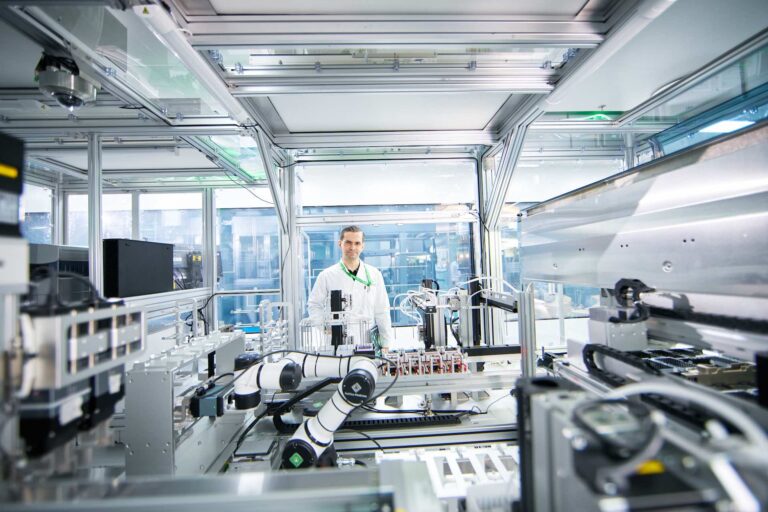

Nearby, Promise Robotics is automating the building blocks of housing construction. The Toronto-based startup has developed AI that controls commercially available machines to produce pieces for floors, walls and roofs. Promise’s technology doesn’t make the same modular parts again and again. Instead, the system uses construction codes and designs to make decisions, like how many nails to hammer into a joint or whether to use two-by-fours or two-by-sixes.
The firm has its own factory, but is also planning to operate plants in joint ventures with construction firms and sell its technology directly to clients. A homebuilder in Edmonton recently used Promise-made pieces to assemble a house in five and a half hours, according to CEO Ramtin Attar. “The inefficient nature of how we build buildings is not going to go away,” he said, nor are rising construction costs or labour shortages. “You need this type of transformational technology.”
Promise has raised US$25 million after closing its US$15-million Series A last October. Investors include Toronto’s Radical Ventures as well as the Montreal-based Public Sector Pension Investment Board and Relay Ventures. (Relay is also an investor in The Logic.)
“The inefficient nature of how we build is not going away. You need this type of transformational technology.”
Other firms are selling tools to help operations. Toric, a San Francisco-based firm with a large Montreal presence, offers technology to gather and integrate data from a company’s project management, customer information and other systems. The client can then ask questions of Toric’s copilot feature, which is built on top of large language models. “Access to the data and the AI gives you an infinite number of ways to use it,” said CEO Thiago da Costa.
Contractors have used the technology to assess their record of bidding for new projects, or to provide developers with real-time information about ongoing ones; Toric also counts insurance and real estate firms as clients. The firm has raised almost US$37.8 million, per Pitchbook, from backers including Toronto’s Leaders Fund and Autodesk, the construction tech giant in whose Canadian offices Attar, da Costa and Iorio all once worked.
As startups look to address construction labour shortages with automation, though, they’re facing their own competition for workers. Toric has a team of 41. Adding to it in San Francisco and Montreal is “really hard,” said da Costa. “Most of the AI people are employed, so you’ve got to hire them off of other companies.”
Construction-focused startups are marketing open roles to potential hires as a different kind of AI job. While Augmenta is a generative AI firm, it’s not “yet another Midjourney,” said Iorio, noting his firm’s technology helps create buildings that people can see and touch.
At 30-person Promise, Attar offers prospective recruits a compelling technical challenge. “My software guy tells me, ‘I’ve never worked at a company where I can generate code here and at the other end I’ll see a robot picking up a piece of lumber and building something,’” he said.
Convincing prospective clients, at least in Canada, may take more work. Construction’s poor productivity stems from firms’ lacklustre adoption of new technologies, said Jimmy Jean, chief economist and strategist at Desjardins. “You have a lot of small businesses [whose] focus day in and day out is just their jobs,” he noted. “They’re not really focusing on investing [and] getting more technologically advanced.”
That makes it harder to sell them new AI tools—and the need for automation to meet Canada’s ever-growing demand for houses, hospitals and warehouses all the more urgent.



Loading...
Thanks for sharing!
You have shared 5 articles this month and reached the maximum amount of shares available.
CloseThis account has reached its share limit.
If you would like to purchase a sharing license please contact The Logic support at [email protected].
CloseGift the full article!
You have gifted 0 article(s) this month and have 5 remaining.
Recipients will be able to read the full text of the article after submitting their email address. They will not have access to other articles or subscriber benefits.
Photo: The Canadian Press/Christinne Muschi
Most Popular This Week




In-depth, agenda-setting reporting
Great journalism delivered straight to your inbox.
Commentary
Carmichael: Being boxed in will help Canada focus on what matters
Briefing
Rio Tinto gets nearly $165M in additional federal funds for Quebec aluminum
U.S. to lift tariffs on some Canadian products crucial to Maine: Collins
Carney warns of tech dependence after Starlink disruptions in Ukraine
Best business newsletter in Canada
Get up to speed in minutes with insights and analysis on the most important stories of the day, every weekday.
Exclusive events
See the bigger picture with reporters and industry experts in subscriber-exclusive events.
Membership in The Logic Council
Membership provides access to our popular Slack channel, participation in subscriber surveys and invitations to exclusive events with our journalists and special guests.






