OTTAWA — A growing share of Canadians say they trust the Liberals most to handle the economy as the United States continues to threaten tariffs, a new The Logic poll by Abacus Data suggests. The shift coincides with former Bank of Canada governor Mark Carney’s sizable lead in the race to take the helm of the party.
Skip to content



News
Liberals get a bump on economic trust as Trump fears grow
New poll suggests Mark Carney has given the party a lift as voters look for a ‘hero’
Liberal leadership candidate Mark Carney was heavily favoured among Liberal respondents in The Logic poll to deal with Donald Trump. Photo: The Canadian Press/Ethan Cairns
OTTAWA — A growing share of Canadians say they trust the Liberals most to handle the economy as the United States continues to threaten tariffs, a new The Logic poll by Abacus Data suggests. The shift coincides with former Bank of Canada governor Mark Carney’s sizable lead in the race to take the helm of the party.
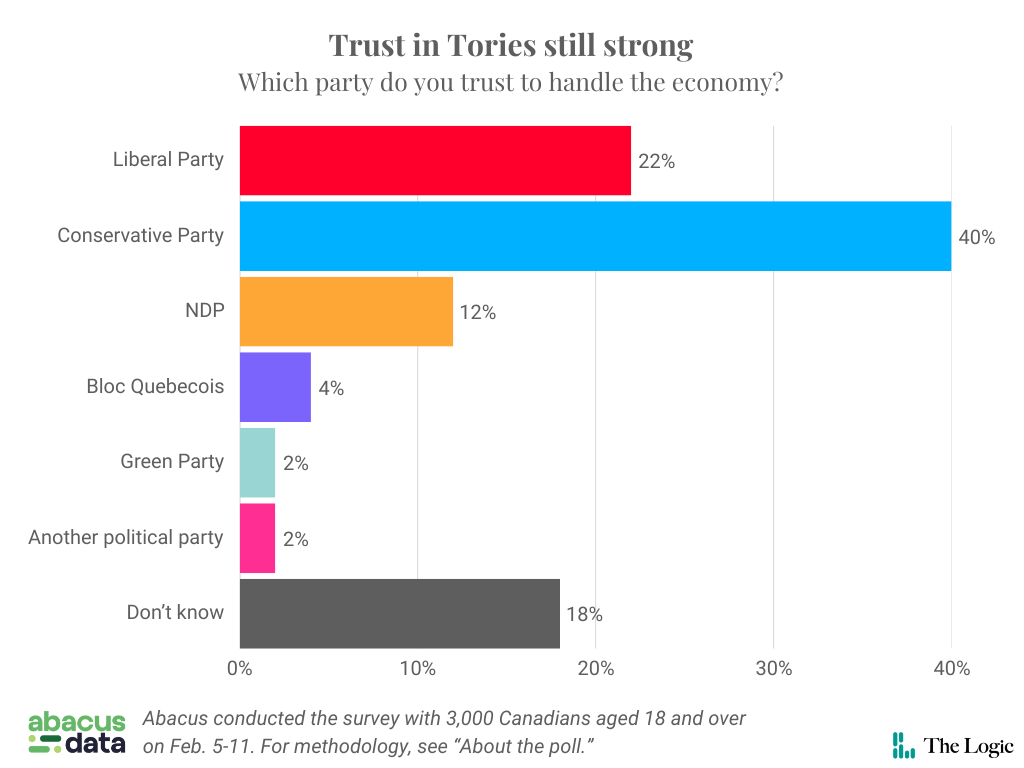
The results show a sudden six-point uptick in the proportion of people surveyed who have faith in the Liberals to handle the economy. Twenty-two per cent in the poll conducted between Feb. 5 and Feb. 11 said they would put their faith in the party, compared to just 16 per cent in early January.
The Conservatives still enjoy a wide lead in economic trust, according to the survey, with 40 per cent of respondents preferring the Tories to take on the economy. However, the Liberal leadership race and the volatility of U.S. President Donald Trump have shifted the political landscape and the way people view their choices, said Abacus CEO David Coletto.
Talking Points
- Canadians’ views of how to handle the economy have changed significantly in the last few months, our latest poll finds. A growing—though still modest—share appear to be looking to the Liberals
- Tariff threats by U.S. President Donald Trump and the Liberal leadership race have reshaped a political landscape that changed little over the last two years, says pollster David Coletto
“For two years, if we think of Canadian politics as a story, Justin Trudeau was the villain and [Conservative Leader] Pierre Poilievre was trying to be the hero,” Coletto said in an interview with The Logic.
“Right now there’s a new villain—a bigger villain, a villain that’s far more anxiety-inducing—and that’s Donald Trump. So now we’re looking for the hero.”
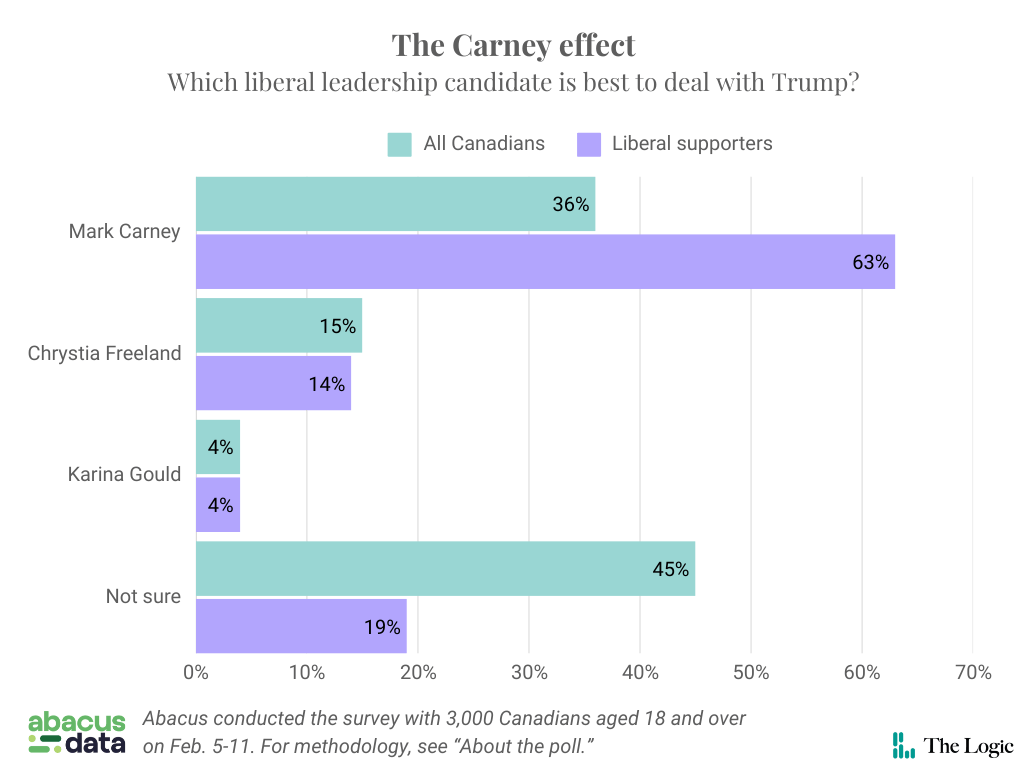
There’s a good chance Carney will be the one competing with Poilievre for that mantle. In The Logic’s poll, 63 per cent of Liberal supporters favour Carney to protect Canadian interests against Trump, compared to just 14 per cent for former finance minister Chrystia Freeland and four per cent for former Liberal House Leader Karina Gould.
Carney is also favoured to battle Trump among all Canadians, with 36 per cent picking him over other Liberal leadership contenders. (Forty-five per cent said they weren’t sure).
“That is a signal to me that he could be a viable candidate, and he could keep the Liberals competitive and perhaps pull off what I think would be almost a miracle in getting them re-elected,” Coletto said.
Related Articles

The share of Canadians who would vote Liberal if an election were held today has jumped five per cent since Jan. 27, the latest Abacus data shows. Those gains are at the expense of the New Democratic Party, Bloc Québécois and Green Party, and give the Liberals 27 per cent support among decided voters, compared to 46 per cent who support the Conservatives, up three percentage points.
The number of Canadians open to the possibility of voting Liberal also jumped four points to 46 per cent in the survey, compared with 50 per cent of Canadians who are open to voting Conservative.
While Coletto still sees the economic environment as favourable to the Tories, he says the recent shift is significant. “Whether we get to a new normal where the Conservatives have a 10-point lead consistently, or we get to one where the Liberals are actually competing, I think will depend on how people react to Mark Carney after he is leader,” he said.
The survey results also show significant movement in the way Canadians are thinking about the economy and how to improve it. In October, diversifying Canadian trade markets was far less of a priority than it is now, climbing from 20 per cent to 35 per cent in the most recent survey. Fewer people now see affordable housing for workers as the best way to improve growth, with support falling from 38 per cent to 31 per cent over the same period.
About the poll
The Logic and Abacus Data have partnered to poll Canadians on key economic issues as the federal political parties prepare for the next election. The surveys take stock of voters’ priorities and their views of the parties’ policies on matters ranging from affordability to making Canada more competitive. On questions of economic stewardship, we are tracking attitudes over time. We will also seek responses on other issues as they emerge in the public conversation. For today’s story, Abacus surveyed 3,000 Canadians aged 18 and over from Feb. 5 to 11 through an online panel. The margin of error for a comparable probability-based random sample of the same size would be 1.8 per cent, 19 times out of 20.
“Canadians, I think, are increasingly of the view that the U.S. is not going to be a reliable trading partner going forward, and so that diversification now has become the No. 2 thing that people are pointing to as a way to grow our economy,” Coletto said.
Reducing personal income taxes to boost consumer spending remains the top preferred strategy among those polled.
A lot could change in the next few weeks. This weekend, Poilievre is set to deliver a speech at a Flag Day rally in Ottawa, representing the unofficial kickoff of the expected election campaign. Later this month, Liberal leadership candidates will face each other in French and English debates in Montreal. And at the beginning of March, Trump will decide whether or not to make good on his tariff threats against Canada.
“I do think that there’s a chance that you could see some big swings in the numbers,” Coletto said. “That means that the public is far more persuadeable.”



Loading...
Thanks for sharing!
You have shared 5 articles this month and reached the maximum amount of shares available.
CloseThis account has reached its share limit.
If you would like to purchase a sharing license please contact The Logic support at [email protected].
CloseGift the full article!
You have gifted 0 article(s) this month and have 5 remaining.
Recipients will be able to read the full text of the article after submitting their email address. They will not have access to other articles or subscriber benefits.
Photo: The Canadian Press/Ethan Cairns
Most Popular This Week




In-depth, agenda-setting reporting
Great journalism delivered straight to your inbox.
News
Panel decries Canada’s chaotic way of funding world-class science
Briefing
AI is pushing insurers to become asset managers, Canadian CEOs say
Trump administration faces lawsuit over 50% tariffs on Canadian goods
Canada-U.S. trade war to reduce real GDP by 1.4% over 2024 levels after five years: PBO
Best business newsletter in Canada
Get up to speed in minutes with insights and analysis on the most important stories of the day, every weekday.
Exclusive events
See the bigger picture with reporters and industry experts in subscriber-exclusive events.
Membership in The Logic Council
Membership provides access to our popular Slack channel, participation in subscriber surveys and invitations to exclusive events with our journalists and special guests.





